


Cracking Public Sector Procurement: The Playbook for Canadian AI & Tech Builders
Cities like Toronto and Montréal are shifting from traditional, multi-year closed RFPs to problem-driven "reverse pitch" challenges—tasking domestic startups directly with operational problems like automated 311 routing, road maintenance dispatch, and infrastructure vision systems.
For Canadian tech founders, enterprise architects, and software leaders, selling into the public sector can feel like a labyrinth of compliance, data residency barriers, and endless procurement cycles.
If your team is looking to target institutional or public sector deployments across Canada, here is the architectural and operational checklist you need to win:
Enforce In-Country Data Residency Early
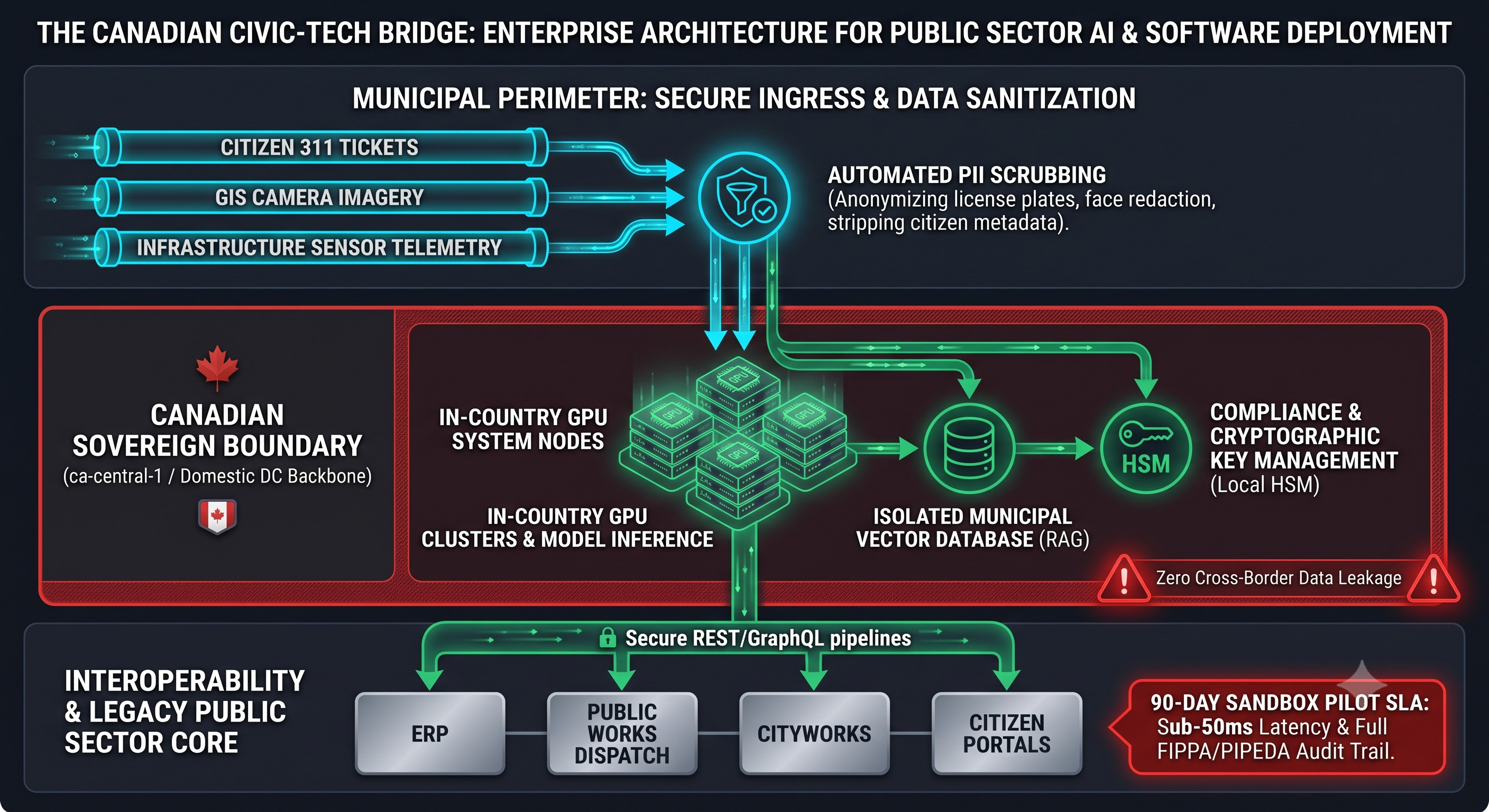
Public sector bodies cannot risk data traversing foreign nodes. Ensure your storage, inference pipelines, and telemetry strictly adhere to Canadian regional boundaries (e.g., ca-central-1 or domestic sovereign cloud infrastructure) to pass municipal privacy audits on day one.
Decouple Edge Telemetry from PII Ingestion
Whether you’re processing images of road conditions or parsing citizen feedback forms, sanitization must occur at the ingress layer. Implement localized pre-filtering pipelines that scrub license plates, faces, and personal identifiers before data ever enters model pipelines.
Design for Interoperability with Legacy Workflows
Municipalities won't replace core ERP or dispatch software overnight. Your competitive advantage is not just a proprietary model—it's having robust webhooks, secure REST/GraphQL connectors, and event streams that feed directly into systems like SAP or Cityworks without disruption.
Pilot Small, Document Provable Unit Economics
Governments prioritize risk reduction over hype. Focus initial proposals on high-frequency, low-risk operational pain points where you can demonstrate a clear reduction in manual backlog hours within a 90-day sandbox.
Bridging the gap between Canadian innovation and public infrastructure is how domestic tech moves from pilot tests to scalable commercial champions.
Discussion Question
For Canadian builders: What has been your biggest bottleneck when bidding on enterprise or public sector contracts—lengthy procurement cycles, compliance/residency audits, or legacy integration?
CTA (Join Techawks Canada)
Want to stay connected with engineers, founders, and tech professionals building the future of Canadian tech?
👉 Join the Techawks Canada community today. Connect with local innovators, access exclusive tech teardowns, and join the conversation shaping our regional ecosystem.
Cities like Toronto and Montréal are shifting from traditional, multi-year closed RFPs to problem-driven "reverse pitch" challenges—tasking domestic startups directly with operational problems like automated 311 routing, road maintenance dispatch, and infrastructure vision systems.
For Canadian tech founders, enterprise architects, and software leaders, selling into the public sector can feel like a labyrinth of compliance, data residency barriers, and endless procurement cycles.
If your team is looking to target institutional or public sector deployments across Canada, here is the architectural and operational checklist you need to win:
Enforce In-Country Data Residency Early
Public sector bodies cannot risk data traversing foreign nodes. Ensure your storage, inference pipelines, and telemetry strictly adhere to Canadian regional boundaries (e.g., ca-central-1 or domestic sovereign cloud infrastructure) to pass municipal privacy audits on day one.
Decouple Edge Telemetry from PII Ingestion
Whether you’re processing images of road conditions or parsing citizen feedback forms, sanitization must occur at the ingress layer. Implement localized pre-filtering pipelines that scrub license plates, faces, and personal identifiers before data ever enters model pipelines.
Design for Interoperability with Legacy Workflows
Municipalities won't replace core ERP or dispatch software overnight. Your competitive advantage is not just a proprietary model—it's having robust webhooks, secure REST/GraphQL connectors, and event streams that feed directly into systems like SAP or Cityworks without disruption.
Pilot Small, Document Provable Unit Economics
Governments prioritize risk reduction over hype. Focus initial proposals on high-frequency, low-risk operational pain points where you can demonstrate a clear reduction in manual backlog hours within a 90-day sandbox.
Bridging the gap between Canadian innovation and public infrastructure is how domestic tech moves from pilot tests to scalable commercial champions.
Discussion Question
For Canadian builders: What has been your biggest bottleneck when bidding on enterprise or public sector contracts—lengthy procurement cycles, compliance/residency audits, or legacy integration?
CTA (Join Techawks Canada)
Want to stay connected with engineers, founders, and tech professionals building the future of Canadian tech?
👉 Join the Techawks Canada community today. Connect with local innovators, access exclusive tech teardowns, and join the conversation shaping our regional ecosystem.
Cracking Public Sector Procurement: The Playbook for Canadian AI & Tech Builders
Cities like Toronto and Montréal are shifting from traditional, multi-year closed RFPs to problem-driven "reverse pitch" challenges—tasking domestic startups directly with operational problems like automated 311 routing, road maintenance dispatch, and infrastructure vision systems.
For Canadian tech founders, enterprise architects, and software leaders, selling into the public sector can feel like a labyrinth of compliance, data residency barriers, and endless procurement cycles.
If your team is looking to target institutional or public sector deployments across Canada, here is the architectural and operational checklist you need to win:
Enforce In-Country Data Residency Early
Public sector bodies cannot risk data traversing foreign nodes. Ensure your storage, inference pipelines, and telemetry strictly adhere to Canadian regional boundaries (e.g., ca-central-1 or domestic sovereign cloud infrastructure) to pass municipal privacy audits on day one.
Decouple Edge Telemetry from PII Ingestion
Whether you’re processing images of road conditions or parsing citizen feedback forms, sanitization must occur at the ingress layer. Implement localized pre-filtering pipelines that scrub license plates, faces, and personal identifiers before data ever enters model pipelines.
Design for Interoperability with Legacy Workflows
Municipalities won't replace core ERP or dispatch software overnight. Your competitive advantage is not just a proprietary model—it's having robust webhooks, secure REST/GraphQL connectors, and event streams that feed directly into systems like SAP or Cityworks without disruption.
Pilot Small, Document Provable Unit Economics
Governments prioritize risk reduction over hype. Focus initial proposals on high-frequency, low-risk operational pain points where you can demonstrate a clear reduction in manual backlog hours within a 90-day sandbox.
Bridging the gap between Canadian innovation and public infrastructure is how domestic tech moves from pilot tests to scalable commercial champions.
Discussion Question
For Canadian builders: What has been your biggest bottleneck when bidding on enterprise or public sector contracts—lengthy procurement cycles, compliance/residency audits, or legacy integration?
CTA (Join Techawks Canada)
Want to stay connected with engineers, founders, and tech professionals building the future of Canadian tech?
👉 Join the Techawks Canada community today. Connect with local innovators, access exclusive tech teardowns, and join the conversation shaping our regional ecosystem.

 Arabic
 French
 Spanish
 Portuguese
 Deutsch
 Turkish
 Dutch
Dutch
 Italiano
 Russian
 Romaian
 Portuguese (Brazil)
 Greek
Greek