


The UPI Latency Playbook: How Indian Tech Stacks Handle Peak Load Without Dropping Transactions
Building high-concurrency systems in India means designing for unpredictable downstream dependencies: core banking platforms, payment gateways, and telecommunication switches that don't scale at your API’s speed.
When your app triggers a real-time payment flow, standard synchronous REST patterns break down fast. Here is how engineering teams build resilient transaction pipelines:
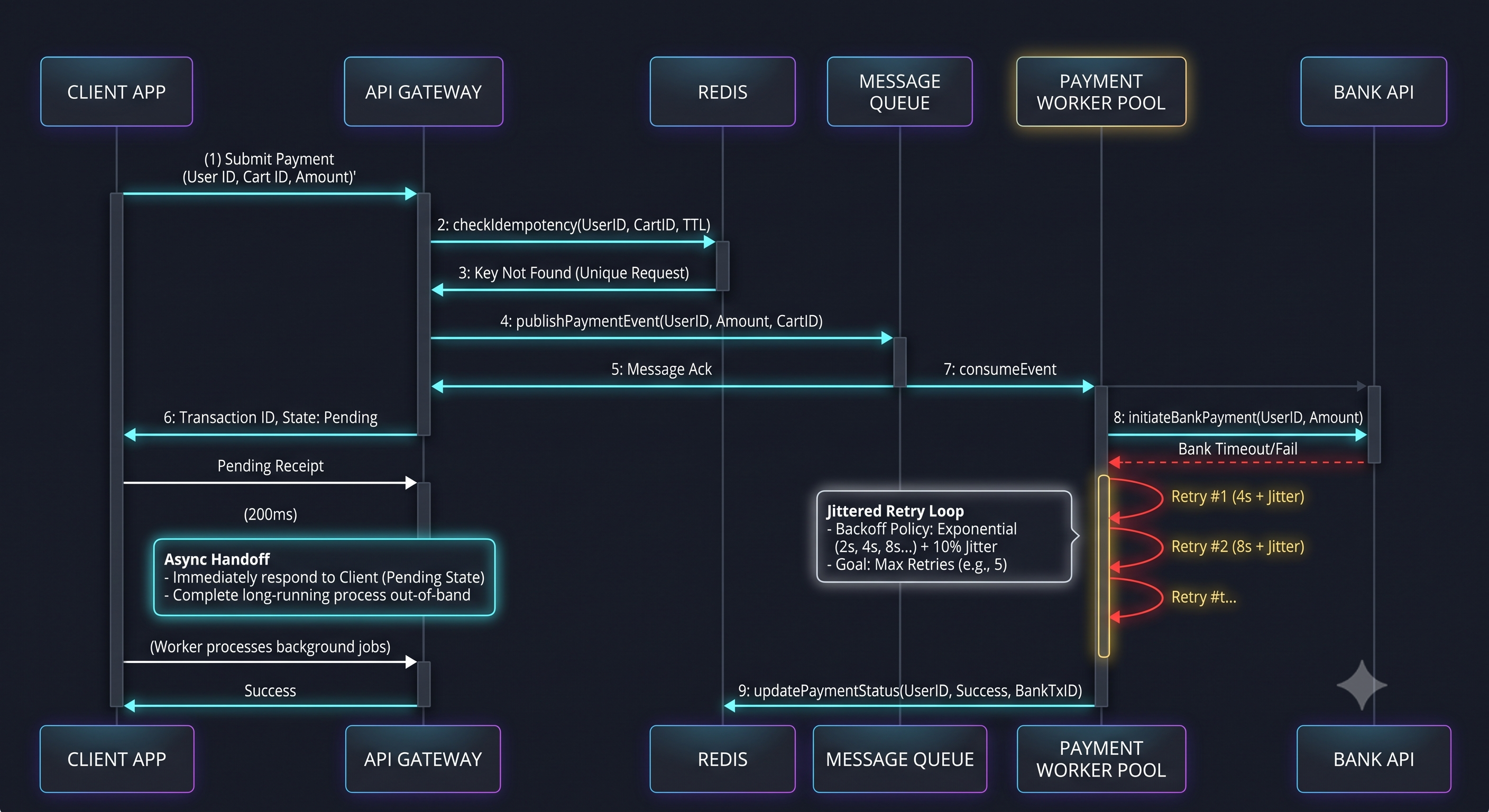
Decouple Initiation from Settlement (Async by Default): Never keep client connections open while waiting for an external bank response. Issue an idempotent Pending receipt back to the front-end within 200 ms, hand off the processing to an event queue (Kafka or RabbitMQ), and let worker pools handle bank polling or webhook processing.
Idempotency Keys with TTLs in Redis: Unstable mobile networks trigger repeated user taps and retry storms. Cache a unique Idempotency-Key (e.g., combination of user_id + cart_id + timestamp_bucket) in an in-memory store before querying your SQL database, returning the cached transaction state on duplicate submissions.
Exponential Jittered Backoffs for Third-Party Webhooks: When bank switches throttle traffic, hammering them every 2 seconds triggers hard rate-limits. Use randomized exponential backoff intervals to prevent synchronized thundering-herd issues on downstream payment gateways.
Split Transaction Logs from Read Models: Keep write operations strictly inside a lightweight Ledger DB, while pushing state projections to read-replicas for balance queries, order tracking, and history screens.
Key Takeaways
Treat third-party banking APIs as inherently unreliable systems with fluctuating SLAs.
Use distributed idempotency keys at the gateway layer to eliminate duplicate transaction debits.
Implement event-driven architecture with jittered retry policies instead of synchronous blocking calls.
CTA
Want to dive deeper into system design, backend architectures, and engineering challenges tailored to the Indian ecosystem?
Join Techawks India to collaborate, share architecture teardowns, and connect with fellow engineers across the country. Link in bio.
Building high-concurrency systems in India means designing for unpredictable downstream dependencies: core banking platforms, payment gateways, and telecommunication switches that don't scale at your API’s speed.
When your app triggers a real-time payment flow, standard synchronous REST patterns break down fast. Here is how engineering teams build resilient transaction pipelines:
Decouple Initiation from Settlement (Async by Default): Never keep client connections open while waiting for an external bank response. Issue an idempotent Pending receipt back to the front-end within 200 ms, hand off the processing to an event queue (Kafka or RabbitMQ), and let worker pools handle bank polling or webhook processing.
Idempotency Keys with TTLs in Redis: Unstable mobile networks trigger repeated user taps and retry storms. Cache a unique Idempotency-Key (e.g., combination of user_id + cart_id + timestamp_bucket) in an in-memory store before querying your SQL database, returning the cached transaction state on duplicate submissions.
Exponential Jittered Backoffs for Third-Party Webhooks: When bank switches throttle traffic, hammering them every 2 seconds triggers hard rate-limits. Use randomized exponential backoff intervals to prevent synchronized thundering-herd issues on downstream payment gateways.
Split Transaction Logs from Read Models: Keep write operations strictly inside a lightweight Ledger DB, while pushing state projections to read-replicas for balance queries, order tracking, and history screens.
Key Takeaways
Treat third-party banking APIs as inherently unreliable systems with fluctuating SLAs.
Use distributed idempotency keys at the gateway layer to eliminate duplicate transaction debits.
Implement event-driven architecture with jittered retry policies instead of synchronous blocking calls.
CTA
Want to dive deeper into system design, backend architectures, and engineering challenges tailored to the Indian ecosystem?
Join Techawks India to collaborate, share architecture teardowns, and connect with fellow engineers across the country. Link in bio.
The UPI Latency Playbook: How Indian Tech Stacks Handle Peak Load Without Dropping Transactions
Building high-concurrency systems in India means designing for unpredictable downstream dependencies: core banking platforms, payment gateways, and telecommunication switches that don't scale at your API’s speed.
When your app triggers a real-time payment flow, standard synchronous REST patterns break down fast. Here is how engineering teams build resilient transaction pipelines:
Decouple Initiation from Settlement (Async by Default): Never keep client connections open while waiting for an external bank response. Issue an idempotent Pending receipt back to the front-end within 200 ms, hand off the processing to an event queue (Kafka or RabbitMQ), and let worker pools handle bank polling or webhook processing.
Idempotency Keys with TTLs in Redis: Unstable mobile networks trigger repeated user taps and retry storms. Cache a unique Idempotency-Key (e.g., combination of user_id + cart_id + timestamp_bucket) in an in-memory store before querying your SQL database, returning the cached transaction state on duplicate submissions.
Exponential Jittered Backoffs for Third-Party Webhooks: When bank switches throttle traffic, hammering them every 2 seconds triggers hard rate-limits. Use randomized exponential backoff intervals to prevent synchronized thundering-herd issues on downstream payment gateways.
Split Transaction Logs from Read Models: Keep write operations strictly inside a lightweight Ledger DB, while pushing state projections to read-replicas for balance queries, order tracking, and history screens.
Key Takeaways
Treat third-party banking APIs as inherently unreliable systems with fluctuating SLAs.
Use distributed idempotency keys at the gateway layer to eliminate duplicate transaction debits.
Implement event-driven architecture with jittered retry policies instead of synchronous blocking calls.
CTA
Want to dive deeper into system design, backend architectures, and engineering challenges tailored to the Indian ecosystem?
Join Techawks India to collaborate, share architecture teardowns, and connect with fellow engineers across the country. Link in bio.

 English
 Arabic
 French
 Spanish
 Portuguese
 Deutsch
 Dutch
Dutch
 Italiano
 Russian
 Romaian
 Portuguese (Brazil)
 Greek
Greek