


The Multi-Region Trap: Why Cross-AZ Egress Fees Are Quietly Draining Your Cloud Budget
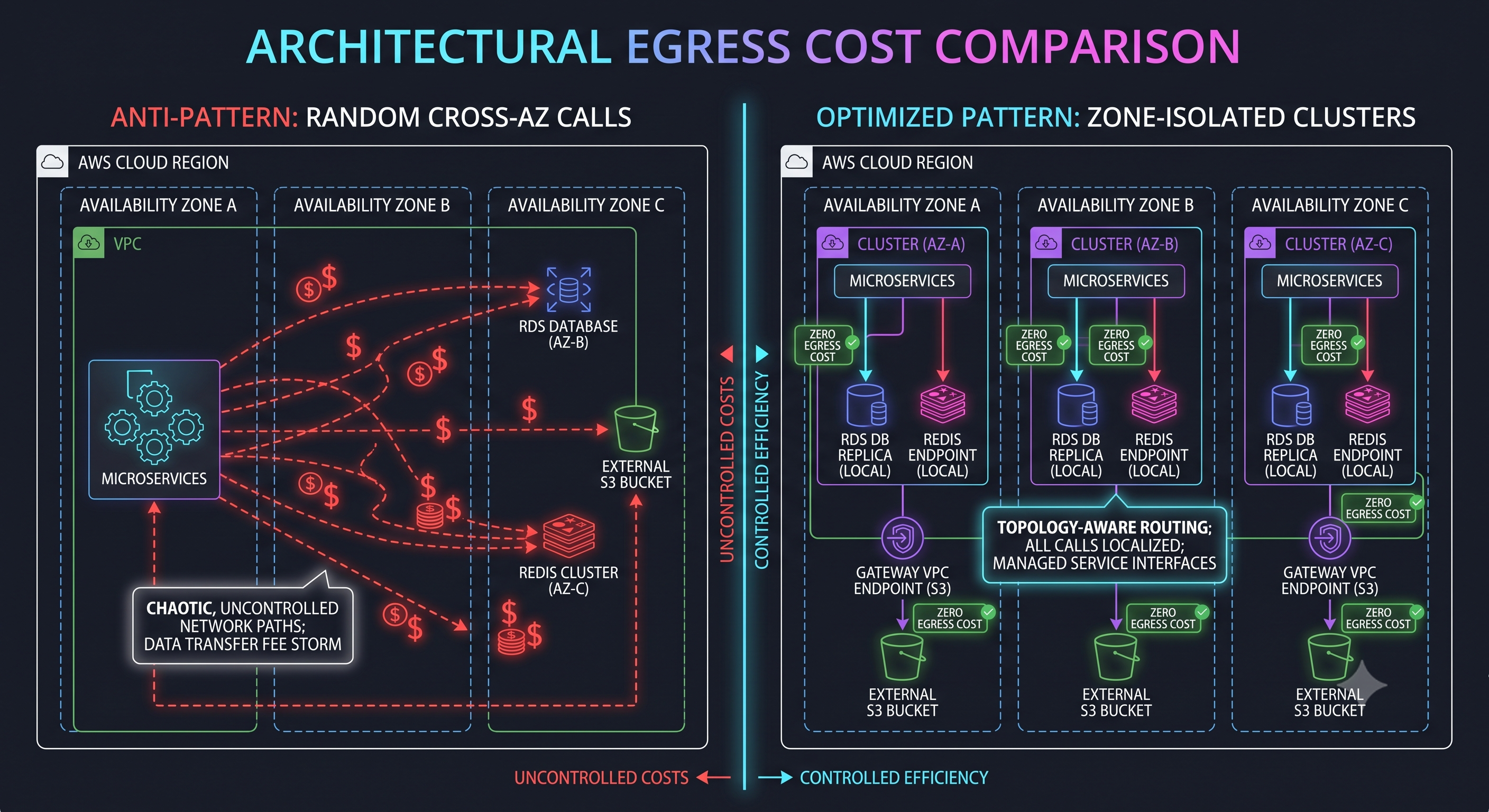
Building on AWS, GCP, or Azure in the US enterprise space often emphasizes high availability (HA) by default. Engineering teams distribute microservices across multiple Availability Zones (AZs) to survive localized outages. However, distributed architectures introduce hidden inter-AZ network egress costs that scale silently with traffic.
Cross-zone data transfer within the same cloud region typically costs around $0.01 to $0.02 per gigabyte. At terabyte scale, chatty microservices and unoptimized cache topologies quickly blow through operating budgets.
Here is how infrastructure and platform teams design resilient architectures without paying a cross-zone tax:
Implement Topology-Aware Routing: Configure Kubernetes service routing (topologyKeys or service.kubernetes.io/topology-mode: Auto) to prefer endpoints within the same availability zone. Traffic routes cross-AZ only when local pods are degraded or saturated.
Colocate Read Replicas and In-Memory Caches: If your compute cluster queries a shared cache pool across AZ boundaries, you pay network latency and transfer fees on every read. Deploy zone-local Redis/Memcached read replicas or run sidecar caching layers for static lookups.
Enforce VPC Endpoints for Managed Services: Avoid routing traffic to internal object storage (e.g., S3, Cloud Storage) or logging aggregators through public NAT gateways. Use Gateway VPC Endpoints to route traffic entirely over the cloud provider’s private network at zero data transfer cost.
Compress Payload Over Cross-Zone Boundaries: For high-volume event streams (Kafka, Kinesis), enable Snappy or Zstandard compression at the producer level before messages cross AZ boundaries. A 60% compression ratio directly translates to a 60% reduction in inter-zone transit cost.
Key Takeaways
Inter-AZ data transfer is not free; unoptimized microservice traffic quietly inflates cloud infrastructure bills.
Keep service communication zone-local by default using Kubernetes topology-aware routing.
Route cloud-native storage and telemetry traffic through free VPC Endpoints instead of fee-generating NAT gateways.
CTA
Looking to optimize cloud spend, master distributed systems, and exchange production battle stories with senior engineers across the states?
Join Techawks USA to connect with backend leads, platform engineers, and cloud architects solving modern infrastructure challenges. Link in bio.
Building on AWS, GCP, or Azure in the US enterprise space often emphasizes high availability (HA) by default. Engineering teams distribute microservices across multiple Availability Zones (AZs) to survive localized outages. However, distributed architectures introduce hidden inter-AZ network egress costs that scale silently with traffic.
Cross-zone data transfer within the same cloud region typically costs around $0.01 to $0.02 per gigabyte. At terabyte scale, chatty microservices and unoptimized cache topologies quickly blow through operating budgets.
Here is how infrastructure and platform teams design resilient architectures without paying a cross-zone tax:
Implement Topology-Aware Routing: Configure Kubernetes service routing (topologyKeys or service.kubernetes.io/topology-mode: Auto) to prefer endpoints within the same availability zone. Traffic routes cross-AZ only when local pods are degraded or saturated.
Colocate Read Replicas and In-Memory Caches: If your compute cluster queries a shared cache pool across AZ boundaries, you pay network latency and transfer fees on every read. Deploy zone-local Redis/Memcached read replicas or run sidecar caching layers for static lookups.
Enforce VPC Endpoints for Managed Services: Avoid routing traffic to internal object storage (e.g., S3, Cloud Storage) or logging aggregators through public NAT gateways. Use Gateway VPC Endpoints to route traffic entirely over the cloud provider’s private network at zero data transfer cost.
Compress Payload Over Cross-Zone Boundaries: For high-volume event streams (Kafka, Kinesis), enable Snappy or Zstandard compression at the producer level before messages cross AZ boundaries. A 60% compression ratio directly translates to a 60% reduction in inter-zone transit cost.
Key Takeaways
Inter-AZ data transfer is not free; unoptimized microservice traffic quietly inflates cloud infrastructure bills.
Keep service communication zone-local by default using Kubernetes topology-aware routing.
Route cloud-native storage and telemetry traffic through free VPC Endpoints instead of fee-generating NAT gateways.
CTA
Looking to optimize cloud spend, master distributed systems, and exchange production battle stories with senior engineers across the states?
Join Techawks USA to connect with backend leads, platform engineers, and cloud architects solving modern infrastructure challenges. Link in bio.
The Multi-Region Trap: Why Cross-AZ Egress Fees Are Quietly Draining Your Cloud Budget
Building on AWS, GCP, or Azure in the US enterprise space often emphasizes high availability (HA) by default. Engineering teams distribute microservices across multiple Availability Zones (AZs) to survive localized outages. However, distributed architectures introduce hidden inter-AZ network egress costs that scale silently with traffic.
Cross-zone data transfer within the same cloud region typically costs around $0.01 to $0.02 per gigabyte. At terabyte scale, chatty microservices and unoptimized cache topologies quickly blow through operating budgets.
Here is how infrastructure and platform teams design resilient architectures without paying a cross-zone tax:
Implement Topology-Aware Routing: Configure Kubernetes service routing (topologyKeys or service.kubernetes.io/topology-mode: Auto) to prefer endpoints within the same availability zone. Traffic routes cross-AZ only when local pods are degraded or saturated.
Colocate Read Replicas and In-Memory Caches: If your compute cluster queries a shared cache pool across AZ boundaries, you pay network latency and transfer fees on every read. Deploy zone-local Redis/Memcached read replicas or run sidecar caching layers for static lookups.
Enforce VPC Endpoints for Managed Services: Avoid routing traffic to internal object storage (e.g., S3, Cloud Storage) or logging aggregators through public NAT gateways. Use Gateway VPC Endpoints to route traffic entirely over the cloud provider’s private network at zero data transfer cost.
Compress Payload Over Cross-Zone Boundaries: For high-volume event streams (Kafka, Kinesis), enable Snappy or Zstandard compression at the producer level before messages cross AZ boundaries. A 60% compression ratio directly translates to a 60% reduction in inter-zone transit cost.
Key Takeaways
Inter-AZ data transfer is not free; unoptimized microservice traffic quietly inflates cloud infrastructure bills.
Keep service communication zone-local by default using Kubernetes topology-aware routing.
Route cloud-native storage and telemetry traffic through free VPC Endpoints instead of fee-generating NAT gateways.
CTA
Looking to optimize cloud spend, master distributed systems, and exchange production battle stories with senior engineers across the states?
Join Techawks USA to connect with backend leads, platform engineers, and cloud architects solving modern infrastructure challenges. Link in bio.

 English
 Arabic
 Spanish
 Portuguese
 Deutsch
 Turkish
 Dutch
Dutch
 Italiano
 Russian
 Romaian
 Portuguese (Brazil)
 Greek
Greek