


Architecting for Data Residency in the UAE: Balancing In-Country Compliance with Global Cloud Scale
As the UAE consolidates its position as a global digital and financial hub, engineering teams face a specific design constraint: local data residency compliance versus the elasticity of global cloud infrastructure. Under local data protection mandates, handling regulated personal records, healthcare metrics, or financial data requires clear geographic isolation.
Simply replicating an entire global infrastructure stack into local regions (such as AWS Middle East UAE, Azure UAE North/Central, or OCI Dubai) is often cost-prohibitive and operationally redundant.
Here is how engineering teams architect hybrid data isolation pipelines for the UAE market:
Implement Strict Data Classification at Ingestion: Segregate data models into regulated PII/financial transactions versus anonymized operational metrics. Route regulated payloads exclusively to in-region databases (hosted within UAE cloud zones), while non-sensitive analytical telemetry passes to shared multi-region clusters.
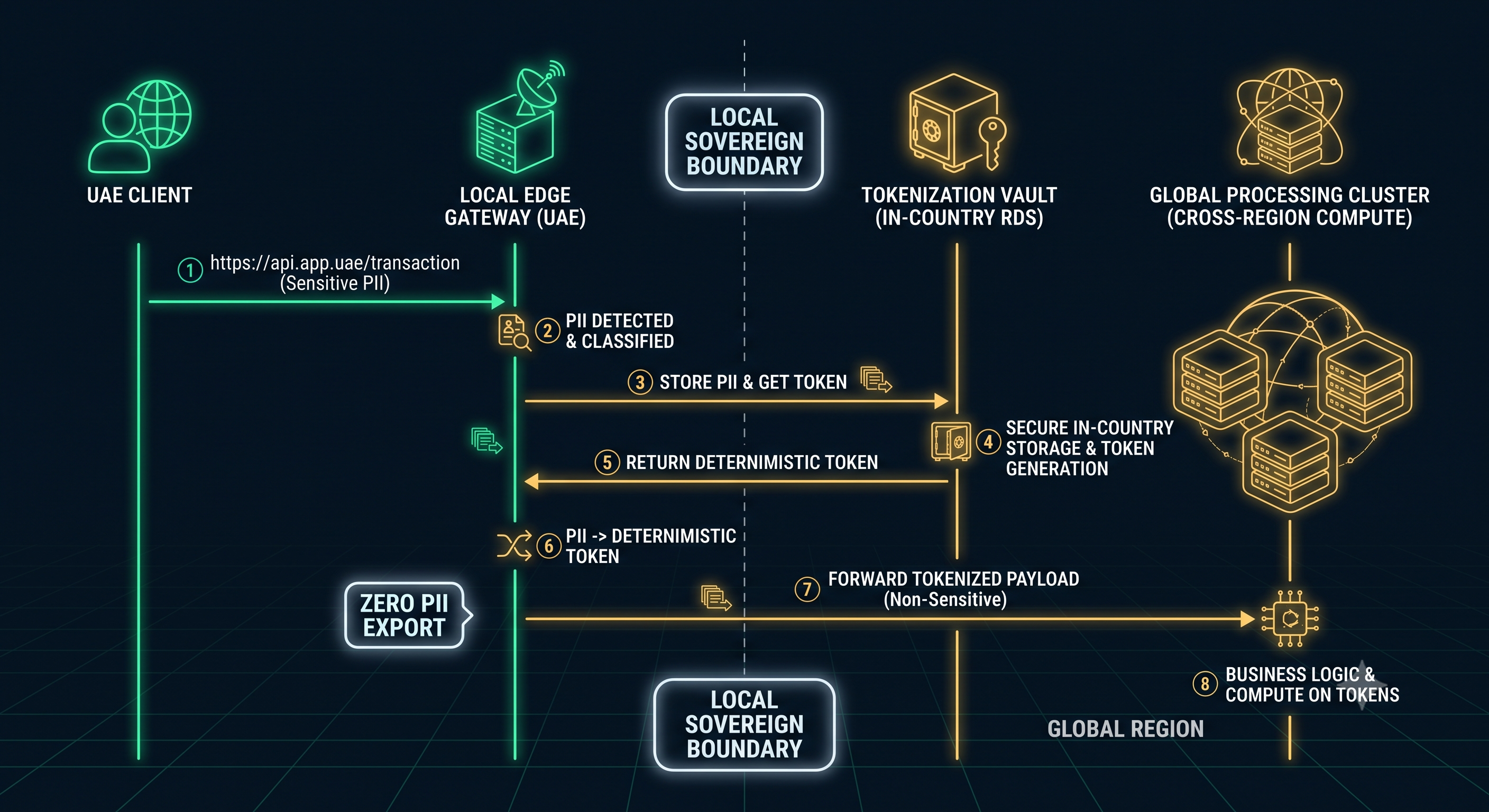
Tokenization via Local Edge Vaults: Terminate API requests within UAE-based edge instances. Before payload data flows into downstream processing, replace sensitive user records with deterministic, encrypted tokens stored in a local UAE key-value store. External global microservices handle business logic solely using tokenized abstractions.
Regional KMS Boundary Isolation: Ensure cryptographic keys for sensitive workloads are generated, rotated, and retained exclusively within UAE-hosted hardware security modules (HSMs). Restrict IAM cross-region delegation policies to prevent keys from ever being exported or called from external VPCs.
Split-Horizon Read/Write Replicas: Keep primary transactional write nodes localized inside UAE availability zones. For global dashboards, aggregate read-only, differential-privacy-masked summaries asynchronously to broader reporting hubs.
Key Takeaways
Architect for compliance early using tokenization rather than duplicating entire application stacks locally.
Keep data encryption keys strictly isolated inside UAE-hosted KMS/HSM partitions.
Use deterministic surrogate tokens to allow global compute pipelines to operate without violating residency constraints.
CTA
Navigating local regulatory architecture, cloud sovereignty, and system scalability in the Emirates?
Join Techawks UAE to connect with tech leads, infrastructure architects, and engineering innovators building across Dubai, Abu Dhabi, and beyond. Link in bio.
As the UAE consolidates its position as a global digital and financial hub, engineering teams face a specific design constraint: local data residency compliance versus the elasticity of global cloud infrastructure. Under local data protection mandates, handling regulated personal records, healthcare metrics, or financial data requires clear geographic isolation.
Simply replicating an entire global infrastructure stack into local regions (such as AWS Middle East UAE, Azure UAE North/Central, or OCI Dubai) is often cost-prohibitive and operationally redundant.
Here is how engineering teams architect hybrid data isolation pipelines for the UAE market:
Implement Strict Data Classification at Ingestion: Segregate data models into regulated PII/financial transactions versus anonymized operational metrics. Route regulated payloads exclusively to in-region databases (hosted within UAE cloud zones), while non-sensitive analytical telemetry passes to shared multi-region clusters.
Tokenization via Local Edge Vaults: Terminate API requests within UAE-based edge instances. Before payload data flows into downstream processing, replace sensitive user records with deterministic, encrypted tokens stored in a local UAE key-value store. External global microservices handle business logic solely using tokenized abstractions.
Regional KMS Boundary Isolation: Ensure cryptographic keys for sensitive workloads are generated, rotated, and retained exclusively within UAE-hosted hardware security modules (HSMs). Restrict IAM cross-region delegation policies to prevent keys from ever being exported or called from external VPCs.
Split-Horizon Read/Write Replicas: Keep primary transactional write nodes localized inside UAE availability zones. For global dashboards, aggregate read-only, differential-privacy-masked summaries asynchronously to broader reporting hubs.
Key Takeaways
Architect for compliance early using tokenization rather than duplicating entire application stacks locally.
Keep data encryption keys strictly isolated inside UAE-hosted KMS/HSM partitions.
Use deterministic surrogate tokens to allow global compute pipelines to operate without violating residency constraints.
CTA
Navigating local regulatory architecture, cloud sovereignty, and system scalability in the Emirates?
Join Techawks UAE to connect with tech leads, infrastructure architects, and engineering innovators building across Dubai, Abu Dhabi, and beyond. Link in bio.
Architecting for Data Residency in the UAE: Balancing In-Country Compliance with Global Cloud Scale
As the UAE consolidates its position as a global digital and financial hub, engineering teams face a specific design constraint: local data residency compliance versus the elasticity of global cloud infrastructure. Under local data protection mandates, handling regulated personal records, healthcare metrics, or financial data requires clear geographic isolation.
Simply replicating an entire global infrastructure stack into local regions (such as AWS Middle East UAE, Azure UAE North/Central, or OCI Dubai) is often cost-prohibitive and operationally redundant.
Here is how engineering teams architect hybrid data isolation pipelines for the UAE market:
Implement Strict Data Classification at Ingestion: Segregate data models into regulated PII/financial transactions versus anonymized operational metrics. Route regulated payloads exclusively to in-region databases (hosted within UAE cloud zones), while non-sensitive analytical telemetry passes to shared multi-region clusters.
Tokenization via Local Edge Vaults: Terminate API requests within UAE-based edge instances. Before payload data flows into downstream processing, replace sensitive user records with deterministic, encrypted tokens stored in a local UAE key-value store. External global microservices handle business logic solely using tokenized abstractions.
Regional KMS Boundary Isolation: Ensure cryptographic keys for sensitive workloads are generated, rotated, and retained exclusively within UAE-hosted hardware security modules (HSMs). Restrict IAM cross-region delegation policies to prevent keys from ever being exported or called from external VPCs.
Split-Horizon Read/Write Replicas: Keep primary transactional write nodes localized inside UAE availability zones. For global dashboards, aggregate read-only, differential-privacy-masked summaries asynchronously to broader reporting hubs.
Key Takeaways
Architect for compliance early using tokenization rather than duplicating entire application stacks locally.
Keep data encryption keys strictly isolated inside UAE-hosted KMS/HSM partitions.
Use deterministic surrogate tokens to allow global compute pipelines to operate without violating residency constraints.
CTA
Navigating local regulatory architecture, cloud sovereignty, and system scalability in the Emirates?
Join Techawks UAE to connect with tech leads, infrastructure architects, and engineering innovators building across Dubai, Abu Dhabi, and beyond. Link in bio.

 English
 Arabic
 French
 Spanish
 Portuguese
 Deutsch
 Dutch
Dutch
 Italiano
 Russian
 Romaian
 Portuguese (Brazil)
 Greek
Greek