


Architecting for PIPEDA and Provincial Privacy Laws: Solving Multi-Jurisdiction Data Pipelines in Canada
Building compliant cloud systems in Canada requires navigating a dual-layer regulatory framework. While PIPEDA governs private-sector commercial data federally, provincial legislation—most notably Québec’s Law 25, along with strict public-sector data sovereignty rules in British Columbia and Nova Scotia—imposes distinct operational obligations on distributed systems.
Simply locating a server in Montreal or Toronto does not guarantee compliance if your logging, analytics, and authentication flows route sensitive payloads beyond defined borders.
Here is how Canadian infrastructure teams build resilient, multi-jurisdictional data pipelines:
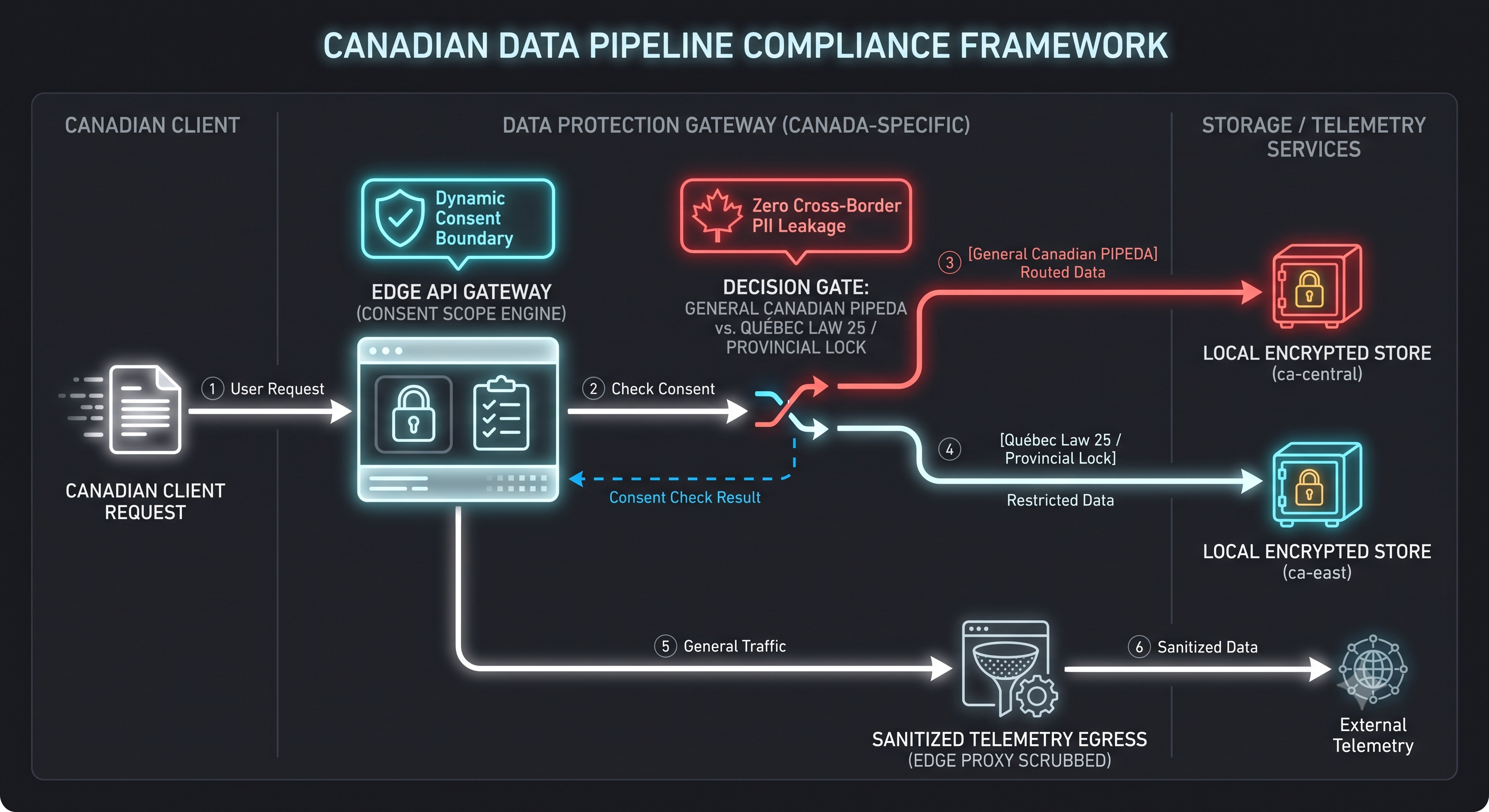
Implement Context-Aware Dynamic Consent Tagging: Under Law 25, implied consent is insufficient for sensitive tracking or profiling. Tag user records with immutable metadata flags at authentication (consent_scope: strict_local). Pass these flags through your API gateway to dynamically toggle downstream third-party telemetry, behavioral trackers, and cross-border analytics.
Establish Provincial Data Pinning for Regulated Entities: For health, educational, or public sector workloads, cross-provincial transfers often require formal privacy impact assessments (PIAs). Configure storage buckets and managed databases with resource-based IAM policies that explicitly restrict replication to specific localized zones (e.g., locking Québec-regulated records strictly within ca-east-1 or designated local outposts).
Enforce Automated Data Retention & De-indexing: Law 25 grants users explicit rights around computerized profiling and algorithmic de-indexing. Implement TTL-based automated lifecycle policies on raw transactional logs, paired with automated deletion workflows across all secondary analytical datastores.
Isolate Telemetry from Core PII: Modern APM tools (Datadog, OpenTelemetry collectors) often default to US-based SaaS endpoints. Implement edge-level scrubbing proxies within your Canadian VPC to sanitize stack traces, query parameters, and error logs of all Canadian resident PII before telemetry egress occurs.
Key Takeaways
Federal compliance (PIPEDA) does not automatically satisfy provincial standards like Québec's Law 25.
Use dynamic consent tags at the gateway layer to automatically restrict non-essential tracking and downstream analytics.
Scrub APM and error telemetry at your local VPC edge to avoid accidental cross-border PII leakage to foreign SaaS endpoints.
CTA
Navigating Canadian cloud architecture, compliance engineering, and high-scale system design?
Join Techawks Canada to connect with software architects, DevOps specialists, and engineering leaders building across Toronto, Vancouver, Montreal, and beyond. Link in bio.
Building compliant cloud systems in Canada requires navigating a dual-layer regulatory framework. While PIPEDA governs private-sector commercial data federally, provincial legislation—most notably Québec’s Law 25, along with strict public-sector data sovereignty rules in British Columbia and Nova Scotia—imposes distinct operational obligations on distributed systems.
Simply locating a server in Montreal or Toronto does not guarantee compliance if your logging, analytics, and authentication flows route sensitive payloads beyond defined borders.
Here is how Canadian infrastructure teams build resilient, multi-jurisdictional data pipelines:
Implement Context-Aware Dynamic Consent Tagging: Under Law 25, implied consent is insufficient for sensitive tracking or profiling. Tag user records with immutable metadata flags at authentication (consent_scope: strict_local). Pass these flags through your API gateway to dynamically toggle downstream third-party telemetry, behavioral trackers, and cross-border analytics.
Establish Provincial Data Pinning for Regulated Entities: For health, educational, or public sector workloads, cross-provincial transfers often require formal privacy impact assessments (PIAs). Configure storage buckets and managed databases with resource-based IAM policies that explicitly restrict replication to specific localized zones (e.g., locking Québec-regulated records strictly within ca-east-1 or designated local outposts).
Enforce Automated Data Retention & De-indexing: Law 25 grants users explicit rights around computerized profiling and algorithmic de-indexing. Implement TTL-based automated lifecycle policies on raw transactional logs, paired with automated deletion workflows across all secondary analytical datastores.
Isolate Telemetry from Core PII: Modern APM tools (Datadog, OpenTelemetry collectors) often default to US-based SaaS endpoints. Implement edge-level scrubbing proxies within your Canadian VPC to sanitize stack traces, query parameters, and error logs of all Canadian resident PII before telemetry egress occurs.
Key Takeaways
Federal compliance (PIPEDA) does not automatically satisfy provincial standards like Québec's Law 25.
Use dynamic consent tags at the gateway layer to automatically restrict non-essential tracking and downstream analytics.
Scrub APM and error telemetry at your local VPC edge to avoid accidental cross-border PII leakage to foreign SaaS endpoints.
CTA
Navigating Canadian cloud architecture, compliance engineering, and high-scale system design?
Join Techawks Canada to connect with software architects, DevOps specialists, and engineering leaders building across Toronto, Vancouver, Montreal, and beyond. Link in bio.
Architecting for PIPEDA and Provincial Privacy Laws: Solving Multi-Jurisdiction Data Pipelines in Canada
Building compliant cloud systems in Canada requires navigating a dual-layer regulatory framework. While PIPEDA governs private-sector commercial data federally, provincial legislation—most notably Québec’s Law 25, along with strict public-sector data sovereignty rules in British Columbia and Nova Scotia—imposes distinct operational obligations on distributed systems.
Simply locating a server in Montreal or Toronto does not guarantee compliance if your logging, analytics, and authentication flows route sensitive payloads beyond defined borders.
Here is how Canadian infrastructure teams build resilient, multi-jurisdictional data pipelines:
Implement Context-Aware Dynamic Consent Tagging: Under Law 25, implied consent is insufficient for sensitive tracking or profiling. Tag user records with immutable metadata flags at authentication (consent_scope: strict_local). Pass these flags through your API gateway to dynamically toggle downstream third-party telemetry, behavioral trackers, and cross-border analytics.
Establish Provincial Data Pinning for Regulated Entities: For health, educational, or public sector workloads, cross-provincial transfers often require formal privacy impact assessments (PIAs). Configure storage buckets and managed databases with resource-based IAM policies that explicitly restrict replication to specific localized zones (e.g., locking Québec-regulated records strictly within ca-east-1 or designated local outposts).
Enforce Automated Data Retention & De-indexing: Law 25 grants users explicit rights around computerized profiling and algorithmic de-indexing. Implement TTL-based automated lifecycle policies on raw transactional logs, paired with automated deletion workflows across all secondary analytical datastores.
Isolate Telemetry from Core PII: Modern APM tools (Datadog, OpenTelemetry collectors) often default to US-based SaaS endpoints. Implement edge-level scrubbing proxies within your Canadian VPC to sanitize stack traces, query parameters, and error logs of all Canadian resident PII before telemetry egress occurs.
Key Takeaways
Federal compliance (PIPEDA) does not automatically satisfy provincial standards like Québec's Law 25.
Use dynamic consent tags at the gateway layer to automatically restrict non-essential tracking and downstream analytics.
Scrub APM and error telemetry at your local VPC edge to avoid accidental cross-border PII leakage to foreign SaaS endpoints.
CTA
Navigating Canadian cloud architecture, compliance engineering, and high-scale system design?
Join Techawks Canada to connect with software architects, DevOps specialists, and engineering leaders building across Toronto, Vancouver, Montreal, and beyond. Link in bio.

 Arabic
 French
 Spanish
 Portuguese
 Deutsch
 Turkish
 Dutch
Dutch
 Italiano
 Russian
 Romaian
 Portuguese (Brazil)
 Greek
Greek