


The Fallacy of "Zero Downtime": Why Rolling Deployments Are Silently Dropping Your Data
Most DevOps teams celebrate when their orchestrator completes a rolling update with no reported service outages. However, container orchestrators only guarantee process replacement—not application-layer compatibility.
True zero-downtime deployments require handling the invisible overlap window when old and new code run simultaneously. Three operational friction points consistently undermine rolling updates:
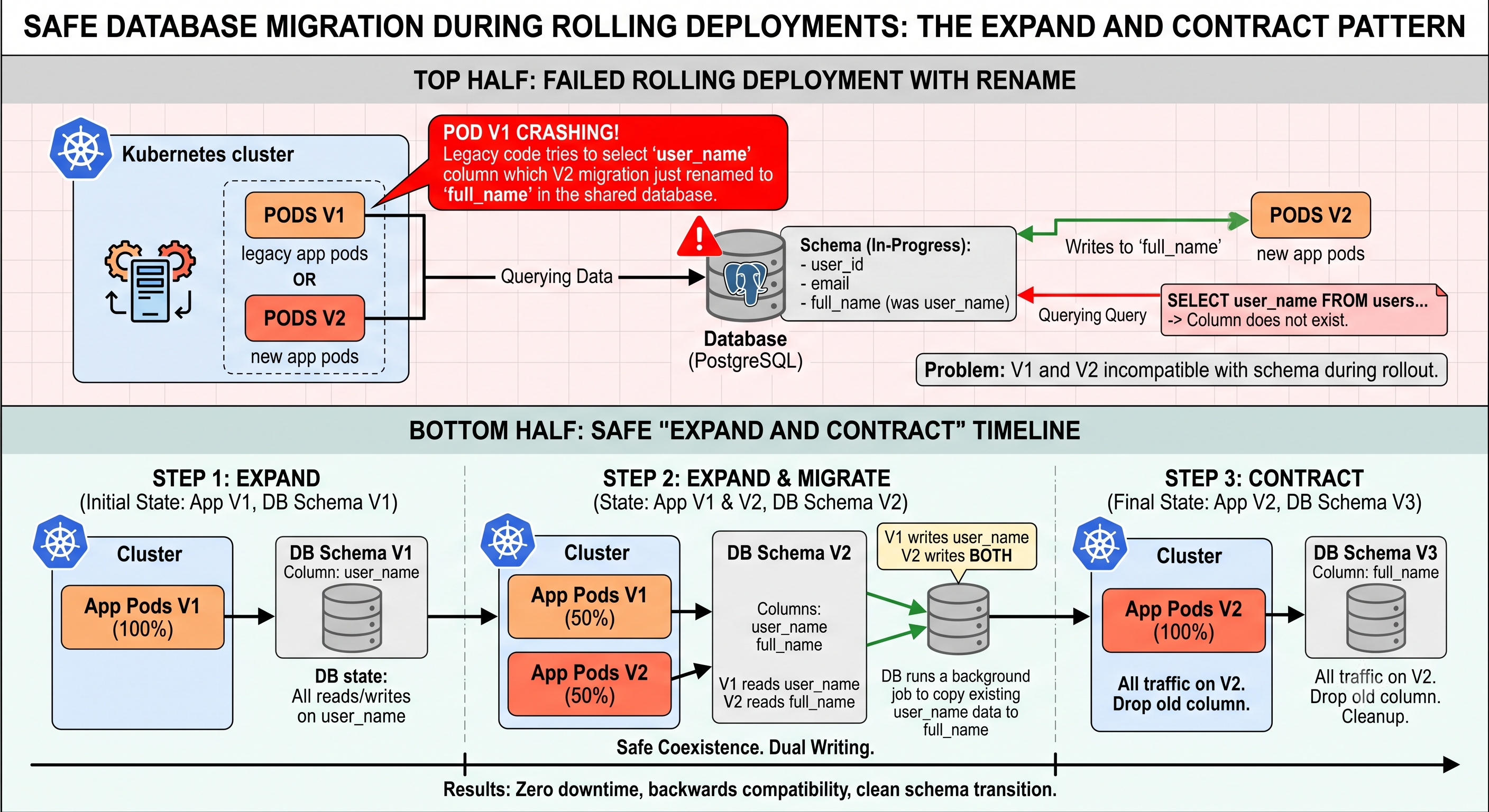
Dual-version database contention: When a new version applies a schema migration (such as renaming or dropping a column), legacy pods still handle active traffic. If an old container queries a column that the migration just modified, requests hard-fail. Migrations must follow the expand-contract pattern: add new fields first, migrate read/write traffic across releases, and only remove legacy columns in a subsequent deployment.
Premature SIGTERM termination: When a container receives a termination signal, it must stop accepting new connections while completing in-flight transactions. Missing a preStop sleep hook or relying on unconfigured graceful shutdown routines causes load balancers to route live requests to pods that have already severed internal socket listeners.
Persistent connection drain latency: Modern microservices use persistent HTTP/2 or gRPC channels. Rolling out new pods does not automatically rebalance established client connections, causing stale instances to handle disproportionate traffic until they are forcefully killed, resulting in aborted RPCs.
Eliminating downtime isn't an infrastructure checkbox—it is a tight contract between your CI/CD pipeline, connection-draining policies, and forward/backward-compatible application code.
Key Takeaways
Rolling updates execute in parallel: Old and new code will coexist for minutes; your database schema must support both versions concurrently.
Decouple migrations from deployments: Always adopt the expand-and-contract pattern across separate release cycles.
Tune lifecycle hooks: Configure graceful shutdown handlers and upstream load balancer drain timeouts before shutting down runtime sockets.
Watch long-lived streams: Actively drain or cycle persistent HTTP/2 and gRPC connections to avoid abrupt client disconnects.
CTA
How does your team handle database schema migrations during rolling updates—do you strictly enforce expand-and-contract across multi-phase releases, or rely on canary environments and feature flags to isolate traffic? Drop your pipeline strategies below.
Most DevOps teams celebrate when their orchestrator completes a rolling update with no reported service outages. However, container orchestrators only guarantee process replacement—not application-layer compatibility.
True zero-downtime deployments require handling the invisible overlap window when old and new code run simultaneously. Three operational friction points consistently undermine rolling updates:
Dual-version database contention: When a new version applies a schema migration (such as renaming or dropping a column), legacy pods still handle active traffic. If an old container queries a column that the migration just modified, requests hard-fail. Migrations must follow the expand-contract pattern: add new fields first, migrate read/write traffic across releases, and only remove legacy columns in a subsequent deployment.
Premature SIGTERM termination: When a container receives a termination signal, it must stop accepting new connections while completing in-flight transactions. Missing a preStop sleep hook or relying on unconfigured graceful shutdown routines causes load balancers to route live requests to pods that have already severed internal socket listeners.
Persistent connection drain latency: Modern microservices use persistent HTTP/2 or gRPC channels. Rolling out new pods does not automatically rebalance established client connections, causing stale instances to handle disproportionate traffic until they are forcefully killed, resulting in aborted RPCs.
Eliminating downtime isn't an infrastructure checkbox—it is a tight contract between your CI/CD pipeline, connection-draining policies, and forward/backward-compatible application code.
Key Takeaways
Rolling updates execute in parallel: Old and new code will coexist for minutes; your database schema must support both versions concurrently.
Decouple migrations from deployments: Always adopt the expand-and-contract pattern across separate release cycles.
Tune lifecycle hooks: Configure graceful shutdown handlers and upstream load balancer drain timeouts before shutting down runtime sockets.
Watch long-lived streams: Actively drain or cycle persistent HTTP/2 and gRPC connections to avoid abrupt client disconnects.
CTA
How does your team handle database schema migrations during rolling updates—do you strictly enforce expand-and-contract across multi-phase releases, or rely on canary environments and feature flags to isolate traffic? Drop your pipeline strategies below.
The Fallacy of "Zero Downtime": Why Rolling Deployments Are Silently Dropping Your Data
Most DevOps teams celebrate when their orchestrator completes a rolling update with no reported service outages. However, container orchestrators only guarantee process replacement—not application-layer compatibility.
True zero-downtime deployments require handling the invisible overlap window when old and new code run simultaneously. Three operational friction points consistently undermine rolling updates:
Dual-version database contention: When a new version applies a schema migration (such as renaming or dropping a column), legacy pods still handle active traffic. If an old container queries a column that the migration just modified, requests hard-fail. Migrations must follow the expand-contract pattern: add new fields first, migrate read/write traffic across releases, and only remove legacy columns in a subsequent deployment.
Premature SIGTERM termination: When a container receives a termination signal, it must stop accepting new connections while completing in-flight transactions. Missing a preStop sleep hook or relying on unconfigured graceful shutdown routines causes load balancers to route live requests to pods that have already severed internal socket listeners.
Persistent connection drain latency: Modern microservices use persistent HTTP/2 or gRPC channels. Rolling out new pods does not automatically rebalance established client connections, causing stale instances to handle disproportionate traffic until they are forcefully killed, resulting in aborted RPCs.
Eliminating downtime isn't an infrastructure checkbox—it is a tight contract between your CI/CD pipeline, connection-draining policies, and forward/backward-compatible application code.
Key Takeaways
Rolling updates execute in parallel: Old and new code will coexist for minutes; your database schema must support both versions concurrently.
Decouple migrations from deployments: Always adopt the expand-and-contract pattern across separate release cycles.
Tune lifecycle hooks: Configure graceful shutdown handlers and upstream load balancer drain timeouts before shutting down runtime sockets.
Watch long-lived streams: Actively drain or cycle persistent HTTP/2 and gRPC connections to avoid abrupt client disconnects.
CTA
How does your team handle database schema migrations during rolling updates—do you strictly enforce expand-and-contract across multi-phase releases, or rely on canary environments and feature flags to isolate traffic? Drop your pipeline strategies below.

 English
 Arabic
 French
 Spanish
 Portuguese
 Deutsch
 Turkish
 Dutch
Dutch
 Russian
 Romaian
 Portuguese (Brazil)
 Greek
Greek