


Data Residency vs. Data Sovereignty: The Architectural Shift UAE Cloud Teams Must Make in 2026
Across Dubai and Abu Dhabi, enterprises have raced to migrate workloads into local hyperscaler zones and sovereign compute backbones like G42 Cloud and Khazna. However, many systems teams still conflate data residency with data sovereignty.
Data Residency is geographic: It simply means your data at rest resides within UAE borders.
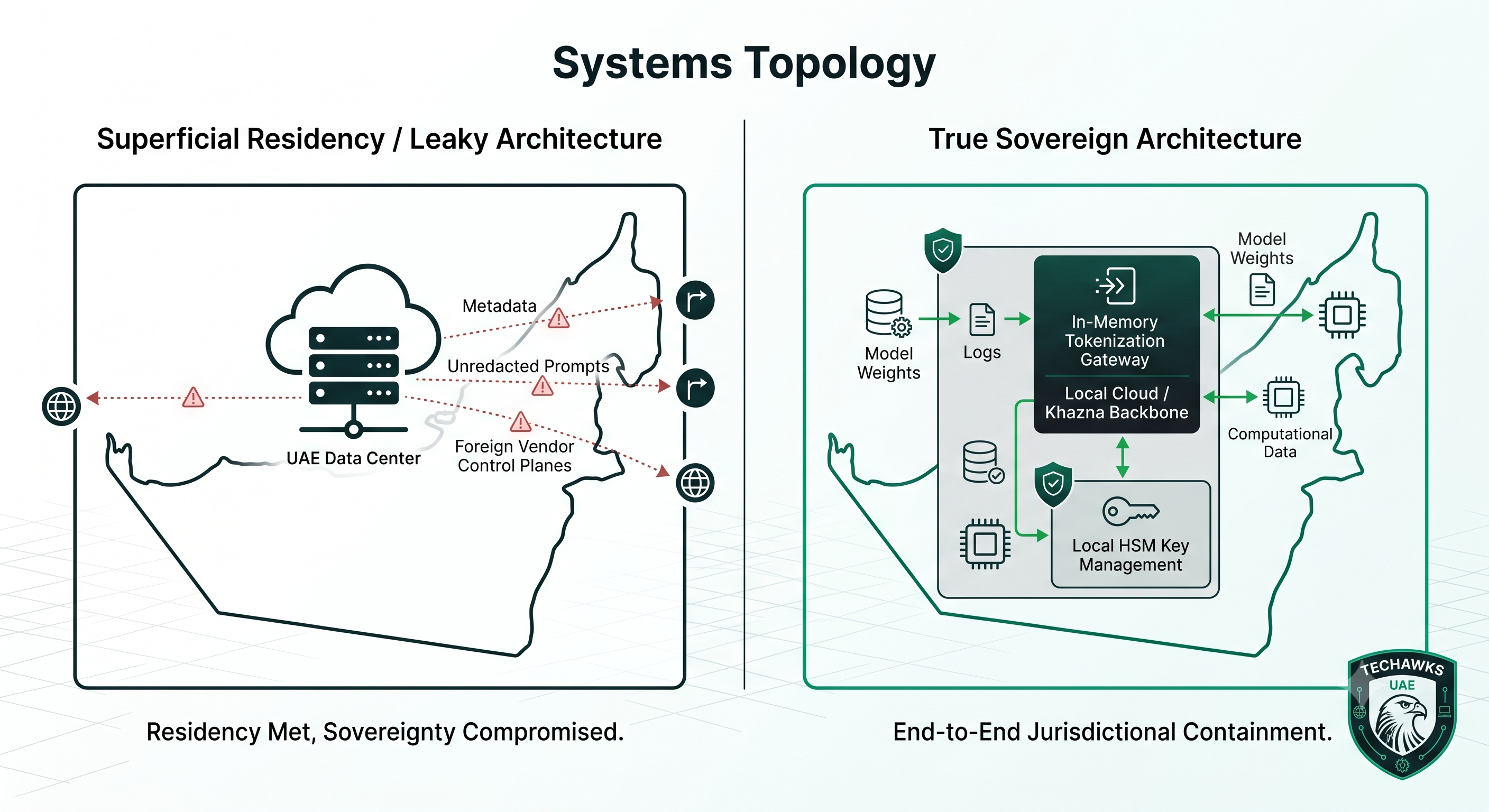
Data Sovereignty is jurisdictional and operational: It ensures that no external entity—via vendor telemetry, remote cross-border control planes, or third-party proprietary AI APIs—can access, decrypt, or process that data without UAE regulatory purview.
If an autonomous AI agent running on local infrastructure sends prompts or metadata to an external orchestration endpoint overseas, data residency is technically preserved in storage, but sovereignty is violated during execution.
To build an architecture that survives modern UAE governance audits (such as UAE PDPL and Central Bank regulatory frameworks), engineering teams must adopt a Sovereign-First Stack:
Customer-Managed Key (CMK) Enclaves:
Do not rely on cloud-provider-managed encryption keys. Enforce hardware security modules (HSMs) anchored locally where the master key never touches a non-sovereign control plane.
Deterministic Prompt Redaction & Tokenization:
Before transactional data or sensitive PII passes into an LLM context window—even regional bilingual models like Jais or Falcon—route the payload through an in-memory tokenization gateway. Replace actual identifiers with deterministic tokens that remain resolvable only inside local VPC boundaries.
Control-Plane Air-Locking:
Audit your infrastructure-as-code pipelines. Ensure logging, telemetry, observability sinks, and model fine-tuning checkpoints are strictly pinned to domestic nodes rather than syncing with global telemetry hubs by default.
Sovereignty isn't a checkbox provided by your hosting provider—it’s an architectural decision built into your pipeline.
Discussion Question
When deploying generative AI models and data pipelines across UAE regions, how does your engineering team ensure that operational metadata and fine-tuning weights remain within domestic jurisdictional boundaries?
CTA
Join Techawks UAE — Connect with Middle East-based systems architects, DevOps specialists, and engineering leaders building the next generation of resilient, sovereign cloud infrastructure.
Across Dubai and Abu Dhabi, enterprises have raced to migrate workloads into local hyperscaler zones and sovereign compute backbones like G42 Cloud and Khazna. However, many systems teams still conflate data residency with data sovereignty.
Data Residency is geographic: It simply means your data at rest resides within UAE borders.
Data Sovereignty is jurisdictional and operational: It ensures that no external entity—via vendor telemetry, remote cross-border control planes, or third-party proprietary AI APIs—can access, decrypt, or process that data without UAE regulatory purview.
If an autonomous AI agent running on local infrastructure sends prompts or metadata to an external orchestration endpoint overseas, data residency is technically preserved in storage, but sovereignty is violated during execution.
To build an architecture that survives modern UAE governance audits (such as UAE PDPL and Central Bank regulatory frameworks), engineering teams must adopt a Sovereign-First Stack:
Customer-Managed Key (CMK) Enclaves:
Do not rely on cloud-provider-managed encryption keys. Enforce hardware security modules (HSMs) anchored locally where the master key never touches a non-sovereign control plane.
Deterministic Prompt Redaction & Tokenization:
Before transactional data or sensitive PII passes into an LLM context window—even regional bilingual models like Jais or Falcon—route the payload through an in-memory tokenization gateway. Replace actual identifiers with deterministic tokens that remain resolvable only inside local VPC boundaries.
Control-Plane Air-Locking:
Audit your infrastructure-as-code pipelines. Ensure logging, telemetry, observability sinks, and model fine-tuning checkpoints are strictly pinned to domestic nodes rather than syncing with global telemetry hubs by default.
Sovereignty isn't a checkbox provided by your hosting provider—it’s an architectural decision built into your pipeline.
Discussion Question
When deploying generative AI models and data pipelines across UAE regions, how does your engineering team ensure that operational metadata and fine-tuning weights remain within domestic jurisdictional boundaries?
CTA
Join Techawks UAE — Connect with Middle East-based systems architects, DevOps specialists, and engineering leaders building the next generation of resilient, sovereign cloud infrastructure.
Data Residency vs. Data Sovereignty: The Architectural Shift UAE Cloud Teams Must Make in 2026
Across Dubai and Abu Dhabi, enterprises have raced to migrate workloads into local hyperscaler zones and sovereign compute backbones like G42 Cloud and Khazna. However, many systems teams still conflate data residency with data sovereignty.
Data Residency is geographic: It simply means your data at rest resides within UAE borders.
Data Sovereignty is jurisdictional and operational: It ensures that no external entity—via vendor telemetry, remote cross-border control planes, or third-party proprietary AI APIs—can access, decrypt, or process that data without UAE regulatory purview.
If an autonomous AI agent running on local infrastructure sends prompts or metadata to an external orchestration endpoint overseas, data residency is technically preserved in storage, but sovereignty is violated during execution.
To build an architecture that survives modern UAE governance audits (such as UAE PDPL and Central Bank regulatory frameworks), engineering teams must adopt a Sovereign-First Stack:
Customer-Managed Key (CMK) Enclaves:
Do not rely on cloud-provider-managed encryption keys. Enforce hardware security modules (HSMs) anchored locally where the master key never touches a non-sovereign control plane.
Deterministic Prompt Redaction & Tokenization:
Before transactional data or sensitive PII passes into an LLM context window—even regional bilingual models like Jais or Falcon—route the payload through an in-memory tokenization gateway. Replace actual identifiers with deterministic tokens that remain resolvable only inside local VPC boundaries.
Control-Plane Air-Locking:
Audit your infrastructure-as-code pipelines. Ensure logging, telemetry, observability sinks, and model fine-tuning checkpoints are strictly pinned to domestic nodes rather than syncing with global telemetry hubs by default.
Sovereignty isn't a checkbox provided by your hosting provider—it’s an architectural decision built into your pipeline.
Discussion Question
When deploying generative AI models and data pipelines across UAE regions, how does your engineering team ensure that operational metadata and fine-tuning weights remain within domestic jurisdictional boundaries?
CTA
Join Techawks UAE — Connect with Middle East-based systems architects, DevOps specialists, and engineering leaders building the next generation of resilient, sovereign cloud infrastructure.

 English
 Arabic
 French
 Spanish
 Deutsch
 Turkish
 Dutch
Dutch
 Italiano
 Russian
 Romaian
 Portuguese (Brazil)
 Greek
Greek