


Carbon-Aware Orchestration: Designing AI Workloads for Canada’s Clean Energy Baseline
With major cloud operators and AI firms signing on to Canada’s newly released Responsible Data Centre Development Principles, the operational mandate across Canadian engineering teams is clear: compute scaling can no longer treat electricity as an unconstrained resource.
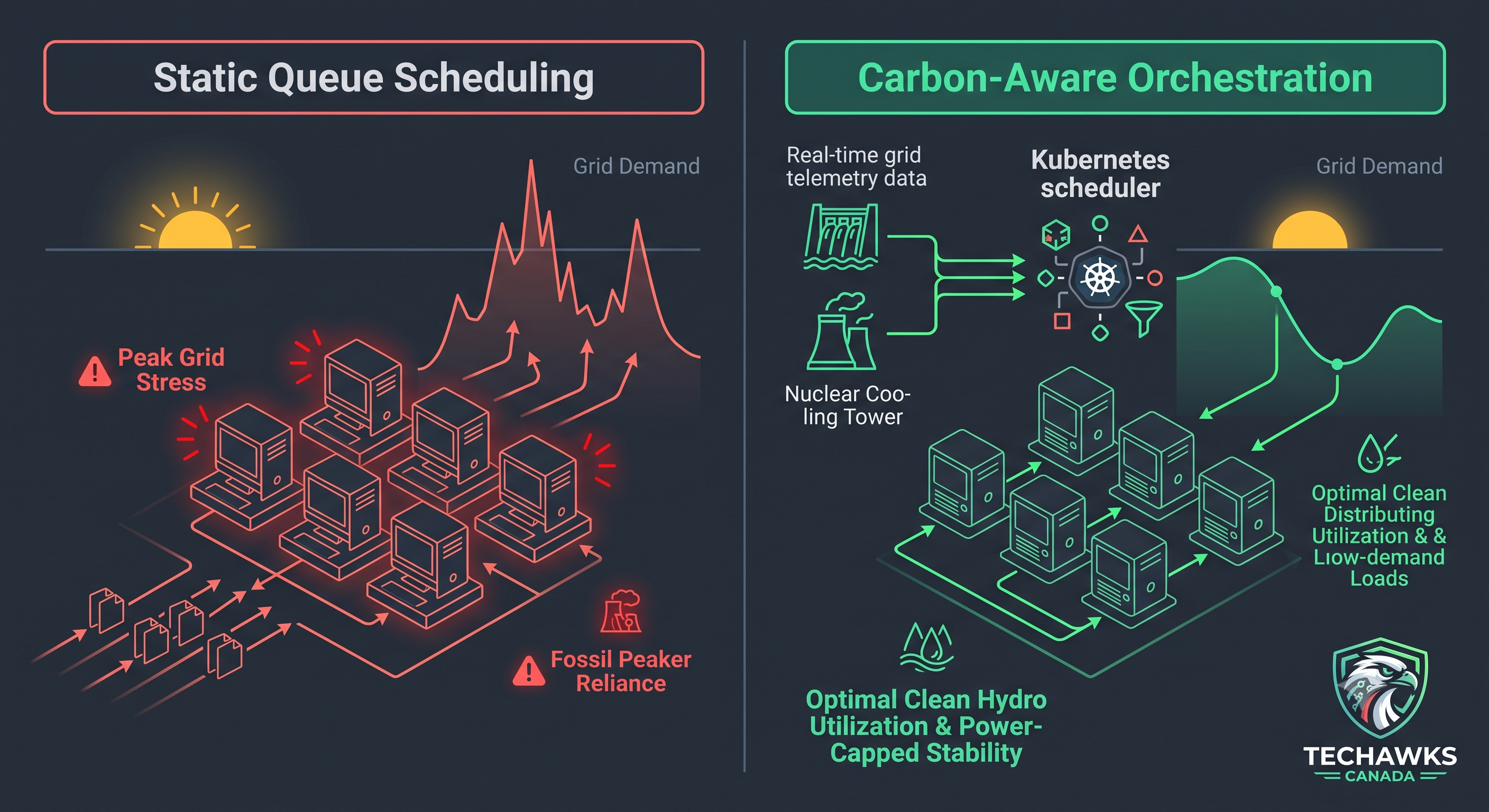
Canada holds a strategic competitive advantage in clean hydro and nuclear generation across provinces like Quebec, Ontario, and British Columbia. However, unmitigated peak GPU spikes strain provincial interties and push local utilities toward fossil-fueled peaker plants during high-demand hours.
To build sustainable, high-throughput architectures that comply with federal efficiency benchmarks, infrastructure leads must transition from static Kubernetes job queuing to Grid-Responsive Workload Orchestration:
Decouple Training Schedules via Marginal Carbon Intensity (MOER):
Average grid emission factors are misleading. A data center in Ontario or Quebec may average low emissions, but running large training jobs during localized afternoon peaks often forces marginal generation from gas turbines. Ingest real-time marginal intensity APIs into your orchestrator to dynamically throttle batch compute during peak marginal emissions.
Implement Temporal and Spatial Shifting in CI/CD:
Treat compute jobs as schedulable across time and region. Non-urgent tasks—such as batch embedding generation, nightly regression runs, or offline fine-tuning—should use custom resource schedulers (e.g., carbon-aware Keda scalers) that queue execution until local hydro-backed baselines reach optimal utilization.
Hardware P-State & Power-Capping Automation:
Rather than letting GPU nodes idle at nominal draw, enforce automated dynamic voltage and frequency scaling (DVFS) policies. Power-capping training clusters at 80–85% of peak TDP reduces thermal output and grid draw by up to 20% while sacrificing negligible wall-clock compute throughput.
Sustainable engineering in Canada isn’t about purchasing offset certificates; it’s an architectural practice of synchronizing compute load with real-time grid capacity.
Discussion Question
Does your infrastructure stack account for real-time marginal grid emissions when running large-scale batch processing or AI model fine-tuning, or do your orchestrators schedule purely on queue availability?
CTA
Join Techawks Canada — Connect with Canadian software architects, SREs, and cloud-native builders scaling high-performance, energy-efficient digital infrastructure from coast to coast.
With major cloud operators and AI firms signing on to Canada’s newly released Responsible Data Centre Development Principles, the operational mandate across Canadian engineering teams is clear: compute scaling can no longer treat electricity as an unconstrained resource.
Canada holds a strategic competitive advantage in clean hydro and nuclear generation across provinces like Quebec, Ontario, and British Columbia. However, unmitigated peak GPU spikes strain provincial interties and push local utilities toward fossil-fueled peaker plants during high-demand hours.
To build sustainable, high-throughput architectures that comply with federal efficiency benchmarks, infrastructure leads must transition from static Kubernetes job queuing to Grid-Responsive Workload Orchestration:
Decouple Training Schedules via Marginal Carbon Intensity (MOER):
Average grid emission factors are misleading. A data center in Ontario or Quebec may average low emissions, but running large training jobs during localized afternoon peaks often forces marginal generation from gas turbines. Ingest real-time marginal intensity APIs into your orchestrator to dynamically throttle batch compute during peak marginal emissions.
Implement Temporal and Spatial Shifting in CI/CD:
Treat compute jobs as schedulable across time and region. Non-urgent tasks—such as batch embedding generation, nightly regression runs, or offline fine-tuning—should use custom resource schedulers (e.g., carbon-aware Keda scalers) that queue execution until local hydro-backed baselines reach optimal utilization.
Hardware P-State & Power-Capping Automation:
Rather than letting GPU nodes idle at nominal draw, enforce automated dynamic voltage and frequency scaling (DVFS) policies. Power-capping training clusters at 80–85% of peak TDP reduces thermal output and grid draw by up to 20% while sacrificing negligible wall-clock compute throughput.
Sustainable engineering in Canada isn’t about purchasing offset certificates; it’s an architectural practice of synchronizing compute load with real-time grid capacity.
Discussion Question
Does your infrastructure stack account for real-time marginal grid emissions when running large-scale batch processing or AI model fine-tuning, or do your orchestrators schedule purely on queue availability?
CTA
Join Techawks Canada — Connect with Canadian software architects, SREs, and cloud-native builders scaling high-performance, energy-efficient digital infrastructure from coast to coast.
Carbon-Aware Orchestration: Designing AI Workloads for Canada’s Clean Energy Baseline
With major cloud operators and AI firms signing on to Canada’s newly released Responsible Data Centre Development Principles, the operational mandate across Canadian engineering teams is clear: compute scaling can no longer treat electricity as an unconstrained resource.
Canada holds a strategic competitive advantage in clean hydro and nuclear generation across provinces like Quebec, Ontario, and British Columbia. However, unmitigated peak GPU spikes strain provincial interties and push local utilities toward fossil-fueled peaker plants during high-demand hours.
To build sustainable, high-throughput architectures that comply with federal efficiency benchmarks, infrastructure leads must transition from static Kubernetes job queuing to Grid-Responsive Workload Orchestration:
Decouple Training Schedules via Marginal Carbon Intensity (MOER):
Average grid emission factors are misleading. A data center in Ontario or Quebec may average low emissions, but running large training jobs during localized afternoon peaks often forces marginal generation from gas turbines. Ingest real-time marginal intensity APIs into your orchestrator to dynamically throttle batch compute during peak marginal emissions.
Implement Temporal and Spatial Shifting in CI/CD:
Treat compute jobs as schedulable across time and region. Non-urgent tasks—such as batch embedding generation, nightly regression runs, or offline fine-tuning—should use custom resource schedulers (e.g., carbon-aware Keda scalers) that queue execution until local hydro-backed baselines reach optimal utilization.
Hardware P-State & Power-Capping Automation:
Rather than letting GPU nodes idle at nominal draw, enforce automated dynamic voltage and frequency scaling (DVFS) policies. Power-capping training clusters at 80–85% of peak TDP reduces thermal output and grid draw by up to 20% while sacrificing negligible wall-clock compute throughput.
Sustainable engineering in Canada isn’t about purchasing offset certificates; it’s an architectural practice of synchronizing compute load with real-time grid capacity.
Discussion Question
Does your infrastructure stack account for real-time marginal grid emissions when running large-scale batch processing or AI model fine-tuning, or do your orchestrators schedule purely on queue availability?
CTA
Join Techawks Canada — Connect with Canadian software architects, SREs, and cloud-native builders scaling high-performance, energy-efficient digital infrastructure from coast to coast.

 English
 Arabic
 French
 Portuguese
 Deutsch
 Turkish
 Dutch
Dutch
 Italiano
 Russian
 Romaian
 Portuguese (Brazil)
 Greek
Greek