


The "Hidden Architecture" of Indian Tech: Why Designing for Bharat Breaks Standard Cloud Defaults
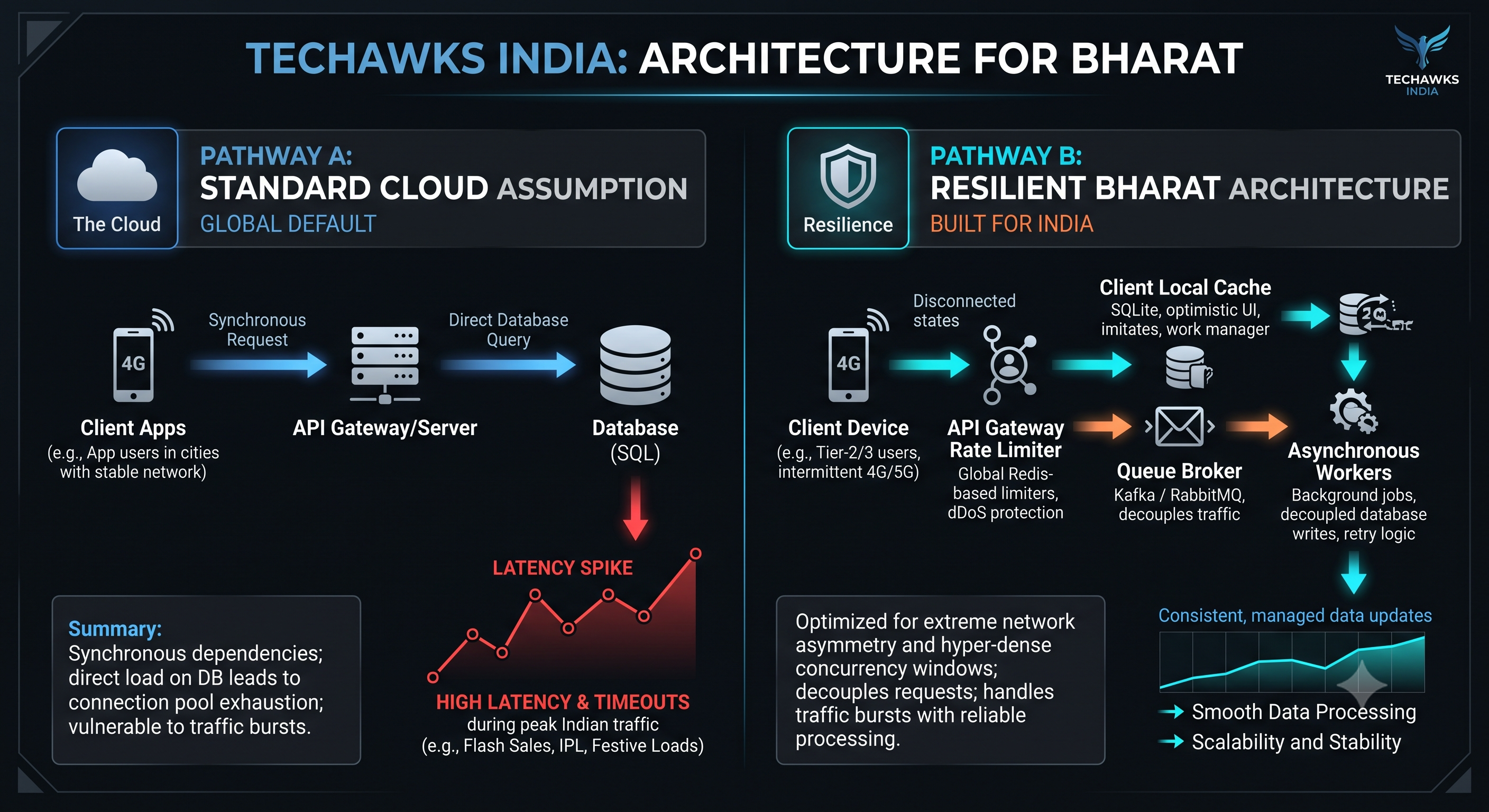
Scaling software across India isn't just about handling traffic spikes; it’s about engineering for extreme network asymmetry, varied device hardware, and hyper-dense concurrency windows.
If you want your backend and client apps to actually survive at scale across India, standard boilerplate patterns won't cut it. Here are three architectural shifts senior Indian engineers swear by:
Design for Intermittent Edge Connectivity: Never assume a continuous WebSocket or active HTTP connection. Treat every mobile client as offline-first. Use optimistic UI updates paired with SQLite/Room local persistence, background synchronization (WorkManager/BackgroundTasks), and idempotent message queues with strict exponential backoff.
Payload Economy Over Pure Serialization Speed: When your users rely on patchy 4G/5G edge cells or budget chipsets, deserializing huge JSON blobs kills client-side battery and memory. Shift to Protobuf/gRPC for internal microservices, enable Brotli compression, and ruthlessly trim redundant API payloads down to essential bytes.
The "Flash-Sale" Concurrency Model: From IPL timeouts to festive flash sales and UPI checkout deadlines, Indian traffic patterns cluster into intense 60-second bursts rather than gentle bell curves. Relying on auto-scaling alone causes lag during cold starts. Front high-velocity writes with distributed message brokers (Kafka/RabbitMQ) and implement Redis-based token-bucket rate limiting at the API gateway layer to shed non-critical load before your core database suffers connection pool exhaustion.
What is one architectural decision you had to completely rewrite after deploying to real-world Indian traffic?
Key Takeaways
Offline-First Resilience: Cache locally, execute actions optimistically, and sync asynchronously.
Aggressive Payload Trimming: Optimize for low-spec device memory and edge network limits using compact serialization.
Proactive Load Buffering: Queue spiky traffic at the edge; never depend entirely on cloud auto-scaling spin-up times.
CTA (Join Techawks India)
Tired of generic tech playbooks that collapse under real-world traffic? Join Techawks India to debate real engineering trade-offs, dissect production postmortems, and connect with engineers building systems that actually scale across Bharat. Drop your thoughts below and hit follow.
Scaling software across India isn't just about handling traffic spikes; it’s about engineering for extreme network asymmetry, varied device hardware, and hyper-dense concurrency windows.
If you want your backend and client apps to actually survive at scale across India, standard boilerplate patterns won't cut it. Here are three architectural shifts senior Indian engineers swear by:
Design for Intermittent Edge Connectivity: Never assume a continuous WebSocket or active HTTP connection. Treat every mobile client as offline-first. Use optimistic UI updates paired with SQLite/Room local persistence, background synchronization (WorkManager/BackgroundTasks), and idempotent message queues with strict exponential backoff.
Payload Economy Over Pure Serialization Speed: When your users rely on patchy 4G/5G edge cells or budget chipsets, deserializing huge JSON blobs kills client-side battery and memory. Shift to Protobuf/gRPC for internal microservices, enable Brotli compression, and ruthlessly trim redundant API payloads down to essential bytes.
The "Flash-Sale" Concurrency Model: From IPL timeouts to festive flash sales and UPI checkout deadlines, Indian traffic patterns cluster into intense 60-second bursts rather than gentle bell curves. Relying on auto-scaling alone causes lag during cold starts. Front high-velocity writes with distributed message brokers (Kafka/RabbitMQ) and implement Redis-based token-bucket rate limiting at the API gateway layer to shed non-critical load before your core database suffers connection pool exhaustion.
What is one architectural decision you had to completely rewrite after deploying to real-world Indian traffic?
Key Takeaways
Offline-First Resilience: Cache locally, execute actions optimistically, and sync asynchronously.
Aggressive Payload Trimming: Optimize for low-spec device memory and edge network limits using compact serialization.
Proactive Load Buffering: Queue spiky traffic at the edge; never depend entirely on cloud auto-scaling spin-up times.
CTA (Join Techawks India)
Tired of generic tech playbooks that collapse under real-world traffic? Join Techawks India to debate real engineering trade-offs, dissect production postmortems, and connect with engineers building systems that actually scale across Bharat. Drop your thoughts below and hit follow.
The "Hidden Architecture" of Indian Tech: Why Designing for Bharat Breaks Standard Cloud Defaults
Scaling software across India isn't just about handling traffic spikes; it’s about engineering for extreme network asymmetry, varied device hardware, and hyper-dense concurrency windows.
If you want your backend and client apps to actually survive at scale across India, standard boilerplate patterns won't cut it. Here are three architectural shifts senior Indian engineers swear by:
Design for Intermittent Edge Connectivity: Never assume a continuous WebSocket or active HTTP connection. Treat every mobile client as offline-first. Use optimistic UI updates paired with SQLite/Room local persistence, background synchronization (WorkManager/BackgroundTasks), and idempotent message queues with strict exponential backoff.
Payload Economy Over Pure Serialization Speed: When your users rely on patchy 4G/5G edge cells or budget chipsets, deserializing huge JSON blobs kills client-side battery and memory. Shift to Protobuf/gRPC for internal microservices, enable Brotli compression, and ruthlessly trim redundant API payloads down to essential bytes.
The "Flash-Sale" Concurrency Model: From IPL timeouts to festive flash sales and UPI checkout deadlines, Indian traffic patterns cluster into intense 60-second bursts rather than gentle bell curves. Relying on auto-scaling alone causes lag during cold starts. Front high-velocity writes with distributed message brokers (Kafka/RabbitMQ) and implement Redis-based token-bucket rate limiting at the API gateway layer to shed non-critical load before your core database suffers connection pool exhaustion.
What is one architectural decision you had to completely rewrite after deploying to real-world Indian traffic?
Key Takeaways
Offline-First Resilience: Cache locally, execute actions optimistically, and sync asynchronously.
Aggressive Payload Trimming: Optimize for low-spec device memory and edge network limits using compact serialization.
Proactive Load Buffering: Queue spiky traffic at the edge; never depend entirely on cloud auto-scaling spin-up times.
CTA (Join Techawks India)
Tired of generic tech playbooks that collapse under real-world traffic? Join Techawks India to debate real engineering trade-offs, dissect production postmortems, and connect with engineers building systems that actually scale across Bharat. Drop your thoughts below and hit follow.

 English
 Arabic
 French
 Spanish
 Portuguese
 Turkish
 Dutch
Dutch
 Italiano
 Russian
 Romaian
 Portuguese (Brazil)
 Greek
Greek