


The Data Sovereignty Maze: Why "UK GDPR Compliance" Requires an Architectural Overhaul, Not Just a Legal Policy
Operating tech in the UK requires navigating a distinct regulatory and infrastructural reality. Between UK GDPR, evolving data bridge frameworks, and stringent Open Banking compliance, building for the UK and European ecosystem means engineering privacy directly into your data pipelines from day one.
Treating data residency and compliance as an afterthought inevitably leads to painful re-platforming down the road. High-performing UK engineering teams design for strict data governance at the architecture level using three practical patterns:
Implement Zero-Trust Field-Level Encryption Before Ingestion: Storing databases in the eu-west-2 (London) region isn't enough if internal services have unrestricted plaintext access. Enforce field-level encryption (FLE) or envelope encryption on high-risk attributes (national identifiers, transaction records, IP addresses) at the application layer before writing to persistent stores. If an operational database is compromised, the sensitive fields remain cryptographically unreadable without localized KMS keys.
Isolate Telemetry and Observability Trails: Log drains and distributed tracing agents (Datadog, OpenTelemetry, Logstash) are the most common unmonitored compliance leaks. User IDs, emails, and transaction tokens frequently slip into error payloads and get shipped to external US-headquartered aggregation nodes. Deploy localized log masking proxies at the ingress layer to sanitize PII, drop unhashed user attributes, and retain debug logs strictly within domestic storage boundaries.
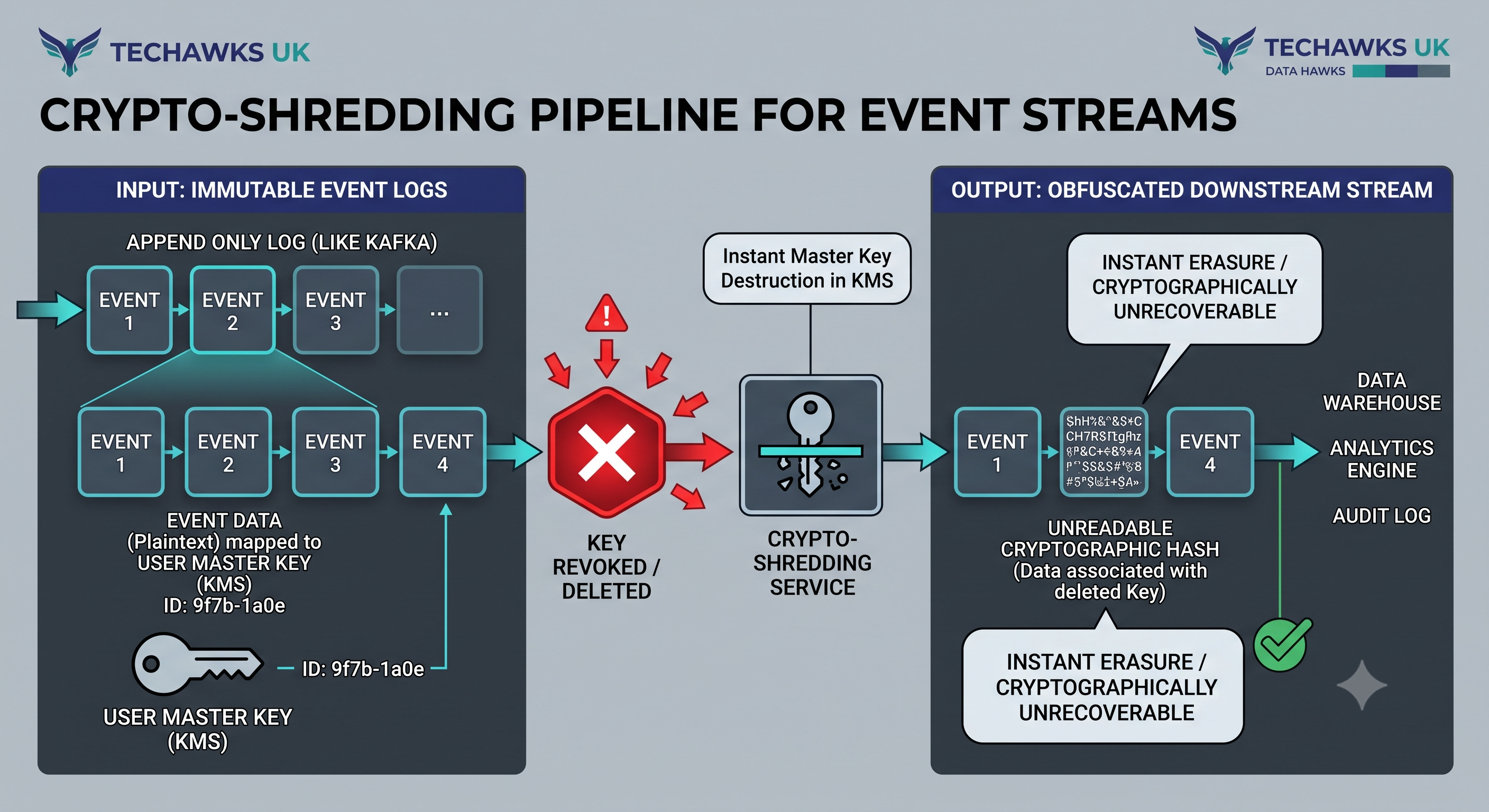
Architect for Granular "Right to Erasure" Hard Deletions: In complex event-driven setups, handling an Article 17 deletion request across Kafka logs, cold S3 archives, and distributed cache clusters is an operational nightmare. Use crypto-shredding: associate each user with a unique cryptographic key stored in a dedicated key management service. When an erasure request arrives, destroy that user's specific key, instantly rendering all their historic, distributed immutable event data permanently unrecoverable without needing to rewrite entire append-only log streams.
How does your engineering team manage the boundary between rapid feature shipping and strict data residency guardrails?
Key Takeaways
Local Region $\neq$ Compliance: Encrypt sensitive fields at the application tier before writes occur; don't rely solely on cloud region selection.
Sanitize Telemetry at Ingress: Filter and mask debug logs and traces locally before they stream out to multi-region observability tools.
Leverage Crypto-Shredding: Solve append-only and streaming data deletion challenges by destroying user-specific encryption keys.
CTA (Join Techawks UK)
Navigating modern software architecture in the UK means balancing high-velocity product delivery with world-class engineering standards and data integrity.
Join Techawks UK to connect with local system architects, unpack production postmortems, and master practical tech leadership. Share your perspective in the comments below.
Operating tech in the UK requires navigating a distinct regulatory and infrastructural reality. Between UK GDPR, evolving data bridge frameworks, and stringent Open Banking compliance, building for the UK and European ecosystem means engineering privacy directly into your data pipelines from day one.
Treating data residency and compliance as an afterthought inevitably leads to painful re-platforming down the road. High-performing UK engineering teams design for strict data governance at the architecture level using three practical patterns:
Implement Zero-Trust Field-Level Encryption Before Ingestion: Storing databases in the eu-west-2 (London) region isn't enough if internal services have unrestricted plaintext access. Enforce field-level encryption (FLE) or envelope encryption on high-risk attributes (national identifiers, transaction records, IP addresses) at the application layer before writing to persistent stores. If an operational database is compromised, the sensitive fields remain cryptographically unreadable without localized KMS keys.
Isolate Telemetry and Observability Trails: Log drains and distributed tracing agents (Datadog, OpenTelemetry, Logstash) are the most common unmonitored compliance leaks. User IDs, emails, and transaction tokens frequently slip into error payloads and get shipped to external US-headquartered aggregation nodes. Deploy localized log masking proxies at the ingress layer to sanitize PII, drop unhashed user attributes, and retain debug logs strictly within domestic storage boundaries.
Architect for Granular "Right to Erasure" Hard Deletions: In complex event-driven setups, handling an Article 17 deletion request across Kafka logs, cold S3 archives, and distributed cache clusters is an operational nightmare. Use crypto-shredding: associate each user with a unique cryptographic key stored in a dedicated key management service. When an erasure request arrives, destroy that user's specific key, instantly rendering all their historic, distributed immutable event data permanently unrecoverable without needing to rewrite entire append-only log streams.
How does your engineering team manage the boundary between rapid feature shipping and strict data residency guardrails?
Key Takeaways
Local Region $\neq$ Compliance: Encrypt sensitive fields at the application tier before writes occur; don't rely solely on cloud region selection.
Sanitize Telemetry at Ingress: Filter and mask debug logs and traces locally before they stream out to multi-region observability tools.
Leverage Crypto-Shredding: Solve append-only and streaming data deletion challenges by destroying user-specific encryption keys.
CTA (Join Techawks UK)
Navigating modern software architecture in the UK means balancing high-velocity product delivery with world-class engineering standards and data integrity.
Join Techawks UK to connect with local system architects, unpack production postmortems, and master practical tech leadership. Share your perspective in the comments below.
The Data Sovereignty Maze: Why "UK GDPR Compliance" Requires an Architectural Overhaul, Not Just a Legal Policy
Operating tech in the UK requires navigating a distinct regulatory and infrastructural reality. Between UK GDPR, evolving data bridge frameworks, and stringent Open Banking compliance, building for the UK and European ecosystem means engineering privacy directly into your data pipelines from day one.
Treating data residency and compliance as an afterthought inevitably leads to painful re-platforming down the road. High-performing UK engineering teams design for strict data governance at the architecture level using three practical patterns:
Implement Zero-Trust Field-Level Encryption Before Ingestion: Storing databases in the eu-west-2 (London) region isn't enough if internal services have unrestricted plaintext access. Enforce field-level encryption (FLE) or envelope encryption on high-risk attributes (national identifiers, transaction records, IP addresses) at the application layer before writing to persistent stores. If an operational database is compromised, the sensitive fields remain cryptographically unreadable without localized KMS keys.
Isolate Telemetry and Observability Trails: Log drains and distributed tracing agents (Datadog, OpenTelemetry, Logstash) are the most common unmonitored compliance leaks. User IDs, emails, and transaction tokens frequently slip into error payloads and get shipped to external US-headquartered aggregation nodes. Deploy localized log masking proxies at the ingress layer to sanitize PII, drop unhashed user attributes, and retain debug logs strictly within domestic storage boundaries.
Architect for Granular "Right to Erasure" Hard Deletions: In complex event-driven setups, handling an Article 17 deletion request across Kafka logs, cold S3 archives, and distributed cache clusters is an operational nightmare. Use crypto-shredding: associate each user with a unique cryptographic key stored in a dedicated key management service. When an erasure request arrives, destroy that user's specific key, instantly rendering all their historic, distributed immutable event data permanently unrecoverable without needing to rewrite entire append-only log streams.
How does your engineering team manage the boundary between rapid feature shipping and strict data residency guardrails?
Key Takeaways
Local Region $\neq$ Compliance: Encrypt sensitive fields at the application tier before writes occur; don't rely solely on cloud region selection.
Sanitize Telemetry at Ingress: Filter and mask debug logs and traces locally before they stream out to multi-region observability tools.
Leverage Crypto-Shredding: Solve append-only and streaming data deletion challenges by destroying user-specific encryption keys.
CTA (Join Techawks UK)
Navigating modern software architecture in the UK means balancing high-velocity product delivery with world-class engineering standards and data integrity.
Join Techawks UK to connect with local system architects, unpack production postmortems, and master practical tech leadership. Share your perspective in the comments below.

 English
 Arabic
 Spanish
 Portuguese
 Deutsch
 Turkish
 Dutch
Dutch
 Italiano
 Russian
 Romaian
 Portuguese (Brazil)
 Greek
Greek