


The Multi-Tenant Middle East Playbook: Designing for GCC Data Residency Without Quadrupling Infrastructure Costs
Building and scaling B2B or consumer platforms in the UAE means engineering for a unique intersection: world-class connectivity, high-value enterprise requirements, and stringent domestic data protection laws (such as UAE Federal Decree-Law No. 45/2021).
Many teams make the expensive mistake of spin-cloning their entire microservice stack into every local cloud region (like me-central-1 or me-south-1) for every enterprise customer. That approach obliterates operational margins and creates deployment gridlock.
Senior systems architects in the region manage data residency while maintaining high shipping velocity by implementing three core architectural strategies:
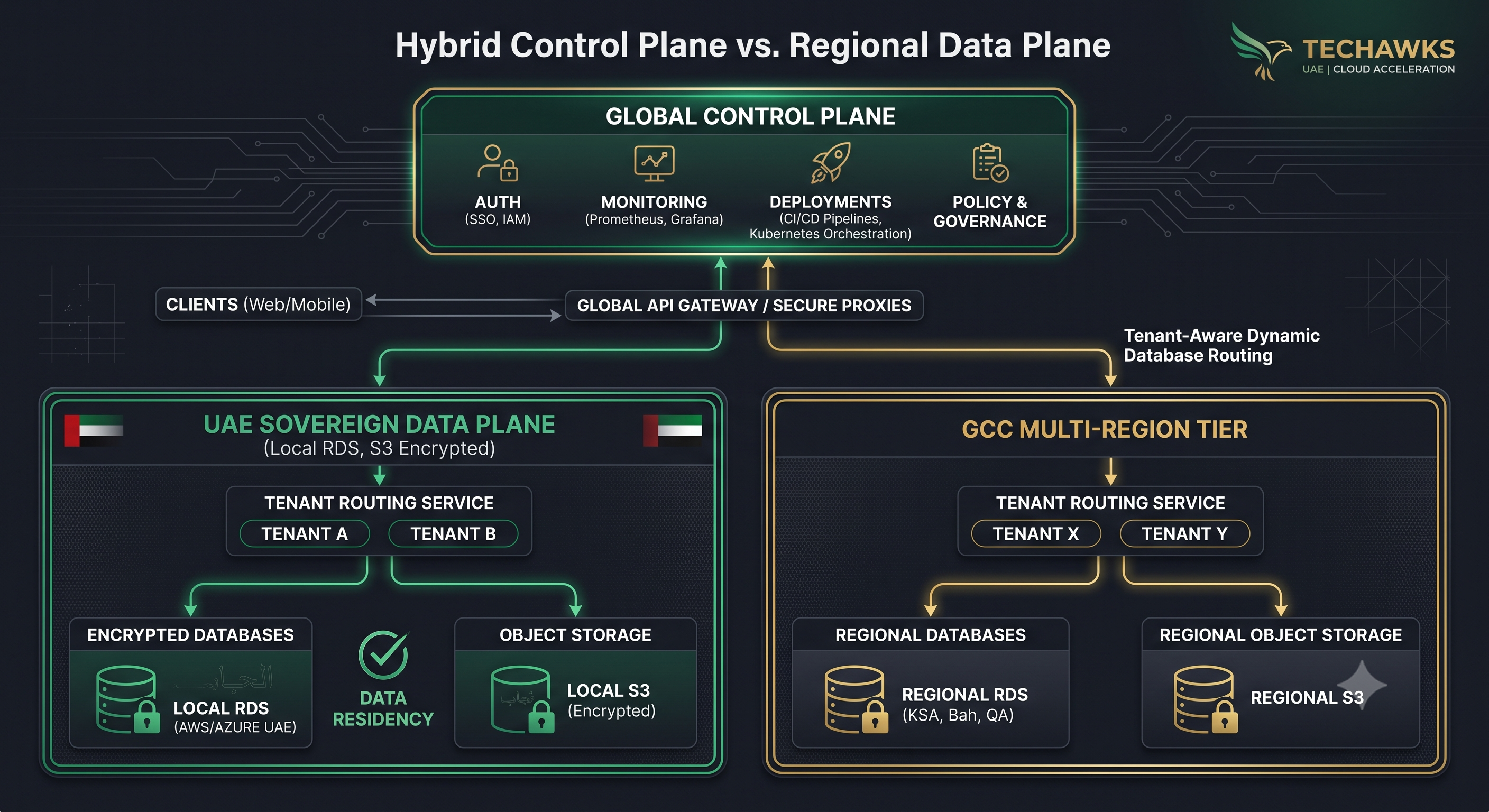
Adopt a Hybrid "Control Plane vs. Data Plane" Separation: Decouple your global operational services (authentication orchestration, billing aggregations, static asset delivery) from customer data storage. Run a centralized, global control plane while keeping the data plane (PII tables, transactional records, encrypted document stores) strictly containerized within local UAE cloud data centres or dedicated sovereign partitions.
Implement Dynamic Connection Routing at the Gateway: Avoid spinning up separate API gateways for each jurisdiction. Use tenant-aware middleware at the ingress layer. By evaluating the tenant's cryptographically verified JWT on entry, your API proxy routes the transaction request directly to the compliant regional database connection pool, keeping multi-tenant application logic shared while database storage remains strictly siloed.
Bake In Bi-Directional Arabic (RTL) Data Sanitization and Tokenization: Localization in the Gulf is not merely translating UI strings. Storing and indexing mixed RTL (Arabic) and LTR (English, phone numbers, alphanumeric IDs) text requires correct Unicode normalization (NFKC) and database collation settings (e.g., utf8mb4_unicode_ci) at the schema stage to prevent search index fragmentation, broken query matching, and corrupt data exports.
How is your engineering team solving the trade-off between strict local data isolation and manageable cloud infrastructure overhead?
Key Takeaways
Split Control vs. Data Planes: Centralize non-sensitive application orchestration; localize persistent user data inside domestic cloud zones.
Tenant-Aware Query Routing: Keep microservices unified while routing database reads/writes dynamically based on tenant residency rules.
Native RTL Schema Design: Enforce strict Unicode normalization and collation early to prevent downstream data pipeline corruption with Arabic text.
CTA (Join Techawks UAE)
Scaling resilient, compliant tech across the UAE and GCC requires battle-tested engineering playbooks. Join Techawks UAE to exchange insights with leading local CTOs, software engineers, and cloud architects building the region’s next digital powerhouses. Drop your thoughts in the comments below.
Building and scaling B2B or consumer platforms in the UAE means engineering for a unique intersection: world-class connectivity, high-value enterprise requirements, and stringent domestic data protection laws (such as UAE Federal Decree-Law No. 45/2021).
Many teams make the expensive mistake of spin-cloning their entire microservice stack into every local cloud region (like me-central-1 or me-south-1) for every enterprise customer. That approach obliterates operational margins and creates deployment gridlock.
Senior systems architects in the region manage data residency while maintaining high shipping velocity by implementing three core architectural strategies:
Adopt a Hybrid "Control Plane vs. Data Plane" Separation: Decouple your global operational services (authentication orchestration, billing aggregations, static asset delivery) from customer data storage. Run a centralized, global control plane while keeping the data plane (PII tables, transactional records, encrypted document stores) strictly containerized within local UAE cloud data centres or dedicated sovereign partitions.
Implement Dynamic Connection Routing at the Gateway: Avoid spinning up separate API gateways for each jurisdiction. Use tenant-aware middleware at the ingress layer. By evaluating the tenant's cryptographically verified JWT on entry, your API proxy routes the transaction request directly to the compliant regional database connection pool, keeping multi-tenant application logic shared while database storage remains strictly siloed.
Bake In Bi-Directional Arabic (RTL) Data Sanitization and Tokenization: Localization in the Gulf is not merely translating UI strings. Storing and indexing mixed RTL (Arabic) and LTR (English, phone numbers, alphanumeric IDs) text requires correct Unicode normalization (NFKC) and database collation settings (e.g., utf8mb4_unicode_ci) at the schema stage to prevent search index fragmentation, broken query matching, and corrupt data exports.
How is your engineering team solving the trade-off between strict local data isolation and manageable cloud infrastructure overhead?
Key Takeaways
Split Control vs. Data Planes: Centralize non-sensitive application orchestration; localize persistent user data inside domestic cloud zones.
Tenant-Aware Query Routing: Keep microservices unified while routing database reads/writes dynamically based on tenant residency rules.
Native RTL Schema Design: Enforce strict Unicode normalization and collation early to prevent downstream data pipeline corruption with Arabic text.
CTA (Join Techawks UAE)
Scaling resilient, compliant tech across the UAE and GCC requires battle-tested engineering playbooks. Join Techawks UAE to exchange insights with leading local CTOs, software engineers, and cloud architects building the region’s next digital powerhouses. Drop your thoughts in the comments below.
The Multi-Tenant Middle East Playbook: Designing for GCC Data Residency Without Quadrupling Infrastructure Costs
Building and scaling B2B or consumer platforms in the UAE means engineering for a unique intersection: world-class connectivity, high-value enterprise requirements, and stringent domestic data protection laws (such as UAE Federal Decree-Law No. 45/2021).
Many teams make the expensive mistake of spin-cloning their entire microservice stack into every local cloud region (like me-central-1 or me-south-1) for every enterprise customer. That approach obliterates operational margins and creates deployment gridlock.
Senior systems architects in the region manage data residency while maintaining high shipping velocity by implementing three core architectural strategies:
Adopt a Hybrid "Control Plane vs. Data Plane" Separation: Decouple your global operational services (authentication orchestration, billing aggregations, static asset delivery) from customer data storage. Run a centralized, global control plane while keeping the data plane (PII tables, transactional records, encrypted document stores) strictly containerized within local UAE cloud data centres or dedicated sovereign partitions.
Implement Dynamic Connection Routing at the Gateway: Avoid spinning up separate API gateways for each jurisdiction. Use tenant-aware middleware at the ingress layer. By evaluating the tenant's cryptographically verified JWT on entry, your API proxy routes the transaction request directly to the compliant regional database connection pool, keeping multi-tenant application logic shared while database storage remains strictly siloed.
Bake In Bi-Directional Arabic (RTL) Data Sanitization and Tokenization: Localization in the Gulf is not merely translating UI strings. Storing and indexing mixed RTL (Arabic) and LTR (English, phone numbers, alphanumeric IDs) text requires correct Unicode normalization (NFKC) and database collation settings (e.g., utf8mb4_unicode_ci) at the schema stage to prevent search index fragmentation, broken query matching, and corrupt data exports.
How is your engineering team solving the trade-off between strict local data isolation and manageable cloud infrastructure overhead?
Key Takeaways
Split Control vs. Data Planes: Centralize non-sensitive application orchestration; localize persistent user data inside domestic cloud zones.
Tenant-Aware Query Routing: Keep microservices unified while routing database reads/writes dynamically based on tenant residency rules.
Native RTL Schema Design: Enforce strict Unicode normalization and collation early to prevent downstream data pipeline corruption with Arabic text.
CTA (Join Techawks UAE)
Scaling resilient, compliant tech across the UAE and GCC requires battle-tested engineering playbooks. Join Techawks UAE to exchange insights with leading local CTOs, software engineers, and cloud architects building the region’s next digital powerhouses. Drop your thoughts in the comments below.

 English
 Arabic
 French
 Spanish
 Portuguese
 Deutsch
 Turkish
 Dutch
Dutch
 Italiano
 Russian
 Romaian
 Portuguese (Brazil)