


The Over-Engineered Cluster: Why Kubernetes Isn't the Default for Every Workload
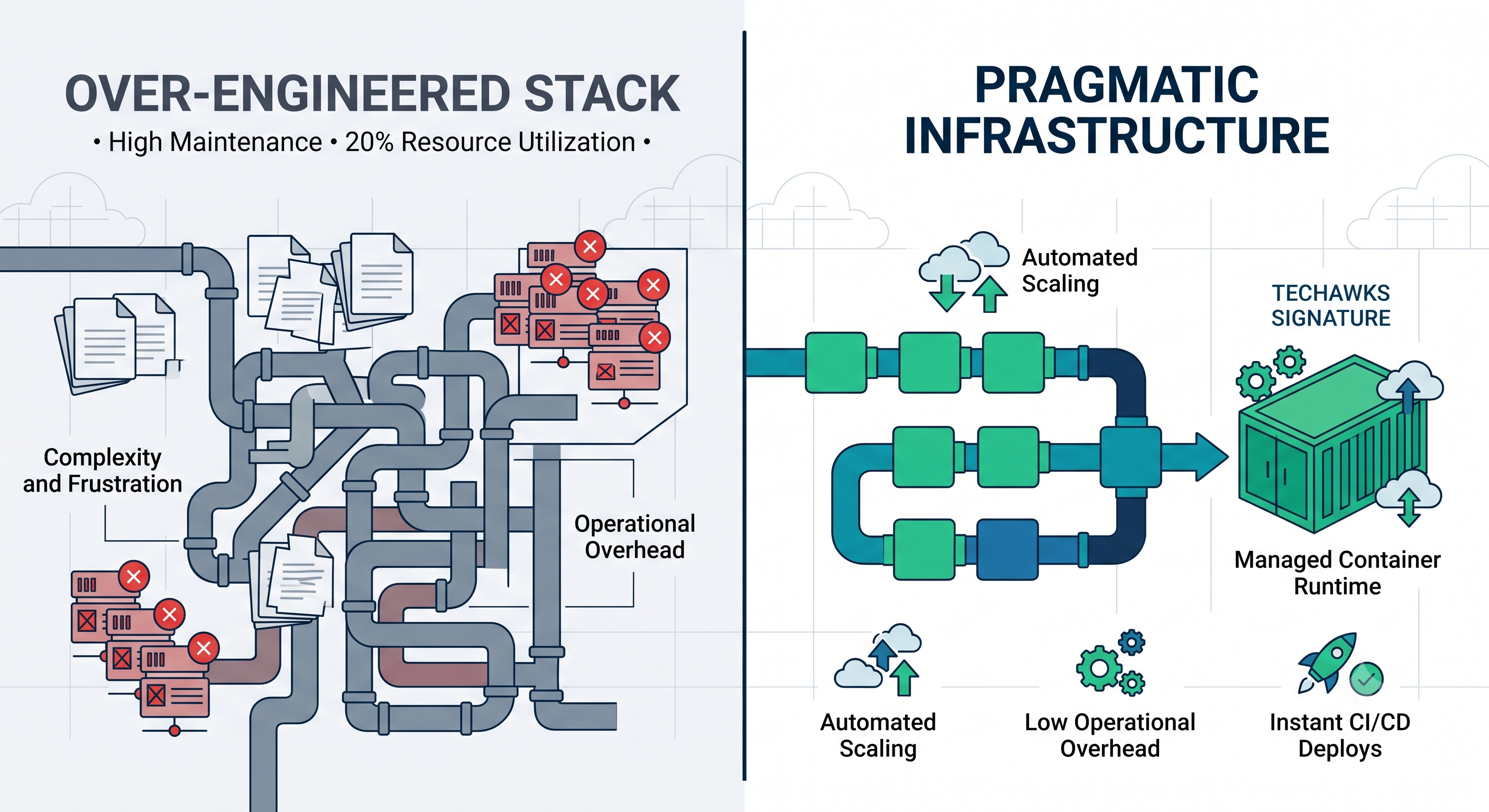
The cloud ecosystem often pushes teams toward complex orchestration long before they reach the scale that justifies it. Infrastructure should solve tangible operational bottlenecks, not serve as a resume-padding exercise.
Reliable, scalable cloud engineering hinges on matching architectural complexity to team capacity:
The Hidden Tax of Control Plane Maintenance: Kubernetes provides incredible declarative control, but it demands constant operational maintenance—ingress controllers, service meshes, cluster upgrades, sidecars, and stateful volume orchestration. If your team spends more time debugging YAML and control planes than deploying business logic, your tooling is working against you.
Boring Architecture Scales Farther Than You Think: Managed container platforms (like AWS ECS, Cloud Run, or Azure Container Apps) and simple PaaS environments handle auto-scaling, blue-green deployments, and health checks out of the box. Teams frequently reach millions of requests per day on simpler infrastructure before ever needing raw orchestration primitives.
Observability Before Orchestration: Splitting monoliths into microservices without mature tracing, centralized logging, and clear network boundaries turns standard debugging sessions into multi-day incident hunts. If you cannot trace a single transaction across services reliably, adding more distributed layers will only amplify downtime.
Scale the architecture to the problem, not to the industry hype.
Key Takeaways
Complexity Is a Cost: Every added orchestration layer increases cognitive overhead, maintenance hours, and potential failure modes.
Lean on Managed Primitives: Standard container-as-a-service offerings solve 90% of autoscaling and deployment needs without manual cluster overhead.
Earn Your Architecture: Introduce distributed systems and microservices only when traffic, domain boundaries, or organizational team size strictly demand it.
CTA
Let’s talk operational reality vs. architecture diagrams:
What was a time your team chose a simpler infrastructure stack and it ended up outperforming a complex setup?
Alternatively, what was the exact inflection point or incident that made migrating to full container orchestration genuinely necessary for your systems? Share your deployment experiences and architecture wins below.
The cloud ecosystem often pushes teams toward complex orchestration long before they reach the scale that justifies it. Infrastructure should solve tangible operational bottlenecks, not serve as a resume-padding exercise.
Reliable, scalable cloud engineering hinges on matching architectural complexity to team capacity:
The Hidden Tax of Control Plane Maintenance: Kubernetes provides incredible declarative control, but it demands constant operational maintenance—ingress controllers, service meshes, cluster upgrades, sidecars, and stateful volume orchestration. If your team spends more time debugging YAML and control planes than deploying business logic, your tooling is working against you.
Boring Architecture Scales Farther Than You Think: Managed container platforms (like AWS ECS, Cloud Run, or Azure Container Apps) and simple PaaS environments handle auto-scaling, blue-green deployments, and health checks out of the box. Teams frequently reach millions of requests per day on simpler infrastructure before ever needing raw orchestration primitives.
Observability Before Orchestration: Splitting monoliths into microservices without mature tracing, centralized logging, and clear network boundaries turns standard debugging sessions into multi-day incident hunts. If you cannot trace a single transaction across services reliably, adding more distributed layers will only amplify downtime.
Scale the architecture to the problem, not to the industry hype.
Key Takeaways
Complexity Is a Cost: Every added orchestration layer increases cognitive overhead, maintenance hours, and potential failure modes.
Lean on Managed Primitives: Standard container-as-a-service offerings solve 90% of autoscaling and deployment needs without manual cluster overhead.
Earn Your Architecture: Introduce distributed systems and microservices only when traffic, domain boundaries, or organizational team size strictly demand it.
CTA
Let’s talk operational reality vs. architecture diagrams:
What was a time your team chose a simpler infrastructure stack and it ended up outperforming a complex setup?
Alternatively, what was the exact inflection point or incident that made migrating to full container orchestration genuinely necessary for your systems? Share your deployment experiences and architecture wins below.
The Over-Engineered Cluster: Why Kubernetes Isn't the Default for Every Workload
The cloud ecosystem often pushes teams toward complex orchestration long before they reach the scale that justifies it. Infrastructure should solve tangible operational bottlenecks, not serve as a resume-padding exercise.
Reliable, scalable cloud engineering hinges on matching architectural complexity to team capacity:
The Hidden Tax of Control Plane Maintenance: Kubernetes provides incredible declarative control, but it demands constant operational maintenance—ingress controllers, service meshes, cluster upgrades, sidecars, and stateful volume orchestration. If your team spends more time debugging YAML and control planes than deploying business logic, your tooling is working against you.
Boring Architecture Scales Farther Than You Think: Managed container platforms (like AWS ECS, Cloud Run, or Azure Container Apps) and simple PaaS environments handle auto-scaling, blue-green deployments, and health checks out of the box. Teams frequently reach millions of requests per day on simpler infrastructure before ever needing raw orchestration primitives.
Observability Before Orchestration: Splitting monoliths into microservices without mature tracing, centralized logging, and clear network boundaries turns standard debugging sessions into multi-day incident hunts. If you cannot trace a single transaction across services reliably, adding more distributed layers will only amplify downtime.
Scale the architecture to the problem, not to the industry hype.
Key Takeaways
Complexity Is a Cost: Every added orchestration layer increases cognitive overhead, maintenance hours, and potential failure modes.
Lean on Managed Primitives: Standard container-as-a-service offerings solve 90% of autoscaling and deployment needs without manual cluster overhead.
Earn Your Architecture: Introduce distributed systems and microservices only when traffic, domain boundaries, or organizational team size strictly demand it.
CTA
Let’s talk operational reality vs. architecture diagrams:
What was a time your team chose a simpler infrastructure stack and it ended up outperforming a complex setup?
Alternatively, what was the exact inflection point or incident that made migrating to full container orchestration genuinely necessary for your systems? Share your deployment experiences and architecture wins below.

 English
 Arabic
 French
 Spanish
 Portuguese
 Deutsch
 Turkish
 Dutch
Dutch
 Italiano
 Russian
 Portuguese (Brazil)
 Greek
Greek