


Architecting for India’s DPDP Era: Why Your Database Schema Needs a "Purpose ID"
With transitional compliance timelines approaching operational enforcement, Indian startups and tech enterprises are moving past simple cookie banners and generic privacy policy updates. The core tenet of the DPDP framework centers on Purpose Limitation and verifiable Consent Revocation.
If a user revokes marketing consent while keeping transactional consent active, can your backend delete their engagement logs without breaking their order history?
For 90% of legacy schemas, the answer is no. Here is how engineering teams are re-architecting their data layer:
Tag Data at Ingestion, Not Audit
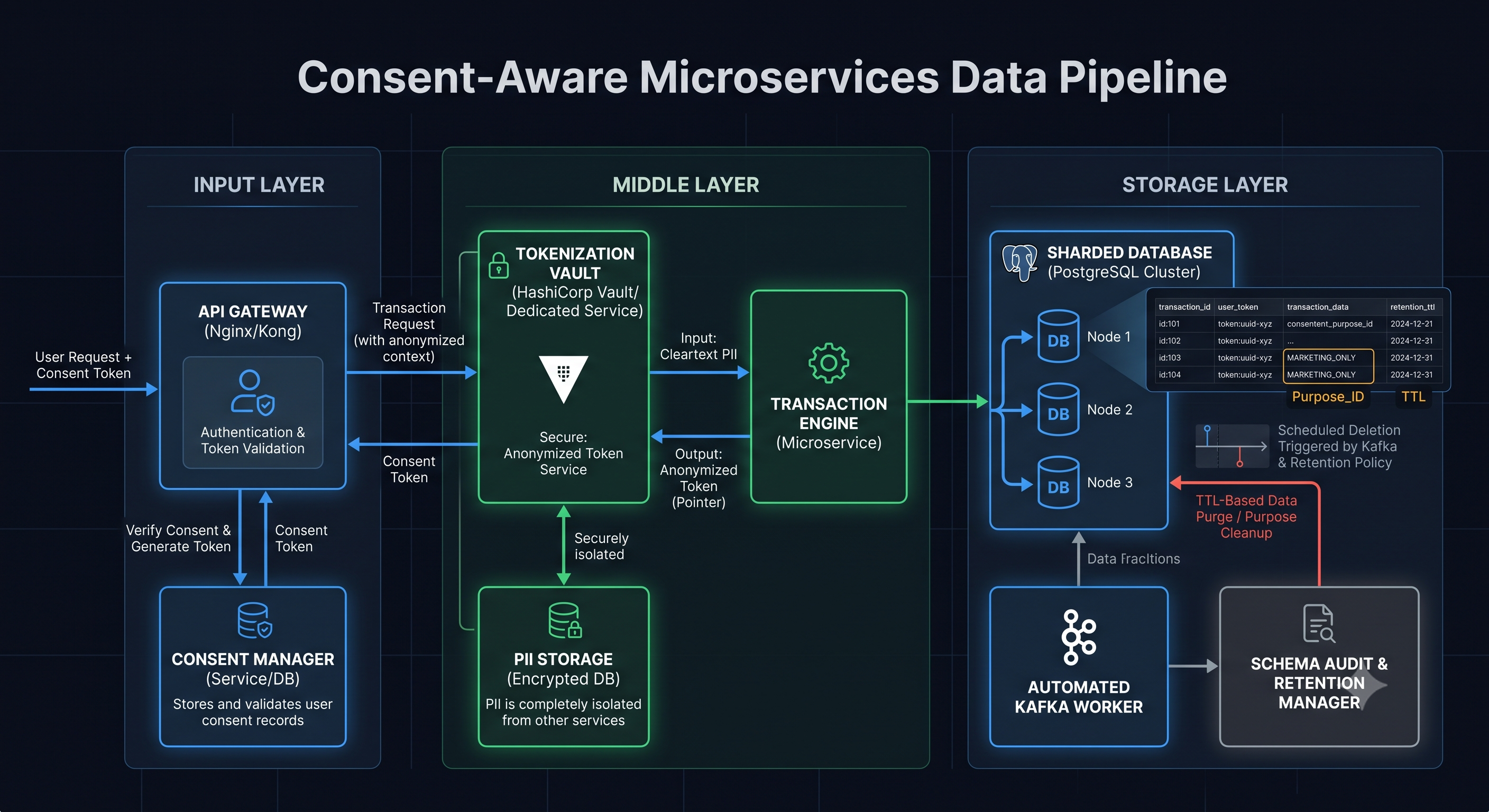
Never dump unstructured payload blobs into shared stores. Every write operation containing Personal Identifiable Information (PII) must carry metadata:
consent_id (pointing to an immutable consent event log)
purpose_scope (e.g., AUTH, BILLING, MARKETING_PROFILING)
retention_ttl (epoch timestamp for hard deletion)
Decouple Identity from Operational State
Adopt Pseudonymisation by Design. Store core identity attributes in an isolated, encrypted token vault. Let production services process anonymised surrogate IDs (UUIDs). Revoking or purging user data becomes an isolated operation on the vault key rather than a risky cascade across 40 microservices.
Event-Driven Revocation Pipelines
Consent changes cannot rely on scheduled batch jobs. When a consent withdrawal event fires:
Publish a ConsentRevokedEvent via your message broker (Kafka/RabbitMQ).
Subscribed services purge or mask associated non-essential data partitions in real time to prevent leakage into downstream analytics or ML training sets.
Privacy is no longer boilerplate legal text; it is an infrastructure constraint. Building these controls now prevents high refactoring costs and significant non-compliance penalties once audits begin.
Discussion Question
Has your team started auditing database schemas for consent-linked deletion, or is privacy handling still trapped inside legal spreadsheets?
CTA
Want actionable, no-fluff technical playbooks built for the Indian tech ecosystem? Follow and join Techawks India for deep dives into engineering architecture, cloud infrastructure, and emerging tech policy.
With transitional compliance timelines approaching operational enforcement, Indian startups and tech enterprises are moving past simple cookie banners and generic privacy policy updates. The core tenet of the DPDP framework centers on Purpose Limitation and verifiable Consent Revocation.
If a user revokes marketing consent while keeping transactional consent active, can your backend delete their engagement logs without breaking their order history?
For 90% of legacy schemas, the answer is no. Here is how engineering teams are re-architecting their data layer:
Tag Data at Ingestion, Not Audit
Never dump unstructured payload blobs into shared stores. Every write operation containing Personal Identifiable Information (PII) must carry metadata:
consent_id (pointing to an immutable consent event log)
purpose_scope (e.g., AUTH, BILLING, MARKETING_PROFILING)
retention_ttl (epoch timestamp for hard deletion)
Decouple Identity from Operational State
Adopt Pseudonymisation by Design. Store core identity attributes in an isolated, encrypted token vault. Let production services process anonymised surrogate IDs (UUIDs). Revoking or purging user data becomes an isolated operation on the vault key rather than a risky cascade across 40 microservices.
Event-Driven Revocation Pipelines
Consent changes cannot rely on scheduled batch jobs. When a consent withdrawal event fires:
Publish a ConsentRevokedEvent via your message broker (Kafka/RabbitMQ).
Subscribed services purge or mask associated non-essential data partitions in real time to prevent leakage into downstream analytics or ML training sets.
Privacy is no longer boilerplate legal text; it is an infrastructure constraint. Building these controls now prevents high refactoring costs and significant non-compliance penalties once audits begin.
Discussion Question
Has your team started auditing database schemas for consent-linked deletion, or is privacy handling still trapped inside legal spreadsheets?
CTA
Want actionable, no-fluff technical playbooks built for the Indian tech ecosystem? Follow and join Techawks India for deep dives into engineering architecture, cloud infrastructure, and emerging tech policy.
Architecting for India’s DPDP Era: Why Your Database Schema Needs a "Purpose ID"
With transitional compliance timelines approaching operational enforcement, Indian startups and tech enterprises are moving past simple cookie banners and generic privacy policy updates. The core tenet of the DPDP framework centers on Purpose Limitation and verifiable Consent Revocation.
If a user revokes marketing consent while keeping transactional consent active, can your backend delete their engagement logs without breaking their order history?
For 90% of legacy schemas, the answer is no. Here is how engineering teams are re-architecting their data layer:
Tag Data at Ingestion, Not Audit
Never dump unstructured payload blobs into shared stores. Every write operation containing Personal Identifiable Information (PII) must carry metadata:
consent_id (pointing to an immutable consent event log)
purpose_scope (e.g., AUTH, BILLING, MARKETING_PROFILING)
retention_ttl (epoch timestamp for hard deletion)
Decouple Identity from Operational State
Adopt Pseudonymisation by Design. Store core identity attributes in an isolated, encrypted token vault. Let production services process anonymised surrogate IDs (UUIDs). Revoking or purging user data becomes an isolated operation on the vault key rather than a risky cascade across 40 microservices.
Event-Driven Revocation Pipelines
Consent changes cannot rely on scheduled batch jobs. When a consent withdrawal event fires:
Publish a ConsentRevokedEvent via your message broker (Kafka/RabbitMQ).
Subscribed services purge or mask associated non-essential data partitions in real time to prevent leakage into downstream analytics or ML training sets.
Privacy is no longer boilerplate legal text; it is an infrastructure constraint. Building these controls now prevents high refactoring costs and significant non-compliance penalties once audits begin.
Discussion Question
Has your team started auditing database schemas for consent-linked deletion, or is privacy handling still trapped inside legal spreadsheets?
CTA
Want actionable, no-fluff technical playbooks built for the Indian tech ecosystem? Follow and join Techawks India for deep dives into engineering architecture, cloud infrastructure, and emerging tech policy.

 Arabic
 French
 Spanish
 Portuguese
 Deutsch
 Turkish
 Dutch
Dutch
 Italiano
 Russian
 Romaian
 Portuguese (Brazil)
 Greek
Greek