


Post-Quantum Cryptography in Production: Why Your TLS Stack Needs a Packet Size Audit
With NIST finalizing FIPS 203 (ML-KEM) for key exchange and FIPS 204 (ML-DSA) for digital signatures, engineering teams across enterprise cloud, defense tech, and fintech are moving from cryptographic discovery into operational rollout. The central engineering challenge is not the underlying lattice mathematics—it is the physical footprint of the keys.
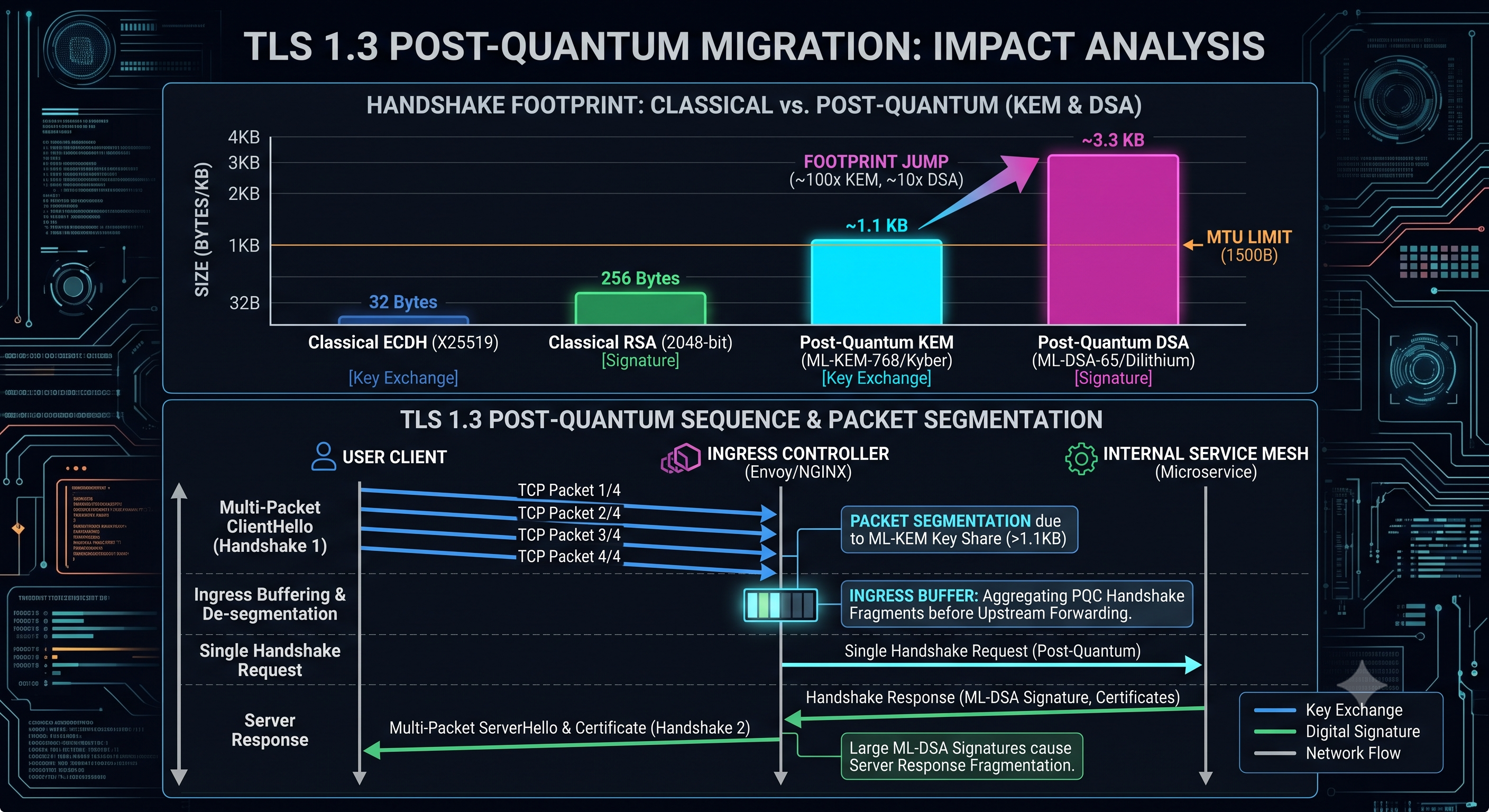
Classic elliptic-curve keys (X25519) require just 32 bytes for a public key and 32 bytes for a shared secret. Under ML-KEM-768, public keys balloon to 1,184 bytes, and ciphertexts reach 1,088 bytes. When combined with ML-DSA signatures (which exceed 2.4 KB to 3.3 KB), TLS handshakes routinely break single-packet Maximum Transmission Unit (MTU) boundaries.
If an ingress gateway, middlebox, or legacy load balancer is not tuned for multi-packet ClientHello and Certificate payloads, latency spikes or silent TCP connection drops will occur. Here is how systems architects are addressing crypto-agility in production:
Deploy Hybrid Key Exchange (X25519 + ML-KEM-768)
Do not jump straight to pure post-quantum handshakes. Standardize on hybrid key encapsulation mechanisms (KEMs) within your TLS 1.3 edge termination layer. This preserves existing FIPS/FedRAMP compliance baselines while defending against "harvest now, decrypt later" adversary campaigns targeting long-lived secrets.
Mitigate TCP Handshake Fragmentation
Because ML-KEM handshakes exceed standard 1,500-byte Ethernet MTUs, the initial TLS flight requires fragmentation over multiple packets:
Audit your ingress controllers (Envoy, NGINX, or Cloudflare edge endpoints) to ensure TCP window sizes accommodate early multi-packet bursts.
Enforce TCP Fast Open (TFO) and evaluate QUIC/HTTP/3, where loss recovery and flow control handle out-of-order handshake packets more gracefully than legacy middleboxes.
Separate Signature Lifecycles from Ephemeral KEMs
Focus KEM migration on dynamic transport traffic today (to prevent retrospective eavesdropping), but isolate signature algorithm upgrades (FIPS 204 / ML-DSA) to internal code signing and certificate authorities first. Upgrading edge leaf certificates before verifying intermediate CA chain compatibility risks breaking external client connections across unmanaged devices.
Crypto-agility is an infrastructure performance benchmark. Teams that build transport-layer headroom and modular cryptographic libraries today will avoid emergency rewrites as federal timelines and browser enforcement tighten.
With NIST finalizing FIPS 203 (ML-KEM) for key exchange and FIPS 204 (ML-DSA) for digital signatures, engineering teams across enterprise cloud, defense tech, and fintech are moving from cryptographic discovery into operational rollout. The central engineering challenge is not the underlying lattice mathematics—it is the physical footprint of the keys.
Classic elliptic-curve keys (X25519) require just 32 bytes for a public key and 32 bytes for a shared secret. Under ML-KEM-768, public keys balloon to 1,184 bytes, and ciphertexts reach 1,088 bytes. When combined with ML-DSA signatures (which exceed 2.4 KB to 3.3 KB), TLS handshakes routinely break single-packet Maximum Transmission Unit (MTU) boundaries.
If an ingress gateway, middlebox, or legacy load balancer is not tuned for multi-packet ClientHello and Certificate payloads, latency spikes or silent TCP connection drops will occur. Here is how systems architects are addressing crypto-agility in production:
Deploy Hybrid Key Exchange (X25519 + ML-KEM-768)
Do not jump straight to pure post-quantum handshakes. Standardize on hybrid key encapsulation mechanisms (KEMs) within your TLS 1.3 edge termination layer. This preserves existing FIPS/FedRAMP compliance baselines while defending against "harvest now, decrypt later" adversary campaigns targeting long-lived secrets.
Mitigate TCP Handshake Fragmentation
Because ML-KEM handshakes exceed standard 1,500-byte Ethernet MTUs, the initial TLS flight requires fragmentation over multiple packets:
Audit your ingress controllers (Envoy, NGINX, or Cloudflare edge endpoints) to ensure TCP window sizes accommodate early multi-packet bursts.
Enforce TCP Fast Open (TFO) and evaluate QUIC/HTTP/3, where loss recovery and flow control handle out-of-order handshake packets more gracefully than legacy middleboxes.
Separate Signature Lifecycles from Ephemeral KEMs
Focus KEM migration on dynamic transport traffic today (to prevent retrospective eavesdropping), but isolate signature algorithm upgrades (FIPS 204 / ML-DSA) to internal code signing and certificate authorities first. Upgrading edge leaf certificates before verifying intermediate CA chain compatibility risks breaking external client connections across unmanaged devices.
Crypto-agility is an infrastructure performance benchmark. Teams that build transport-layer headroom and modular cryptographic libraries today will avoid emergency rewrites as federal timelines and browser enforcement tighten.
Post-Quantum Cryptography in Production: Why Your TLS Stack Needs a Packet Size Audit
With NIST finalizing FIPS 203 (ML-KEM) for key exchange and FIPS 204 (ML-DSA) for digital signatures, engineering teams across enterprise cloud, defense tech, and fintech are moving from cryptographic discovery into operational rollout. The central engineering challenge is not the underlying lattice mathematics—it is the physical footprint of the keys.
Classic elliptic-curve keys (X25519) require just 32 bytes for a public key and 32 bytes for a shared secret. Under ML-KEM-768, public keys balloon to 1,184 bytes, and ciphertexts reach 1,088 bytes. When combined with ML-DSA signatures (which exceed 2.4 KB to 3.3 KB), TLS handshakes routinely break single-packet Maximum Transmission Unit (MTU) boundaries.
If an ingress gateway, middlebox, or legacy load balancer is not tuned for multi-packet ClientHello and Certificate payloads, latency spikes or silent TCP connection drops will occur. Here is how systems architects are addressing crypto-agility in production:
Deploy Hybrid Key Exchange (X25519 + ML-KEM-768)
Do not jump straight to pure post-quantum handshakes. Standardize on hybrid key encapsulation mechanisms (KEMs) within your TLS 1.3 edge termination layer. This preserves existing FIPS/FedRAMP compliance baselines while defending against "harvest now, decrypt later" adversary campaigns targeting long-lived secrets.
Mitigate TCP Handshake Fragmentation
Because ML-KEM handshakes exceed standard 1,500-byte Ethernet MTUs, the initial TLS flight requires fragmentation over multiple packets:
Audit your ingress controllers (Envoy, NGINX, or Cloudflare edge endpoints) to ensure TCP window sizes accommodate early multi-packet bursts.
Enforce TCP Fast Open (TFO) and evaluate QUIC/HTTP/3, where loss recovery and flow control handle out-of-order handshake packets more gracefully than legacy middleboxes.
Separate Signature Lifecycles from Ephemeral KEMs
Focus KEM migration on dynamic transport traffic today (to prevent retrospective eavesdropping), but isolate signature algorithm upgrades (FIPS 204 / ML-DSA) to internal code signing and certificate authorities first. Upgrading edge leaf certificates before verifying intermediate CA chain compatibility risks breaking external client connections across unmanaged devices.
Crypto-agility is an infrastructure performance benchmark. Teams that build transport-layer headroom and modular cryptographic libraries today will avoid emergency rewrites as federal timelines and browser enforcement tighten.

 Arabic
 French
 Spanish
 Portuguese
 Deutsch
 Turkish
 Dutch
Dutch
 Italiano
 Russian
 Romaian
 Portuguese (Brazil)
 Greek
Greek