


Designing for the UK’s Statutory AI Code: Why Your LLM Pipelines Need Deterministic Audit Logs
While the EU relies on centralized statutory classifications, the UK’s multi-regulator model (ICO, CMA, FCA, and Ofcom via the DRCF) places accountability directly on production behavior. Regulators are zeroing in on non-deterministic AI decisions, agentic transaction execution, and unverified data feeding into model fine-tuning.
If a user or auditor asks why your agentic workflow triggered an automated financial transaction or processed a sensitive decision, relying on "the model hallucinated" is a direct regulatory liability.
Here is how UK engineering teams are adapting their production AI pipelines to build defensible auditability:
Implement Deterministic Replay Logs
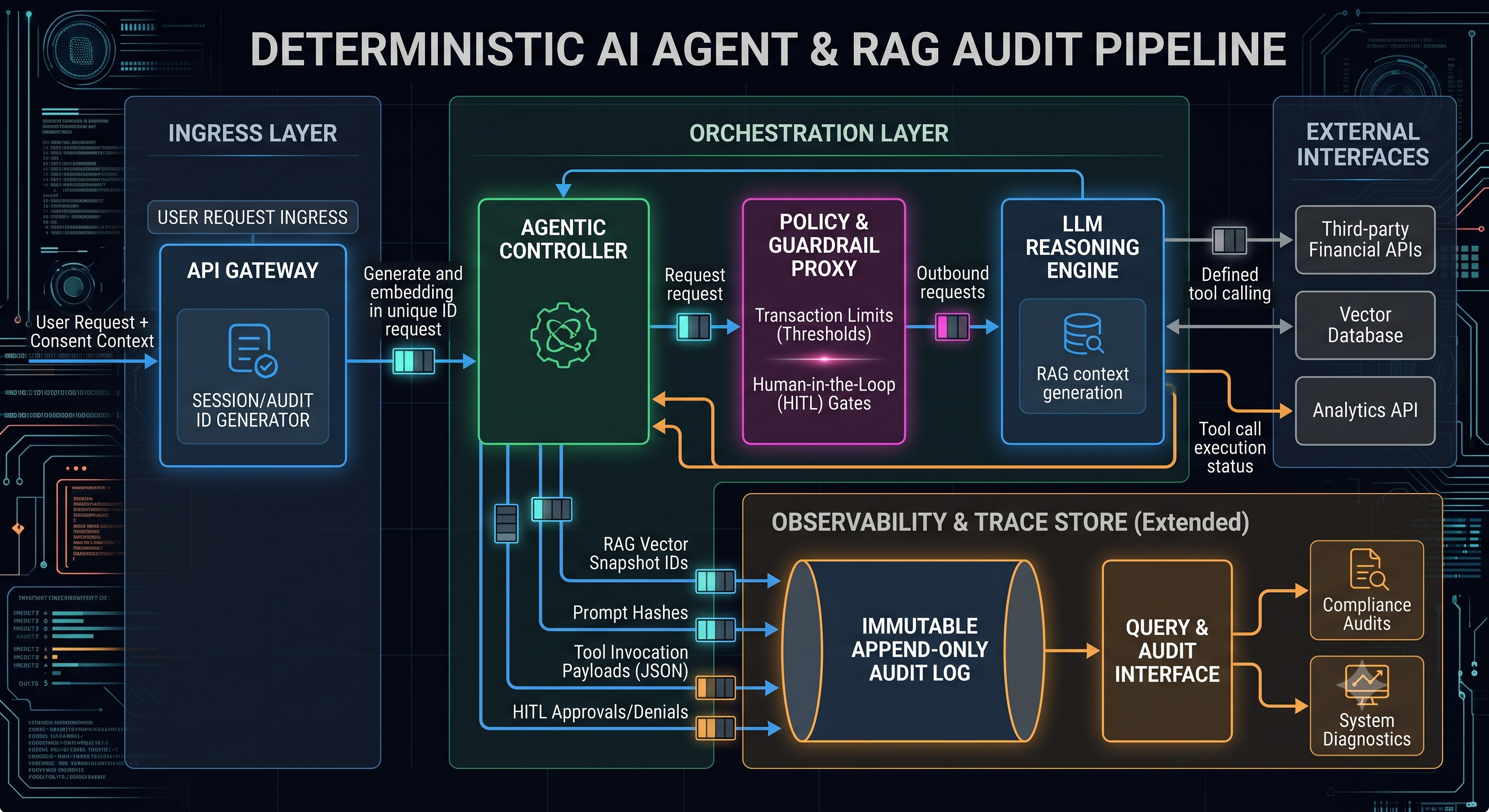
Never treat LLM API calls as ephemeral HTTP requests. For every model interaction that influences user outcomes, capture an immutable evaluation snapshot:
input_prompt_hash & retrieval_chunk_ids (exact RAG vectors passed in context)
model_checkpoint_digest & hyperparameters (temperature, top_p, system instructions)
tool_call_manifest (exact payload schema passed to downstream functions before execution)
Decouple Agent Decisions from Execution Gates
To comply with emerging consumer protection directives for autonomous agents, eliminate unbounded autonomous actions:
Introduce an idempotent policy enforcement proxy between the agent's function-calling engine and write APIs.
Enforce hard thresholds (e.g., transactional caps, scope boundaries, require human-in-the-loop sign-off on anomalous state transitions).
Treat Vendor SaaS AI as Tier-1 Dependencies
UK privacy guidance scrutinizes silent data exposure in third-party integrations. If your stack integrates external reasoning APIs or managed vector stores, enforce egress filtering proxies to strip or pseudonymise PII before external ingestion, logging cryptographic verification of sanitisation at the edge.
Auditability is becoming an essential system design constraint. Structuring deterministic traces and enforcement boundaries today protects your platform from costly operational retrofits as UK sector enforcement intensifies.
Discussion Question
Are your production AI agents logged deterministically for retrospective audits, or is your agentic observability still limited to standard application latency metrics?
CTA
Looking for actionable engineering frameworks, systems architecture teardowns, and tech governance insight tailored to the UK tech landscape? Join Techawks UK to connect with technical architects, engineering leads, and systems builders.
While the EU relies on centralized statutory classifications, the UK’s multi-regulator model (ICO, CMA, FCA, and Ofcom via the DRCF) places accountability directly on production behavior. Regulators are zeroing in on non-deterministic AI decisions, agentic transaction execution, and unverified data feeding into model fine-tuning.
If a user or auditor asks why your agentic workflow triggered an automated financial transaction or processed a sensitive decision, relying on "the model hallucinated" is a direct regulatory liability.
Here is how UK engineering teams are adapting their production AI pipelines to build defensible auditability:
Implement Deterministic Replay Logs
Never treat LLM API calls as ephemeral HTTP requests. For every model interaction that influences user outcomes, capture an immutable evaluation snapshot:
input_prompt_hash & retrieval_chunk_ids (exact RAG vectors passed in context)
model_checkpoint_digest & hyperparameters (temperature, top_p, system instructions)
tool_call_manifest (exact payload schema passed to downstream functions before execution)
Decouple Agent Decisions from Execution Gates
To comply with emerging consumer protection directives for autonomous agents, eliminate unbounded autonomous actions:
Introduce an idempotent policy enforcement proxy between the agent's function-calling engine and write APIs.
Enforce hard thresholds (e.g., transactional caps, scope boundaries, require human-in-the-loop sign-off on anomalous state transitions).
Treat Vendor SaaS AI as Tier-1 Dependencies
UK privacy guidance scrutinizes silent data exposure in third-party integrations. If your stack integrates external reasoning APIs or managed vector stores, enforce egress filtering proxies to strip or pseudonymise PII before external ingestion, logging cryptographic verification of sanitisation at the edge.
Auditability is becoming an essential system design constraint. Structuring deterministic traces and enforcement boundaries today protects your platform from costly operational retrofits as UK sector enforcement intensifies.
Discussion Question
Are your production AI agents logged deterministically for retrospective audits, or is your agentic observability still limited to standard application latency metrics?
CTA
Looking for actionable engineering frameworks, systems architecture teardowns, and tech governance insight tailored to the UK tech landscape? Join Techawks UK to connect with technical architects, engineering leads, and systems builders.
Designing for the UK’s Statutory AI Code: Why Your LLM Pipelines Need Deterministic Audit Logs
While the EU relies on centralized statutory classifications, the UK’s multi-regulator model (ICO, CMA, FCA, and Ofcom via the DRCF) places accountability directly on production behavior. Regulators are zeroing in on non-deterministic AI decisions, agentic transaction execution, and unverified data feeding into model fine-tuning.
If a user or auditor asks why your agentic workflow triggered an automated financial transaction or processed a sensitive decision, relying on "the model hallucinated" is a direct regulatory liability.
Here is how UK engineering teams are adapting their production AI pipelines to build defensible auditability:
Implement Deterministic Replay Logs
Never treat LLM API calls as ephemeral HTTP requests. For every model interaction that influences user outcomes, capture an immutable evaluation snapshot:
input_prompt_hash & retrieval_chunk_ids (exact RAG vectors passed in context)
model_checkpoint_digest & hyperparameters (temperature, top_p, system instructions)
tool_call_manifest (exact payload schema passed to downstream functions before execution)
Decouple Agent Decisions from Execution Gates
To comply with emerging consumer protection directives for autonomous agents, eliminate unbounded autonomous actions:
Introduce an idempotent policy enforcement proxy between the agent's function-calling engine and write APIs.
Enforce hard thresholds (e.g., transactional caps, scope boundaries, require human-in-the-loop sign-off on anomalous state transitions).
Treat Vendor SaaS AI as Tier-1 Dependencies
UK privacy guidance scrutinizes silent data exposure in third-party integrations. If your stack integrates external reasoning APIs or managed vector stores, enforce egress filtering proxies to strip or pseudonymise PII before external ingestion, logging cryptographic verification of sanitisation at the edge.
Auditability is becoming an essential system design constraint. Structuring deterministic traces and enforcement boundaries today protects your platform from costly operational retrofits as UK sector enforcement intensifies.
Discussion Question
Are your production AI agents logged deterministically for retrospective audits, or is your agentic observability still limited to standard application latency metrics?
CTA
Looking for actionable engineering frameworks, systems architecture teardowns, and tech governance insight tailored to the UK tech landscape? Join Techawks UK to connect with technical architects, engineering leads, and systems builders.

 English
 Arabic
 French
 Spanish
 Portuguese
 Turkish
 Dutch
Dutch
 Italiano
 Russian
 Romaian
 Portuguese (Brazil)
 Greek
Greek