


Cross-Border RAG Pipelines in Canada: Why Your Architecture Needs Provincial Boundary Routing
Canadian engineering stacks are navigating a dual reality: scaling AI features while managing the strict operational boundaries between federal PIPEDA and provincial frameworks—most notably Quebec’s Law 25. Under these provisions, sending personal data outside the province or country for automated processing requires a documented Privacy Impact Assessment (PIA), explicit necessity thresholds, and adequate protection equivalency.
If your RAG (Retrieval-Augmented Generation) pipeline sends raw customer support records, banking context, or telemetry across the border to multi-tenant US LLM endpoints without deterministic masking, your system breaches statutory transfer conditions.
Here is how Canadian infrastructure and data teams are structuring compliant, low-latency AI pipelines:
Provincial Ingress & Anonymization at the Edge
Never route un-sanitized user payloads straight to vector databases or foundational model endpoints.
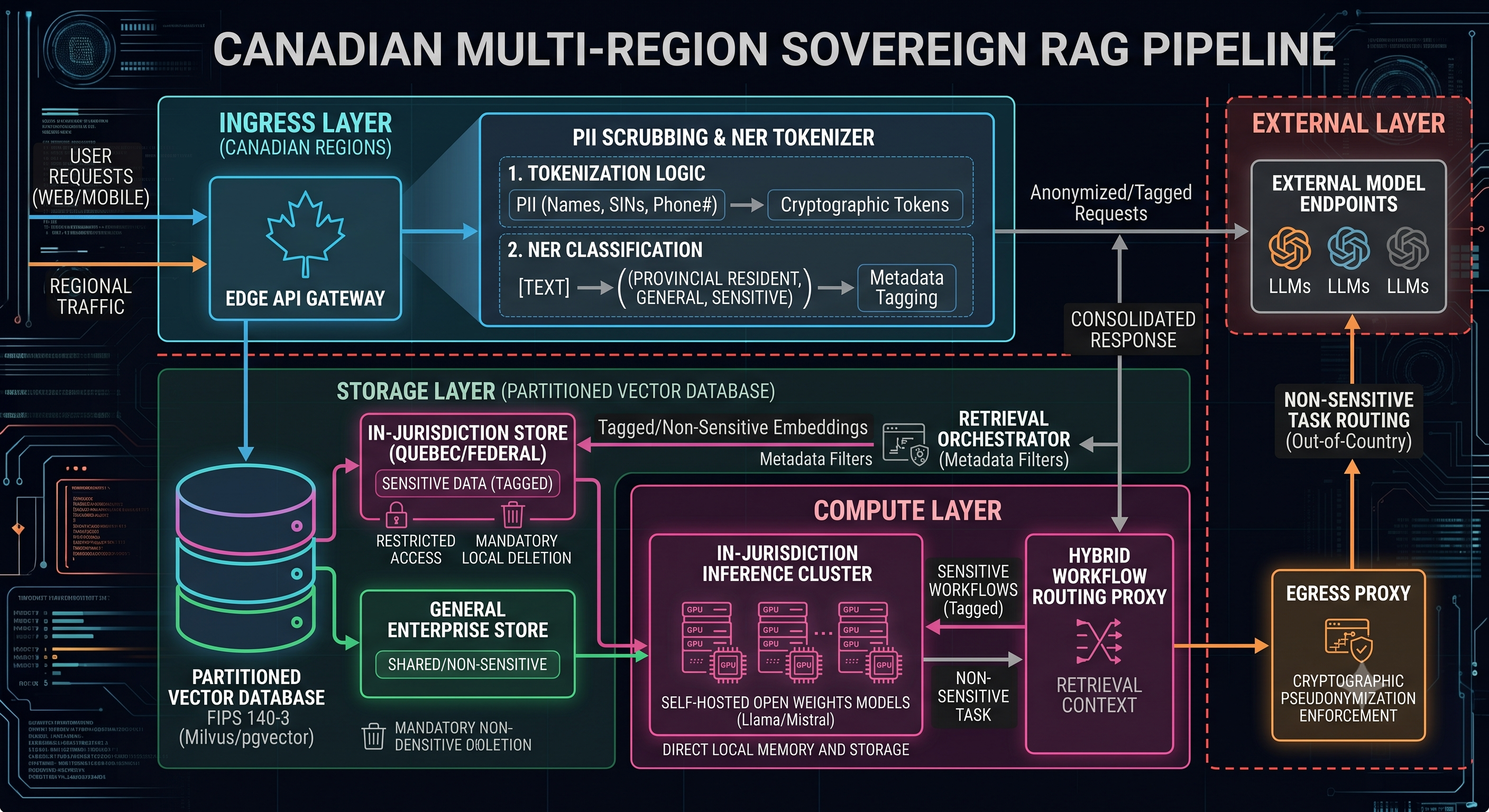
Deploy localized edge proxies (e.g., in Montreal and Toronto zones) that run lightweight local Named Entity Recognition (NER) models.
Tokenize direct identifiers (names, SINs, phone numbers, localized telemetry) into synthetic identifiers before data crosses regional boundaries or enters vector stores.
Decouple Regional Vector Indexes
Avoid deploying single global vector namespaces for Canadian users. If enterprise records contain Quebec-resident data:
Partition vector collections by legal jurisdiction (e.g., vector_db_ca_east vs vector_db_shared).
Enforce strict metadata filtering at retrieval time so an automated agent querying general enterprise knowledge cannot inadvertently fetch protected provincial customer fragments into an external inference prompt context.
Hybrid Fallback: Sovereign Local Compute vs. Global Reasoning
To balance latency, costs, and compliance under emerging sovereign AI compute initiatives:
Route sensitive transactional classifications, KYC processing, and personal data summarization to self-hosted, Canadian-domiciled open weights models.
Route non-sensitive, aggregated, or anonymized reasoning queries upstream to global frontier models through strict egress sanitization gateways.
Compliance is no longer just legal paperwork—it is an infrastructure design pattern. Building regional isolation into your RAG pipelines today saves Canadian engineering teams from massive, disruptive data migration projects as cross-provincial enforcement tightens.
Discussion Question
Has your team audited whether your LLM retrieval pipelines and vector stores are transferring unmasked resident data across borders, or are you treating all North American cloud traffic as a single zone?
CTA
Looking for deep technical teardowns, distributed systems patterns, and data architecture resources tailored to the Canadian ecosystem? Join Techawks Canada to connect with staff engineers, cloud architects, and tech leaders scaling across Canada.
Canadian engineering stacks are navigating a dual reality: scaling AI features while managing the strict operational boundaries between federal PIPEDA and provincial frameworks—most notably Quebec’s Law 25. Under these provisions, sending personal data outside the province or country for automated processing requires a documented Privacy Impact Assessment (PIA), explicit necessity thresholds, and adequate protection equivalency.
If your RAG (Retrieval-Augmented Generation) pipeline sends raw customer support records, banking context, or telemetry across the border to multi-tenant US LLM endpoints without deterministic masking, your system breaches statutory transfer conditions.
Here is how Canadian infrastructure and data teams are structuring compliant, low-latency AI pipelines:
Provincial Ingress & Anonymization at the Edge
Never route un-sanitized user payloads straight to vector databases or foundational model endpoints.
Deploy localized edge proxies (e.g., in Montreal and Toronto zones) that run lightweight local Named Entity Recognition (NER) models.
Tokenize direct identifiers (names, SINs, phone numbers, localized telemetry) into synthetic identifiers before data crosses regional boundaries or enters vector stores.
Decouple Regional Vector Indexes
Avoid deploying single global vector namespaces for Canadian users. If enterprise records contain Quebec-resident data:
Partition vector collections by legal jurisdiction (e.g., vector_db_ca_east vs vector_db_shared).
Enforce strict metadata filtering at retrieval time so an automated agent querying general enterprise knowledge cannot inadvertently fetch protected provincial customer fragments into an external inference prompt context.
Hybrid Fallback: Sovereign Local Compute vs. Global Reasoning
To balance latency, costs, and compliance under emerging sovereign AI compute initiatives:
Route sensitive transactional classifications, KYC processing, and personal data summarization to self-hosted, Canadian-domiciled open weights models.
Route non-sensitive, aggregated, or anonymized reasoning queries upstream to global frontier models through strict egress sanitization gateways.
Compliance is no longer just legal paperwork—it is an infrastructure design pattern. Building regional isolation into your RAG pipelines today saves Canadian engineering teams from massive, disruptive data migration projects as cross-provincial enforcement tightens.
Discussion Question
Has your team audited whether your LLM retrieval pipelines and vector stores are transferring unmasked resident data across borders, or are you treating all North American cloud traffic as a single zone?
CTA
Looking for deep technical teardowns, distributed systems patterns, and data architecture resources tailored to the Canadian ecosystem? Join Techawks Canada to connect with staff engineers, cloud architects, and tech leaders scaling across Canada.
Cross-Border RAG Pipelines in Canada: Why Your Architecture Needs Provincial Boundary Routing
Canadian engineering stacks are navigating a dual reality: scaling AI features while managing the strict operational boundaries between federal PIPEDA and provincial frameworks—most notably Quebec’s Law 25. Under these provisions, sending personal data outside the province or country for automated processing requires a documented Privacy Impact Assessment (PIA), explicit necessity thresholds, and adequate protection equivalency.
If your RAG (Retrieval-Augmented Generation) pipeline sends raw customer support records, banking context, or telemetry across the border to multi-tenant US LLM endpoints without deterministic masking, your system breaches statutory transfer conditions.
Here is how Canadian infrastructure and data teams are structuring compliant, low-latency AI pipelines:
Provincial Ingress & Anonymization at the Edge
Never route un-sanitized user payloads straight to vector databases or foundational model endpoints.
Deploy localized edge proxies (e.g., in Montreal and Toronto zones) that run lightweight local Named Entity Recognition (NER) models.
Tokenize direct identifiers (names, SINs, phone numbers, localized telemetry) into synthetic identifiers before data crosses regional boundaries or enters vector stores.
Decouple Regional Vector Indexes
Avoid deploying single global vector namespaces for Canadian users. If enterprise records contain Quebec-resident data:
Partition vector collections by legal jurisdiction (e.g., vector_db_ca_east vs vector_db_shared).
Enforce strict metadata filtering at retrieval time so an automated agent querying general enterprise knowledge cannot inadvertently fetch protected provincial customer fragments into an external inference prompt context.
Hybrid Fallback: Sovereign Local Compute vs. Global Reasoning
To balance latency, costs, and compliance under emerging sovereign AI compute initiatives:
Route sensitive transactional classifications, KYC processing, and personal data summarization to self-hosted, Canadian-domiciled open weights models.
Route non-sensitive, aggregated, or anonymized reasoning queries upstream to global frontier models through strict egress sanitization gateways.
Compliance is no longer just legal paperwork—it is an infrastructure design pattern. Building regional isolation into your RAG pipelines today saves Canadian engineering teams from massive, disruptive data migration projects as cross-provincial enforcement tightens.
Discussion Question
Has your team audited whether your LLM retrieval pipelines and vector stores are transferring unmasked resident data across borders, or are you treating all North American cloud traffic as a single zone?
CTA
Looking for deep technical teardowns, distributed systems patterns, and data architecture resources tailored to the Canadian ecosystem? Join Techawks Canada to connect with staff engineers, cloud architects, and tech leaders scaling across Canada.

 English
 Arabic
 French
 Spanish
 Portuguese
 Deutsch
 Turkish
 Dutch
Dutch
 Russian
 Romaian
 Portuguese (Brazil)
 Greek
Greek