


Beyond the Region Lock: Why US Platform Teams Are Migrating to Local-First AI Architectures in 2026
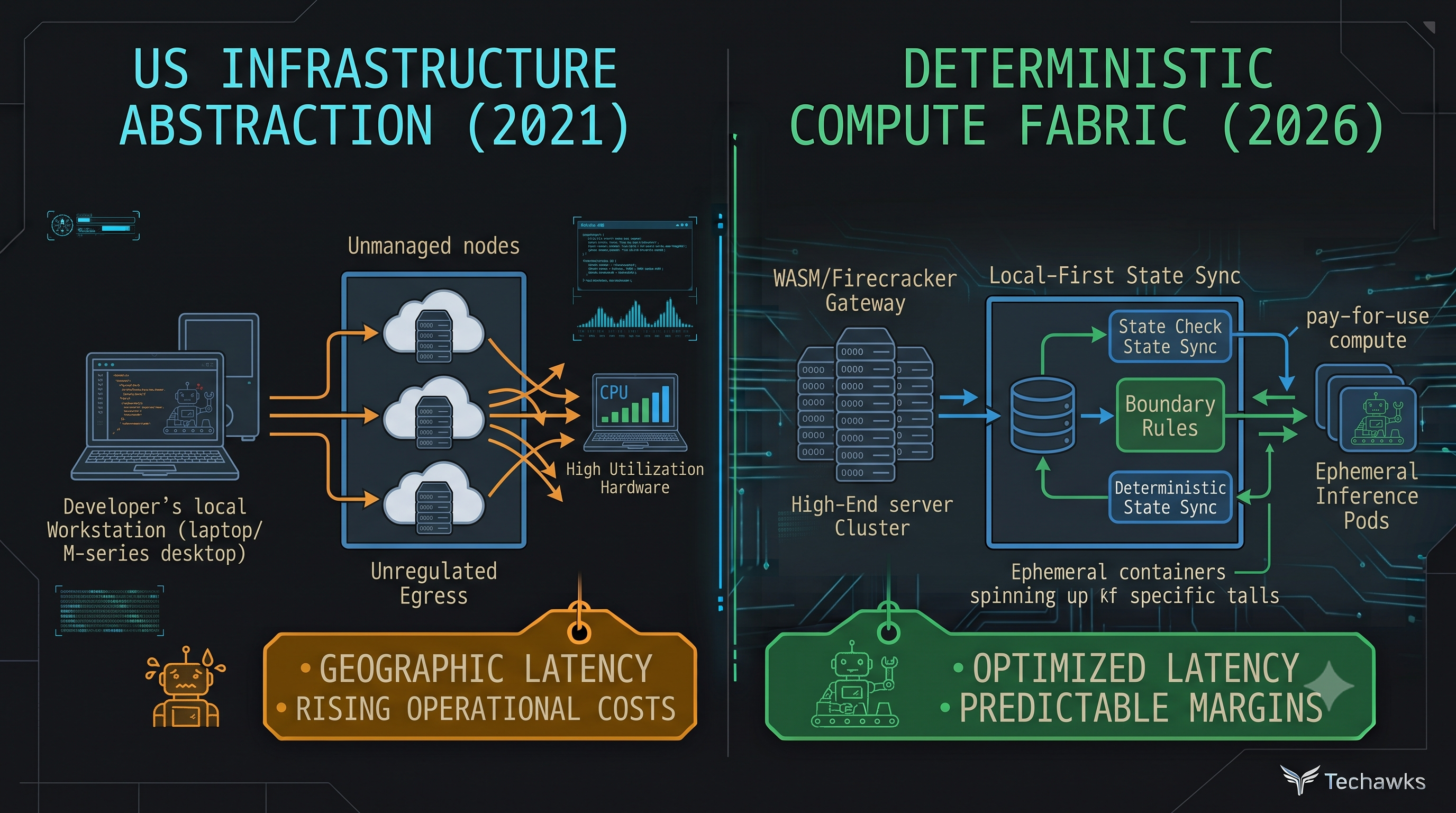
The legacy promise of US cloud data centers was unlimited scale via geographic abstraction: spin up instances anywhere, pay-for-use, and let the network handle replication. However, the AI-native shift has corrupted this model.
For critical US workloads, geographic latency and data egress costs are the new performance bottlenecks. High-performing engineering teams are moving beyond region-locking toward Deterministic Compute Fabrics that are local-first.
In 2026, optimization is defined by removing infrastructure, not adding it. US platform stewards must master three architectural shifts:
Your 3-Step Local-First Migration Strategy:
Shift Right, then Shift Left (Boundary Inference)
Treat developer workstations (especially M-series and high-end RTX rigs) as an extended compute plane. Use containerized local inference gateways. Enforce strict boundary rules: if a query requires fewer than 14B parameters or can be handled by an SLM, drop it from the cloud egress pipeline entirely.
Move from VMs to Native WASM & MicroVMs
If an agent workflow must burst to the cloud for validation or state consistency, use highly ephemeral execution environments. Do not spin up a VM or a K8s pod. Use WebAssembly (WASM) runtimes (e.g., Wasmtime) or MicroVMs (e.g., Firecracker) for transactional, low-millisecond agent calls.
Master Local/Cloud Deterministic Sync
The bottleneck isn’t compute; it’s state. Implement local-first Conflict-free Replicated Data Types (CRDTs) or robust transactional databases that guarantee state determinism between the localized user session and the cloud control plane.
Your US cloud strategy is no longer about managing sprawl across 'us-east-1' and 'us-west-2'. It’s about building minimal, deterministic gateways that coordinate execution across decentralized, high-utilization local hardware.
Discussion Question
For US-based cloud engineers and platform architects: How are you handling the hybrid AI split—are you using service mesh to route inference locally, containerizing SLMs, or purely optimizing on-demand cloud costs in congested regions? Share your optimization playbook.
CTA
Ready to build minimal, scalable, and cost-efficient cloud systems optimized for local-first execution?
👉 Join Techawks USA to master distributed systems, WASM orchestration, and production engineering alongside US practitioners.
The legacy promise of US cloud data centers was unlimited scale via geographic abstraction: spin up instances anywhere, pay-for-use, and let the network handle replication. However, the AI-native shift has corrupted this model.
For critical US workloads, geographic latency and data egress costs are the new performance bottlenecks. High-performing engineering teams are moving beyond region-locking toward Deterministic Compute Fabrics that are local-first.
In 2026, optimization is defined by removing infrastructure, not adding it. US platform stewards must master three architectural shifts:
Your 3-Step Local-First Migration Strategy:
Shift Right, then Shift Left (Boundary Inference)
Treat developer workstations (especially M-series and high-end RTX rigs) as an extended compute plane. Use containerized local inference gateways. Enforce strict boundary rules: if a query requires fewer than 14B parameters or can be handled by an SLM, drop it from the cloud egress pipeline entirely.
Move from VMs to Native WASM & MicroVMs
If an agent workflow must burst to the cloud for validation or state consistency, use highly ephemeral execution environments. Do not spin up a VM or a K8s pod. Use WebAssembly (WASM) runtimes (e.g., Wasmtime) or MicroVMs (e.g., Firecracker) for transactional, low-millisecond agent calls.
Master Local/Cloud Deterministic Sync
The bottleneck isn’t compute; it’s state. Implement local-first Conflict-free Replicated Data Types (CRDTs) or robust transactional databases that guarantee state determinism between the localized user session and the cloud control plane.
Your US cloud strategy is no longer about managing sprawl across 'us-east-1' and 'us-west-2'. It’s about building minimal, deterministic gateways that coordinate execution across decentralized, high-utilization local hardware.
Discussion Question
For US-based cloud engineers and platform architects: How are you handling the hybrid AI split—are you using service mesh to route inference locally, containerizing SLMs, or purely optimizing on-demand cloud costs in congested regions? Share your optimization playbook.
CTA
Ready to build minimal, scalable, and cost-efficient cloud systems optimized for local-first execution?
👉 Join Techawks USA to master distributed systems, WASM orchestration, and production engineering alongside US practitioners.
Beyond the Region Lock: Why US Platform Teams Are Migrating to Local-First AI Architectures in 2026
The legacy promise of US cloud data centers was unlimited scale via geographic abstraction: spin up instances anywhere, pay-for-use, and let the network handle replication. However, the AI-native shift has corrupted this model.
For critical US workloads, geographic latency and data egress costs are the new performance bottlenecks. High-performing engineering teams are moving beyond region-locking toward Deterministic Compute Fabrics that are local-first.
In 2026, optimization is defined by removing infrastructure, not adding it. US platform stewards must master three architectural shifts:
Your 3-Step Local-First Migration Strategy:
Shift Right, then Shift Left (Boundary Inference)
Treat developer workstations (especially M-series and high-end RTX rigs) as an extended compute plane. Use containerized local inference gateways. Enforce strict boundary rules: if a query requires fewer than 14B parameters or can be handled by an SLM, drop it from the cloud egress pipeline entirely.
Move from VMs to Native WASM & MicroVMs
If an agent workflow must burst to the cloud for validation or state consistency, use highly ephemeral execution environments. Do not spin up a VM or a K8s pod. Use WebAssembly (WASM) runtimes (e.g., Wasmtime) or MicroVMs (e.g., Firecracker) for transactional, low-millisecond agent calls.
Master Local/Cloud Deterministic Sync
The bottleneck isn’t compute; it’s state. Implement local-first Conflict-free Replicated Data Types (CRDTs) or robust transactional databases that guarantee state determinism between the localized user session and the cloud control plane.
Your US cloud strategy is no longer about managing sprawl across 'us-east-1' and 'us-west-2'. It’s about building minimal, deterministic gateways that coordinate execution across decentralized, high-utilization local hardware.
Discussion Question
For US-based cloud engineers and platform architects: How are you handling the hybrid AI split—are you using service mesh to route inference locally, containerizing SLMs, or purely optimizing on-demand cloud costs in congested regions? Share your optimization playbook.
CTA
Ready to build minimal, scalable, and cost-efficient cloud systems optimized for local-first execution?
👉 Join Techawks USA to master distributed systems, WASM orchestration, and production engineering alongside US practitioners.

 English
 Arabic
 French
 Spanish
 Portuguese
 Deutsch
 Turkish
 Dutch
Dutch
 Russian
 Romaian
 Portuguese (Brazil)
 Greek
Greek