


The Regulatory Air-Gap: Why UK Engineering Teams Must Decouple Data Residency from Sovereign Execution
UK tech leaders are navigating a dual operational reality: accelerating agentic AI adoption while aligning with the strict regulatory expectations of the Cyber Security and Resilience Bill, sector-specific FCA/PRA operational resilience mandates, and the ICO's statutory guidance on automated decision-making.
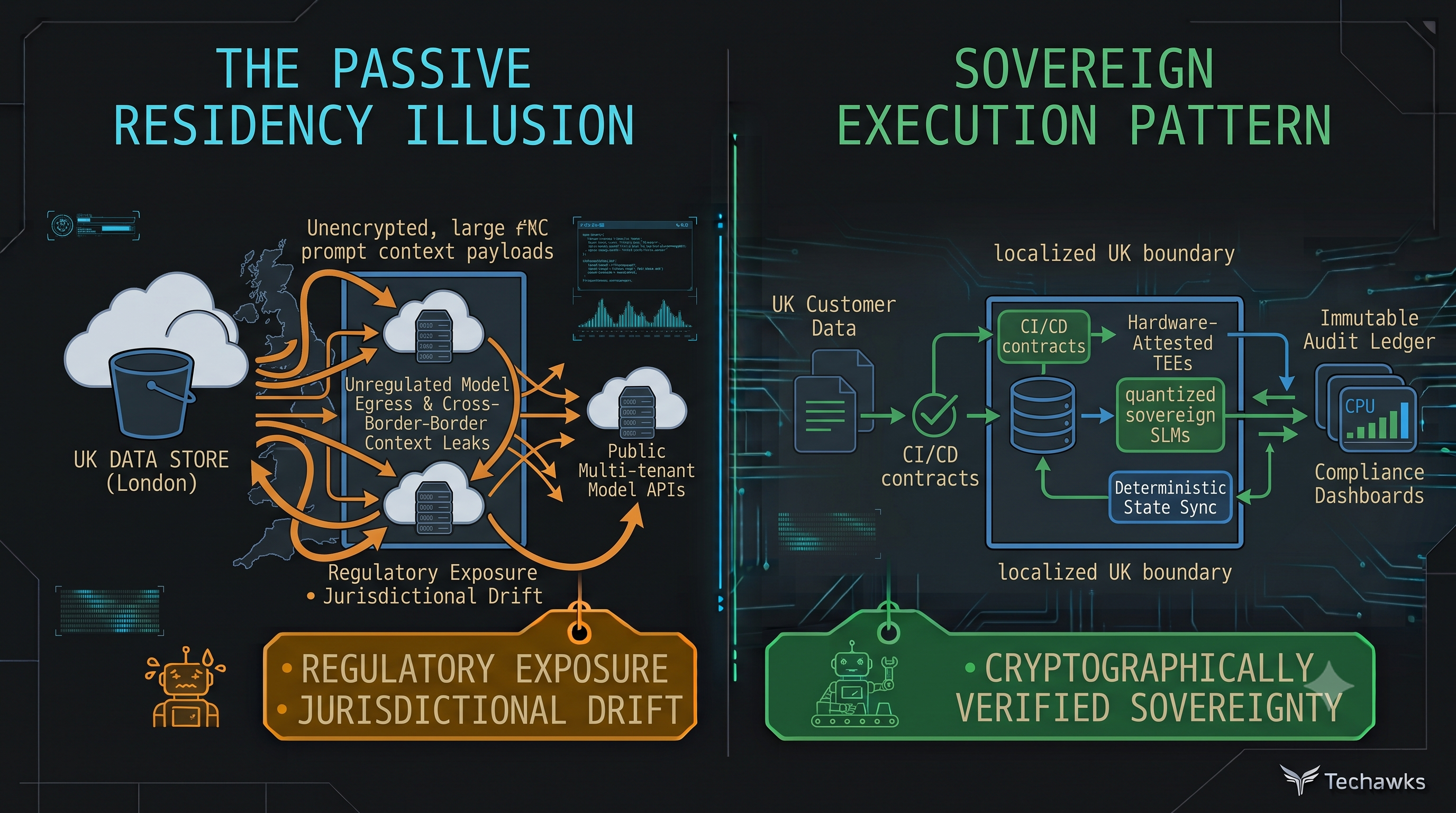
The classic enterprise response has been Passive Data Residency: store the database inside UK borders, but pipe sensitive customer telemetry, prompt contexts, and operational metadata out to non-sovereign multi-tenant model APIs across external regions.
Under modern scrutiny, that boundary is untenable. Real resilience requires moving from simple storage residency to Sovereign Execution & Enclave Determinism.
How to Architect for Sovereign Runtime Compliance:
Deploy Confidential Computing Enclaves (Hardware Attestation)
Encrypting data at rest and in transit is baseline hygiene. To protect sensitive customer contexts during inference, isolate model runtimes inside hardware-attested Trusted Execution Environments (TEEs) on UK-domiciled bare metal. This guarantees that host infrastructure administrators and third-party hypervisors cannot inspect memory state during runtime execution.
Implement Localized Model Distillation & SLM Gateways
Never send high-compliance transactions (e.g., patient records, credit decisions, identifiable telemetry) to opaque public endpoints. Route in-scope requests to local, quantized Small Language Models (SLMs) running inside air-gapped VPCs. Use deterministic rule-based classifiers to scrub and verify data contracts before any anonymized residual workloads trigger external fallbacks.
Enforce Immutable Audit Ledgers for Automated Decisions
The ICO and FCA hold Senior Managers directly accountable for automated decision chains. Replace opaque, non-deterministic agent loops with cryptographically signed execution traces. Record the input context hash, model weight version, state transition, and output payload in an append-only log to ensure forensic auditability on demand.
Sovereignty isn't a checkmark on a cloud billing dashboard—it is an architectural pattern that guarantees total jurisdictional control over code, context, and compute.
Discussion Question
For UK tech leaders, CTOs, and platform architects: How is your team reconciling high-speed agent deployment with strict UK compliance—are you adopting local sovereign SLMs, investing in confidential computing enclaves, or relying on contractual provider assurances? Let's discuss where the practical trade-offs lie.
CTA
Ready to build resilient, sovereign, and audit-proof technical systems?
👉 Join Techawks UK to collaborate with senior engineers, discuss sovereign cloud architecture, and benchmark production frameworks alongside the British tech community.
UK tech leaders are navigating a dual operational reality: accelerating agentic AI adoption while aligning with the strict regulatory expectations of the Cyber Security and Resilience Bill, sector-specific FCA/PRA operational resilience mandates, and the ICO's statutory guidance on automated decision-making.
The classic enterprise response has been Passive Data Residency: store the database inside UK borders, but pipe sensitive customer telemetry, prompt contexts, and operational metadata out to non-sovereign multi-tenant model APIs across external regions.
Under modern scrutiny, that boundary is untenable. Real resilience requires moving from simple storage residency to Sovereign Execution & Enclave Determinism.
How to Architect for Sovereign Runtime Compliance:
Deploy Confidential Computing Enclaves (Hardware Attestation)
Encrypting data at rest and in transit is baseline hygiene. To protect sensitive customer contexts during inference, isolate model runtimes inside hardware-attested Trusted Execution Environments (TEEs) on UK-domiciled bare metal. This guarantees that host infrastructure administrators and third-party hypervisors cannot inspect memory state during runtime execution.
Implement Localized Model Distillation & SLM Gateways
Never send high-compliance transactions (e.g., patient records, credit decisions, identifiable telemetry) to opaque public endpoints. Route in-scope requests to local, quantized Small Language Models (SLMs) running inside air-gapped VPCs. Use deterministic rule-based classifiers to scrub and verify data contracts before any anonymized residual workloads trigger external fallbacks.
Enforce Immutable Audit Ledgers for Automated Decisions
The ICO and FCA hold Senior Managers directly accountable for automated decision chains. Replace opaque, non-deterministic agent loops with cryptographically signed execution traces. Record the input context hash, model weight version, state transition, and output payload in an append-only log to ensure forensic auditability on demand.
Sovereignty isn't a checkmark on a cloud billing dashboard—it is an architectural pattern that guarantees total jurisdictional control over code, context, and compute.
Discussion Question
For UK tech leaders, CTOs, and platform architects: How is your team reconciling high-speed agent deployment with strict UK compliance—are you adopting local sovereign SLMs, investing in confidential computing enclaves, or relying on contractual provider assurances? Let's discuss where the practical trade-offs lie.
CTA
Ready to build resilient, sovereign, and audit-proof technical systems?
👉 Join Techawks UK to collaborate with senior engineers, discuss sovereign cloud architecture, and benchmark production frameworks alongside the British tech community.
The Regulatory Air-Gap: Why UK Engineering Teams Must Decouple Data Residency from Sovereign Execution
UK tech leaders are navigating a dual operational reality: accelerating agentic AI adoption while aligning with the strict regulatory expectations of the Cyber Security and Resilience Bill, sector-specific FCA/PRA operational resilience mandates, and the ICO's statutory guidance on automated decision-making.
The classic enterprise response has been Passive Data Residency: store the database inside UK borders, but pipe sensitive customer telemetry, prompt contexts, and operational metadata out to non-sovereign multi-tenant model APIs across external regions.
Under modern scrutiny, that boundary is untenable. Real resilience requires moving from simple storage residency to Sovereign Execution & Enclave Determinism.
How to Architect for Sovereign Runtime Compliance:
Deploy Confidential Computing Enclaves (Hardware Attestation)
Encrypting data at rest and in transit is baseline hygiene. To protect sensitive customer contexts during inference, isolate model runtimes inside hardware-attested Trusted Execution Environments (TEEs) on UK-domiciled bare metal. This guarantees that host infrastructure administrators and third-party hypervisors cannot inspect memory state during runtime execution.
Implement Localized Model Distillation & SLM Gateways
Never send high-compliance transactions (e.g., patient records, credit decisions, identifiable telemetry) to opaque public endpoints. Route in-scope requests to local, quantized Small Language Models (SLMs) running inside air-gapped VPCs. Use deterministic rule-based classifiers to scrub and verify data contracts before any anonymized residual workloads trigger external fallbacks.
Enforce Immutable Audit Ledgers for Automated Decisions
The ICO and FCA hold Senior Managers directly accountable for automated decision chains. Replace opaque, non-deterministic agent loops with cryptographically signed execution traces. Record the input context hash, model weight version, state transition, and output payload in an append-only log to ensure forensic auditability on demand.
Sovereignty isn't a checkmark on a cloud billing dashboard—it is an architectural pattern that guarantees total jurisdictional control over code, context, and compute.
Discussion Question
For UK tech leaders, CTOs, and platform architects: How is your team reconciling high-speed agent deployment with strict UK compliance—are you adopting local sovereign SLMs, investing in confidential computing enclaves, or relying on contractual provider assurances? Let's discuss where the practical trade-offs lie.
CTA
Ready to build resilient, sovereign, and audit-proof technical systems?
👉 Join Techawks UK to collaborate with senior engineers, discuss sovereign cloud architecture, and benchmark production frameworks alongside the British tech community.

 English
 Arabic
 French
 Spanish
 Portuguese
 Deutsch
 Turkish
 Dutch
Dutch
 Russian
 Romaian
 Portuguese (Brazil)
 Greek
Greek