


Building a Non-Colonized Canadian AI: Why Data Residency Can’t Protect Sovereign Inference
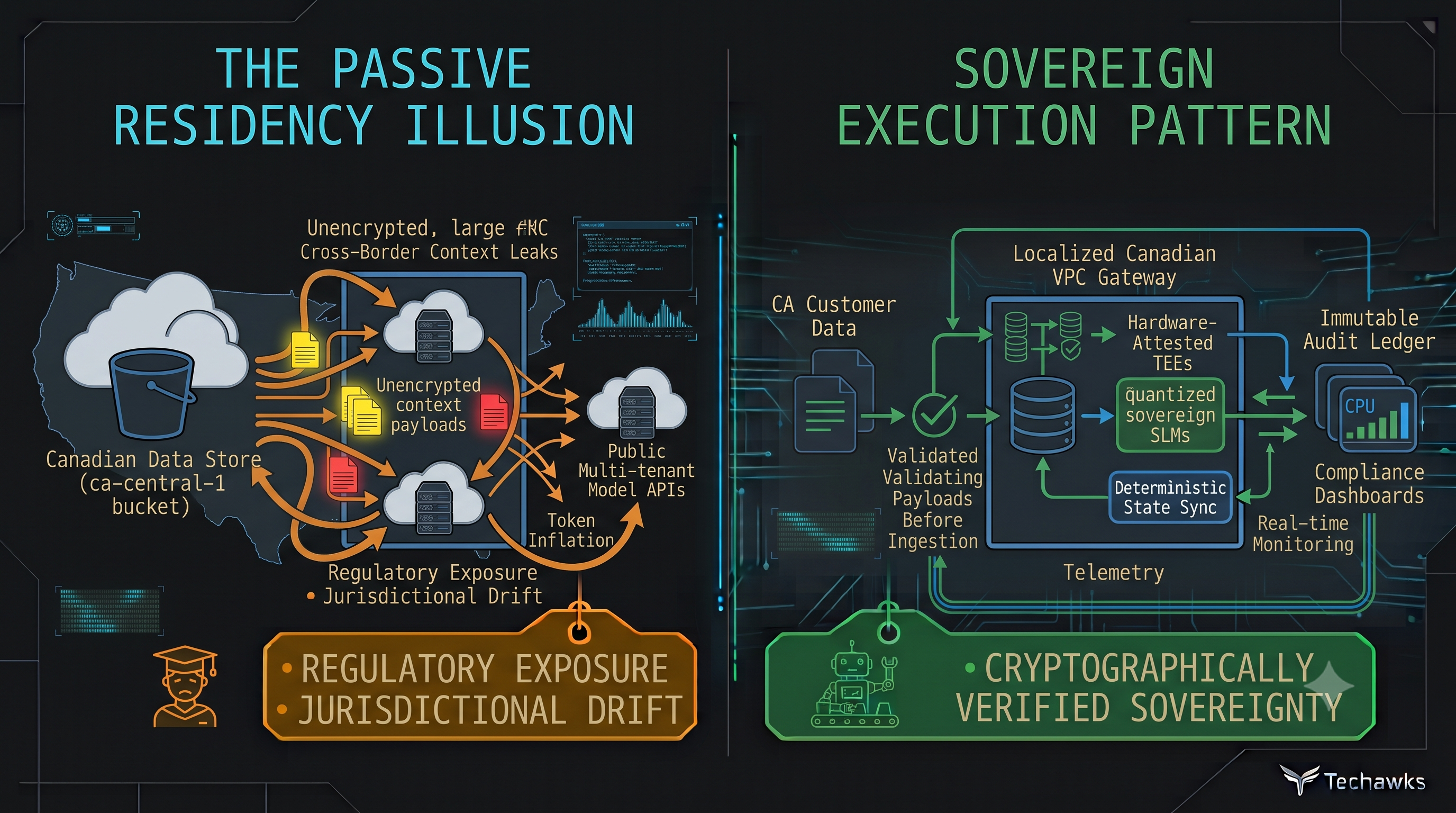
High-performing engineering teams in Toronto, Vancouver, and Montréal are shifting their effort away from simple AI integration and towards architecting for runtime sovereignty. Passive Data Residency—storing data in ca-central-1 cloud buckets—is baseline hygiene. True local relevance requires controlling the complete execution path. Real operational resilience requires moving from unmanaged remote inference to Sovereign Runtime Isolation & TEE Determinism.
How to Architect for Sovereign Runtime Compliance:
Deploy Sovereign Execution in Hardware-Attested TEEs
To protect sensitive prompt contexts during active inference, move model runtimes inside Hardware-Attested Trusted Execution Environments (TEEs) on localized, Canada-domiciled bare metal. This guarantees that host infrastructure administrators and third-party hypervisors cannot inspect the memory state during active execution.
Implement Localized Model Distillation & SLM Gateways
Never pipe high-compliance transactions (e.g., patient records, identity data, identifiable citizen telemetry) to external public endpoints. Route in-scope requests to quantized Small Language Models (SLMs) running inside air-gapped Canadian VPCs. Use deterministic, rule-based classifiers to scrub and verify data contracts before any anonymized residual workloads trigger external fallbacks.
Establish an Immutable, Verifiable Audit Ledger
Canada’s regulatory landscape holds data controllers strictly accountable for automated decision chains. Replace opaque, non-deterministic agent loops with cryptographically signed execution traces. Record the input context hash, model weight version, and transaction diff in an append-only log to ensure forensic auditability on demand.
Sovereignty isn’t a switch you flip on a cloud provider’s billing console; it is an architectural pattern that guarantees total jurisdictional control over code, context, and compute.
Discussion Question
For Canadian CTOs, Platform Engineers, and Data Privacy Leads: Where is your biggest architectural hurdle today—provisioning high-performance TEE compute locally, managing context drift over sovereign SLMs, or reconciling real-time execution needs with data localization mandates? Let’s discuss your implementation trade-offs below.
CTA
Ready to build resilient, sovereign, and audit-proof technical systems designed for Canada?
👉 Join Techawks Canada to collaborate with senior practitioners, discuss sovereign cloud architecture, and master production engineering frameworks tailored for the Canadian context.
High-performing engineering teams in Toronto, Vancouver, and Montréal are shifting their effort away from simple AI integration and towards architecting for runtime sovereignty. Passive Data Residency—storing data in ca-central-1 cloud buckets—is baseline hygiene. True local relevance requires controlling the complete execution path. Real operational resilience requires moving from unmanaged remote inference to Sovereign Runtime Isolation & TEE Determinism.
How to Architect for Sovereign Runtime Compliance:
Deploy Sovereign Execution in Hardware-Attested TEEs
To protect sensitive prompt contexts during active inference, move model runtimes inside Hardware-Attested Trusted Execution Environments (TEEs) on localized, Canada-domiciled bare metal. This guarantees that host infrastructure administrators and third-party hypervisors cannot inspect the memory state during active execution.
Implement Localized Model Distillation & SLM Gateways
Never pipe high-compliance transactions (e.g., patient records, identity data, identifiable citizen telemetry) to external public endpoints. Route in-scope requests to quantized Small Language Models (SLMs) running inside air-gapped Canadian VPCs. Use deterministic, rule-based classifiers to scrub and verify data contracts before any anonymized residual workloads trigger external fallbacks.
Establish an Immutable, Verifiable Audit Ledger
Canada’s regulatory landscape holds data controllers strictly accountable for automated decision chains. Replace opaque, non-deterministic agent loops with cryptographically signed execution traces. Record the input context hash, model weight version, and transaction diff in an append-only log to ensure forensic auditability on demand.
Sovereignty isn’t a switch you flip on a cloud provider’s billing console; it is an architectural pattern that guarantees total jurisdictional control over code, context, and compute.
Discussion Question
For Canadian CTOs, Platform Engineers, and Data Privacy Leads: Where is your biggest architectural hurdle today—provisioning high-performance TEE compute locally, managing context drift over sovereign SLMs, or reconciling real-time execution needs with data localization mandates? Let’s discuss your implementation trade-offs below.
CTA
Ready to build resilient, sovereign, and audit-proof technical systems designed for Canada?
👉 Join Techawks Canada to collaborate with senior practitioners, discuss sovereign cloud architecture, and master production engineering frameworks tailored for the Canadian context.
Building a Non-Colonized Canadian AI: Why Data Residency Can’t Protect Sovereign Inference
High-performing engineering teams in Toronto, Vancouver, and Montréal are shifting their effort away from simple AI integration and towards architecting for runtime sovereignty. Passive Data Residency—storing data in ca-central-1 cloud buckets—is baseline hygiene. True local relevance requires controlling the complete execution path. Real operational resilience requires moving from unmanaged remote inference to Sovereign Runtime Isolation & TEE Determinism.
How to Architect for Sovereign Runtime Compliance:
Deploy Sovereign Execution in Hardware-Attested TEEs
To protect sensitive prompt contexts during active inference, move model runtimes inside Hardware-Attested Trusted Execution Environments (TEEs) on localized, Canada-domiciled bare metal. This guarantees that host infrastructure administrators and third-party hypervisors cannot inspect the memory state during active execution.
Implement Localized Model Distillation & SLM Gateways
Never pipe high-compliance transactions (e.g., patient records, identity data, identifiable citizen telemetry) to external public endpoints. Route in-scope requests to quantized Small Language Models (SLMs) running inside air-gapped Canadian VPCs. Use deterministic, rule-based classifiers to scrub and verify data contracts before any anonymized residual workloads trigger external fallbacks.
Establish an Immutable, Verifiable Audit Ledger
Canada’s regulatory landscape holds data controllers strictly accountable for automated decision chains. Replace opaque, non-deterministic agent loops with cryptographically signed execution traces. Record the input context hash, model weight version, and transaction diff in an append-only log to ensure forensic auditability on demand.
Sovereignty isn’t a switch you flip on a cloud provider’s billing console; it is an architectural pattern that guarantees total jurisdictional control over code, context, and compute.
Discussion Question
For Canadian CTOs, Platform Engineers, and Data Privacy Leads: Where is your biggest architectural hurdle today—provisioning high-performance TEE compute locally, managing context drift over sovereign SLMs, or reconciling real-time execution needs with data localization mandates? Let’s discuss your implementation trade-offs below.
CTA
Ready to build resilient, sovereign, and audit-proof technical systems designed for Canada?
👉 Join Techawks Canada to collaborate with senior practitioners, discuss sovereign cloud architecture, and master production engineering frameworks tailored for the Canadian context.

 English
 Arabic
 French
 Portuguese
 Deutsch
 Turkish
 Dutch
Dutch
 Italiano
 Russian
 Romaian
 Portuguese (Brazil)
 Greek
Greek