


The GitOps Reconciliation Tax: Why Direct Cluster Apply Is Crushing Kubernetes Control Planes
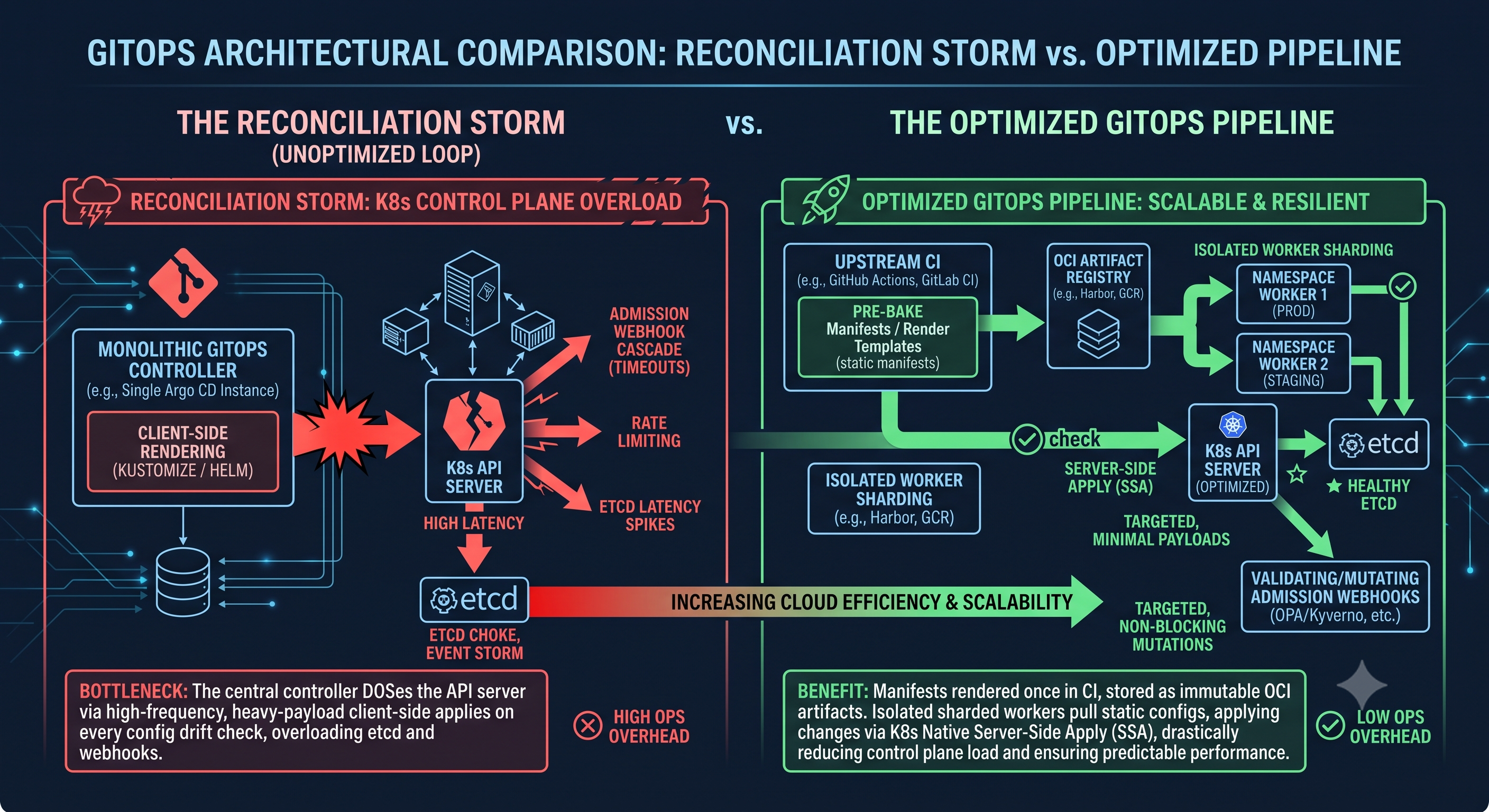
As platforms grow past hundreds of microservices and multi-cluster topologies, the standard GitOps promise—everything declared in Git, reconciled continuously—is running into an architectural bottleneck: the control plane reconciliation storm.
In classical GitOps setups (Argo CD, Flux), controllers continuously compare the live cluster state against the Git repository. When engineering teams scale their custom resources (CRDs), dynamic Helm templating, and automated preview environments, two hidden inefficiencies compound:
The Serialization Bottleneck: A single commit to a monorepo or base directory triggers dozens of reconciler workers to pull manifests, run client-side templating (Kustomize/Helm), and hammer the API server with high-frequency GET and LIST requests to detect drift.
Admission Webhook Cascades: Every synced resource triggers mutating and validating admission webhooks (security scanners, policy-as-code engines like Kyverno/OPA Gatekeeper, and service mesh injectors). Under concurrent sync waves, cluster admission webhooks saturate, driving API request latencies into timeouts.
ETCD Serialization Choke: When hundreds of ephemeral resources churn simultaneously, etcd struggles under heavy writes and watch notifications, degrading cluster scheduling and liveness probes across unrelated production workloads.
Practical Resource: 4 Architectural Tweaks to Tame Sync Thrashing
Decouple Dynamic Templating via OCI Artifact Registries
Stop letting your cluster GitOps agents render complex Helm/Kustomize templates on-the-fly during reconciliation. Render manifests upstream in your CI runner, push pre-baked static manifests as versioned OCI artifacts, and configure your GitOps operator to pull immutable artifacts directly.
Implement Server-Side Apply (SSA) by Default
Switch controllers from standard kubectl apply (client-side three-way merge via last-applied-configuration annotations) to Kubernetes Server-Side Apply. SSA offloads field management directly to the API server, slashing payload size and preventing annotation bloat on large CRDs.
Tune Drift Detection with Webhook-Triggered Syncs
Disable aggressive fixed-interval polling (e.g., polling Git every 60–180 seconds). Rely on Git webhook-driven sync events combined with targeted reconciliation filters (spec.ignoreDifferences) for auto-scaling fields like replicas or dynamic status annotations.
Namespace-Scoped Controllers for Blast-Radius Isolation
Replace monolithic, cluster-wide controller instances with sharded or namespace-scoped operator workers. Isolating high-churn environments (like ephemeral PR preview namespaces) prevents non-production sync spikes from degrading production control planes.
Discussion Question
When scaling GitOps across dozens of clusters or hundreds of microservices, how does your platform team prevent reconciler thrashing and admission webhook latency spikes during high-frequency deploy windows?
CTA (Share deployment experiences)
Share your deployment experiences and architectural war stories below. What strategies or tooling configurations (SSA, custom sync waves, sharding) have made the biggest difference in keeping your cluster API servers healthy?
As platforms grow past hundreds of microservices and multi-cluster topologies, the standard GitOps promise—everything declared in Git, reconciled continuously—is running into an architectural bottleneck: the control plane reconciliation storm.
In classical GitOps setups (Argo CD, Flux), controllers continuously compare the live cluster state against the Git repository. When engineering teams scale their custom resources (CRDs), dynamic Helm templating, and automated preview environments, two hidden inefficiencies compound:
The Serialization Bottleneck: A single commit to a monorepo or base directory triggers dozens of reconciler workers to pull manifests, run client-side templating (Kustomize/Helm), and hammer the API server with high-frequency GET and LIST requests to detect drift.
Admission Webhook Cascades: Every synced resource triggers mutating and validating admission webhooks (security scanners, policy-as-code engines like Kyverno/OPA Gatekeeper, and service mesh injectors). Under concurrent sync waves, cluster admission webhooks saturate, driving API request latencies into timeouts.
ETCD Serialization Choke: When hundreds of ephemeral resources churn simultaneously, etcd struggles under heavy writes and watch notifications, degrading cluster scheduling and liveness probes across unrelated production workloads.
Practical Resource: 4 Architectural Tweaks to Tame Sync Thrashing
Decouple Dynamic Templating via OCI Artifact Registries
Stop letting your cluster GitOps agents render complex Helm/Kustomize templates on-the-fly during reconciliation. Render manifests upstream in your CI runner, push pre-baked static manifests as versioned OCI artifacts, and configure your GitOps operator to pull immutable artifacts directly.
Implement Server-Side Apply (SSA) by Default
Switch controllers from standard kubectl apply (client-side three-way merge via last-applied-configuration annotations) to Kubernetes Server-Side Apply. SSA offloads field management directly to the API server, slashing payload size and preventing annotation bloat on large CRDs.
Tune Drift Detection with Webhook-Triggered Syncs
Disable aggressive fixed-interval polling (e.g., polling Git every 60–180 seconds). Rely on Git webhook-driven sync events combined with targeted reconciliation filters (spec.ignoreDifferences) for auto-scaling fields like replicas or dynamic status annotations.
Namespace-Scoped Controllers for Blast-Radius Isolation
Replace monolithic, cluster-wide controller instances with sharded or namespace-scoped operator workers. Isolating high-churn environments (like ephemeral PR preview namespaces) prevents non-production sync spikes from degrading production control planes.
Discussion Question
When scaling GitOps across dozens of clusters or hundreds of microservices, how does your platform team prevent reconciler thrashing and admission webhook latency spikes during high-frequency deploy windows?
CTA (Share deployment experiences)
Share your deployment experiences and architectural war stories below. What strategies or tooling configurations (SSA, custom sync waves, sharding) have made the biggest difference in keeping your cluster API servers healthy?
The GitOps Reconciliation Tax: Why Direct Cluster Apply Is Crushing Kubernetes Control Planes
As platforms grow past hundreds of microservices and multi-cluster topologies, the standard GitOps promise—everything declared in Git, reconciled continuously—is running into an architectural bottleneck: the control plane reconciliation storm.
In classical GitOps setups (Argo CD, Flux), controllers continuously compare the live cluster state against the Git repository. When engineering teams scale their custom resources (CRDs), dynamic Helm templating, and automated preview environments, two hidden inefficiencies compound:
The Serialization Bottleneck: A single commit to a monorepo or base directory triggers dozens of reconciler workers to pull manifests, run client-side templating (Kustomize/Helm), and hammer the API server with high-frequency GET and LIST requests to detect drift.
Admission Webhook Cascades: Every synced resource triggers mutating and validating admission webhooks (security scanners, policy-as-code engines like Kyverno/OPA Gatekeeper, and service mesh injectors). Under concurrent sync waves, cluster admission webhooks saturate, driving API request latencies into timeouts.
ETCD Serialization Choke: When hundreds of ephemeral resources churn simultaneously, etcd struggles under heavy writes and watch notifications, degrading cluster scheduling and liveness probes across unrelated production workloads.
Practical Resource: 4 Architectural Tweaks to Tame Sync Thrashing
Decouple Dynamic Templating via OCI Artifact Registries
Stop letting your cluster GitOps agents render complex Helm/Kustomize templates on-the-fly during reconciliation. Render manifests upstream in your CI runner, push pre-baked static manifests as versioned OCI artifacts, and configure your GitOps operator to pull immutable artifacts directly.
Implement Server-Side Apply (SSA) by Default
Switch controllers from standard kubectl apply (client-side three-way merge via last-applied-configuration annotations) to Kubernetes Server-Side Apply. SSA offloads field management directly to the API server, slashing payload size and preventing annotation bloat on large CRDs.
Tune Drift Detection with Webhook-Triggered Syncs
Disable aggressive fixed-interval polling (e.g., polling Git every 60–180 seconds). Rely on Git webhook-driven sync events combined with targeted reconciliation filters (spec.ignoreDifferences) for auto-scaling fields like replicas or dynamic status annotations.
Namespace-Scoped Controllers for Blast-Radius Isolation
Replace monolithic, cluster-wide controller instances with sharded or namespace-scoped operator workers. Isolating high-churn environments (like ephemeral PR preview namespaces) prevents non-production sync spikes from degrading production control planes.
Discussion Question
When scaling GitOps across dozens of clusters or hundreds of microservices, how does your platform team prevent reconciler thrashing and admission webhook latency spikes during high-frequency deploy windows?
CTA (Share deployment experiences)
Share your deployment experiences and architectural war stories below. What strategies or tooling configurations (SSA, custom sync waves, sharding) have made the biggest difference in keeping your cluster API servers healthy?

 English
 French
 Spanish
 Portuguese
 Deutsch
 Turkish
 Dutch
Dutch
 Italiano
 Russian
 Romaian
 Portuguese (Brazil)
 Greek
Greek