


The 4-Step Architecture Checklist for Designing Reliable Agentic AI Workflows
As AI builders, the temptation is often to jump straight into complex multi-agent setups. However, scaling agentic systems requires clean separation between deterministic orchestration and non-deterministic reasoning.
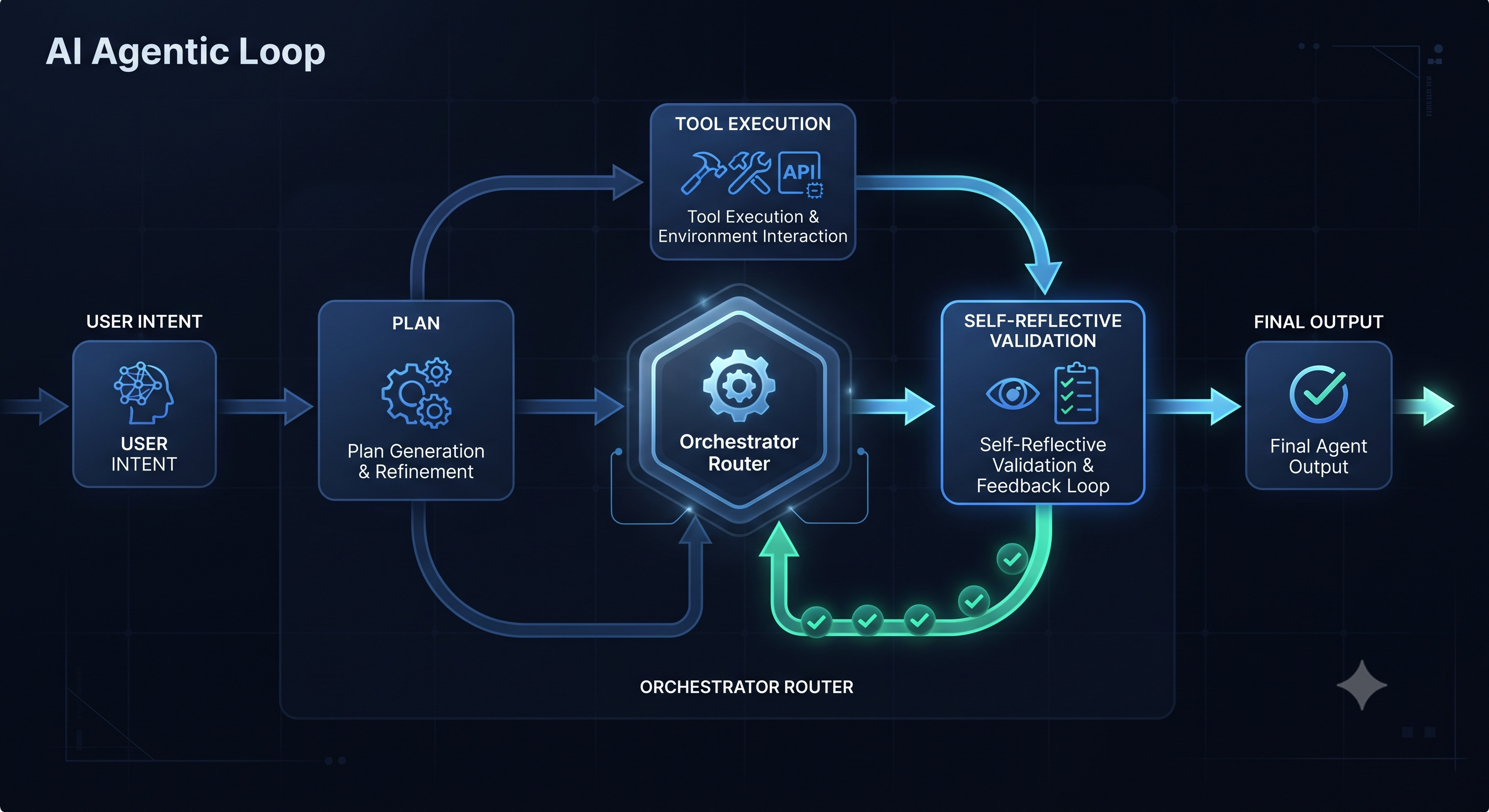
To build agentic applications that actually survive production traffic, run through this Agentic Workflow Architecture Checklist:
1. Choose the Right Core Metaphor: Match your system topology to the problem. Use single-agent planning loops for sequential tasks that share state, and reserve orchestrator-worker multi-agent networks strictly for parallelized subtasks.
2. Constrain Tool Interfaces & Scopes: Never give an agent broad, unstructured access. Expose precise, well-typed tools with deterministic validation schemas to prevent unexpected API execution paths.
3. Build Self-Reflection and Validation Loops: Do not rely on single-pass generation. Implement explicit validation steps—such as unit-test execution or "LLM-as-a-judge" semantic checks—so agents can catch and correct their own errors iteratively.
4. Log Full Decision Contexts, Not Just Outputs: Capture the canonical history of the session. Track not only the tool chosen, but the alternative tools considered, parameters passed, and validator outcomes to make agent debugging deterministic.
Designing resilient software means engineering boundaries that keep agentic autonomy predictable.
Discussion Question
Are you leaning toward single-agent planning loops or multi-agent architectures for your current projects? What’s your biggest bottleneck when handling agent state? Drop your insights below!
CTA (Join AI Builders & Enthusiasts)
Want to master production-grade AI engineering, swap architectural patterns, and build alongside top practitioners? Join AI Builders & Enthusiasts today to connect with developers worldwide!
As AI builders, the temptation is often to jump straight into complex multi-agent setups. However, scaling agentic systems requires clean separation between deterministic orchestration and non-deterministic reasoning.
To build agentic applications that actually survive production traffic, run through this Agentic Workflow Architecture Checklist:
1. Choose the Right Core Metaphor: Match your system topology to the problem. Use single-agent planning loops for sequential tasks that share state, and reserve orchestrator-worker multi-agent networks strictly for parallelized subtasks.
2. Constrain Tool Interfaces & Scopes: Never give an agent broad, unstructured access. Expose precise, well-typed tools with deterministic validation schemas to prevent unexpected API execution paths.
3. Build Self-Reflection and Validation Loops: Do not rely on single-pass generation. Implement explicit validation steps—such as unit-test execution or "LLM-as-a-judge" semantic checks—so agents can catch and correct their own errors iteratively.
4. Log Full Decision Contexts, Not Just Outputs: Capture the canonical history of the session. Track not only the tool chosen, but the alternative tools considered, parameters passed, and validator outcomes to make agent debugging deterministic.
Designing resilient software means engineering boundaries that keep agentic autonomy predictable.
Discussion Question
Are you leaning toward single-agent planning loops or multi-agent architectures for your current projects? What’s your biggest bottleneck when handling agent state? Drop your insights below!
CTA (Join AI Builders & Enthusiasts)
Want to master production-grade AI engineering, swap architectural patterns, and build alongside top practitioners? Join AI Builders & Enthusiasts today to connect with developers worldwide!
The 4-Step Architecture Checklist for Designing Reliable Agentic AI Workflows
As AI builders, the temptation is often to jump straight into complex multi-agent setups. However, scaling agentic systems requires clean separation between deterministic orchestration and non-deterministic reasoning.
To build agentic applications that actually survive production traffic, run through this Agentic Workflow Architecture Checklist:
1. Choose the Right Core Metaphor: Match your system topology to the problem. Use single-agent planning loops for sequential tasks that share state, and reserve orchestrator-worker multi-agent networks strictly for parallelized subtasks.
2. Constrain Tool Interfaces & Scopes: Never give an agent broad, unstructured access. Expose precise, well-typed tools with deterministic validation schemas to prevent unexpected API execution paths.
3. Build Self-Reflection and Validation Loops: Do not rely on single-pass generation. Implement explicit validation steps—such as unit-test execution or "LLM-as-a-judge" semantic checks—so agents can catch and correct their own errors iteratively.
4. Log Full Decision Contexts, Not Just Outputs: Capture the canonical history of the session. Track not only the tool chosen, but the alternative tools considered, parameters passed, and validator outcomes to make agent debugging deterministic.
Designing resilient software means engineering boundaries that keep agentic autonomy predictable.
Discussion Question
Are you leaning toward single-agent planning loops or multi-agent architectures for your current projects? What’s your biggest bottleneck when handling agent state? Drop your insights below!
CTA (Join AI Builders & Enthusiasts)
Want to master production-grade AI engineering, swap architectural patterns, and build alongside top practitioners? Join AI Builders & Enthusiasts today to connect with developers worldwide!

 English
 Arabic
 French
 Spanish
 Portuguese
 Deutsch
 Dutch
Dutch
 Italiano
 Russian
 Romaian
 Portuguese (Brazil)
 Greek
Greek