


Stop Designing AI Like a Chatbot: The 4-Step Agentic UX & Supervision Checklist for Modern Product Teams
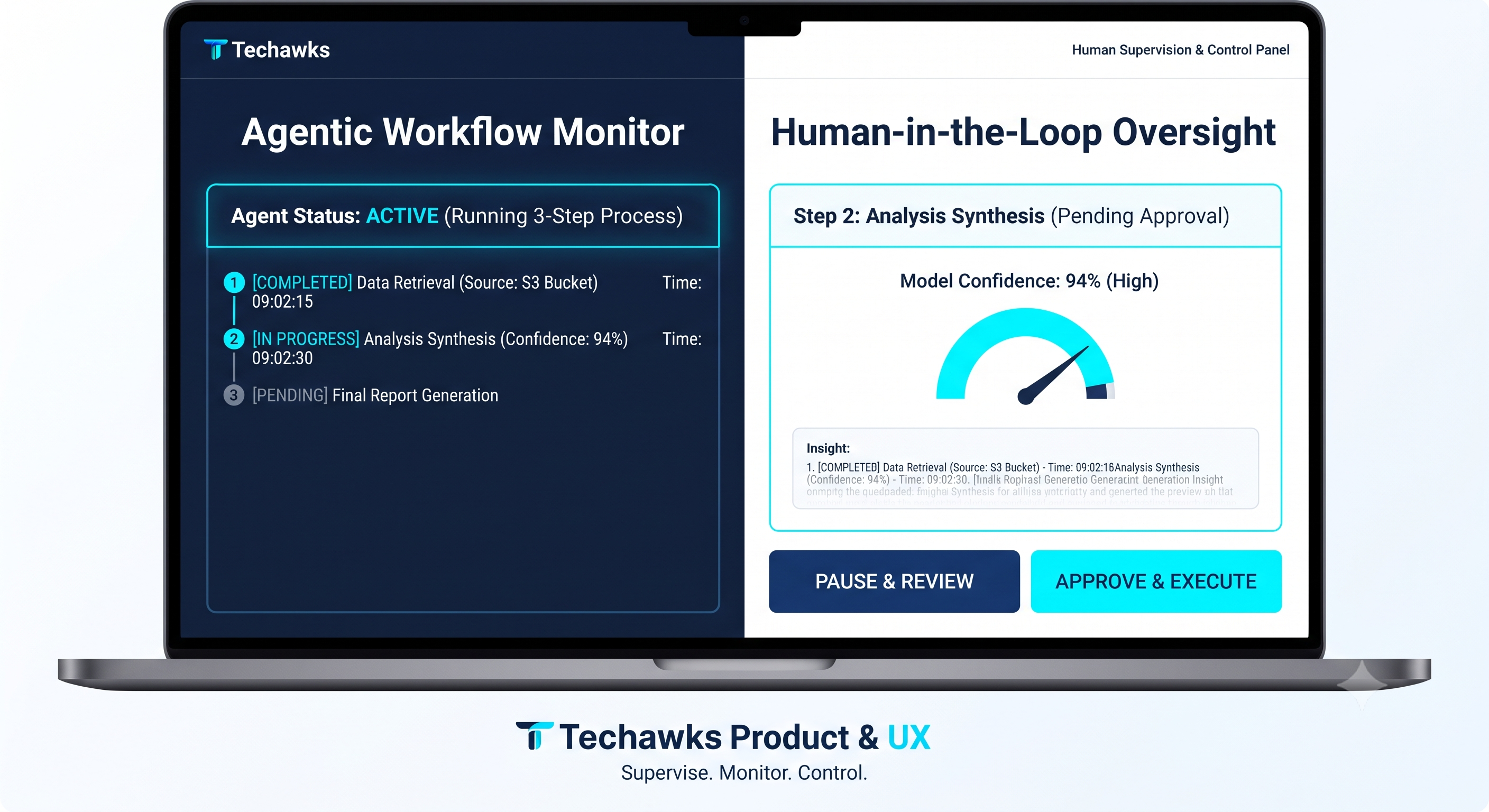
As products shift from simple text prompts to autonomous, multi-step agentic workflows, the role of product managers and designers has fundamentally evolved. You are no longer just designing static screens or linear forms; you are building supervision spaces where humans delegate, monitor, and override automated decisions.
To build trust, reduce cognitive load, and prevent user churn in modern AI applications, use this actionable Agentic UX checklist:
Design for Radical Transparency: Never treat AI output as an absolute black box. Surface confidence scores, cite data sources, and show the intermediate steps an agent takes so users understand why a recommendation was made.
Implement Seamless Interruption & Override Controls: Give users absolute authority. Ensure every automated action can be previewed, paused, edited, or stopped mid-flight without breaking the entire workflow.
Build Clear Failure-State Design: When models hallucinate, hit rate limits, or encounter ambiguous inputs, avoid generic error spinners. Design graceful fallback states with clear manual recovery paths.
Prioritize Calm Over Complexity: Resist the urge to clutter dashboards with endless model metrics. Use progressive disclosure to reveal technical complexity only when the user explicitly requests a deep dive.
Discussion Question: What is your biggest friction point when designing for AI-driven products—communicating model uncertainty without losing user trust, or building intuitive controls for multi-step agent workflows? Let us know below!
CTA (Join Product, UX & Design): Ready to build the next generation of user-centric digital experiences? Join Product, UX & Design to access advanced frameworks, teardowns, and top-tier career growth resources.
As products shift from simple text prompts to autonomous, multi-step agentic workflows, the role of product managers and designers has fundamentally evolved. You are no longer just designing static screens or linear forms; you are building supervision spaces where humans delegate, monitor, and override automated decisions.
To build trust, reduce cognitive load, and prevent user churn in modern AI applications, use this actionable Agentic UX checklist:
Design for Radical Transparency: Never treat AI output as an absolute black box. Surface confidence scores, cite data sources, and show the intermediate steps an agent takes so users understand why a recommendation was made.
Implement Seamless Interruption & Override Controls: Give users absolute authority. Ensure every automated action can be previewed, paused, edited, or stopped mid-flight without breaking the entire workflow.
Build Clear Failure-State Design: When models hallucinate, hit rate limits, or encounter ambiguous inputs, avoid generic error spinners. Design graceful fallback states with clear manual recovery paths.
Prioritize Calm Over Complexity: Resist the urge to clutter dashboards with endless model metrics. Use progressive disclosure to reveal technical complexity only when the user explicitly requests a deep dive.
Discussion Question: What is your biggest friction point when designing for AI-driven products—communicating model uncertainty without losing user trust, or building intuitive controls for multi-step agent workflows? Let us know below!
CTA (Join Product, UX & Design): Ready to build the next generation of user-centric digital experiences? Join Product, UX & Design to access advanced frameworks, teardowns, and top-tier career growth resources.
Stop Designing AI Like a Chatbot: The 4-Step Agentic UX & Supervision Checklist for Modern Product Teams
As products shift from simple text prompts to autonomous, multi-step agentic workflows, the role of product managers and designers has fundamentally evolved. You are no longer just designing static screens or linear forms; you are building supervision spaces where humans delegate, monitor, and override automated decisions.
To build trust, reduce cognitive load, and prevent user churn in modern AI applications, use this actionable Agentic UX checklist:
Design for Radical Transparency: Never treat AI output as an absolute black box. Surface confidence scores, cite data sources, and show the intermediate steps an agent takes so users understand why a recommendation was made.
Implement Seamless Interruption & Override Controls: Give users absolute authority. Ensure every automated action can be previewed, paused, edited, or stopped mid-flight without breaking the entire workflow.
Build Clear Failure-State Design: When models hallucinate, hit rate limits, or encounter ambiguous inputs, avoid generic error spinners. Design graceful fallback states with clear manual recovery paths.
Prioritize Calm Over Complexity: Resist the urge to clutter dashboards with endless model metrics. Use progressive disclosure to reveal technical complexity only when the user explicitly requests a deep dive.
Discussion Question: What is your biggest friction point when designing for AI-driven products—communicating model uncertainty without losing user trust, or building intuitive controls for multi-step agent workflows? Let us know below!
CTA (Join Product, UX & Design): Ready to build the next generation of user-centric digital experiences? Join Product, UX & Design to access advanced frameworks, teardowns, and top-tier career growth resources.

 Arabic
 French
 Spanish
 Portuguese
 Deutsch
 Turkish
 Dutch
Dutch
 Italiano
 Russian
 Romaian
 Portuguese (Brazil)
 Greek
Greek