


Is Your AI Agent Production-Ready or an IAM Liability?
As US enterprises shift from simple LLM wrappers to multi-step autonomous AI agents, enterprise security architecture is hitting a wall.
When an agent plans dynamically, executes tool calls, and accesses downstream databases, standard perimeter defenses and static service accounts fail. If an agent’s identity inherits broad user permissions or runs unchecked API tokens, a single prompt injection can trigger unintended writes, data leakage, or runaway tool execution.
Before you push that autonomous workflow to production, run your architecture against this Production AI Agent Readiness Checklist:
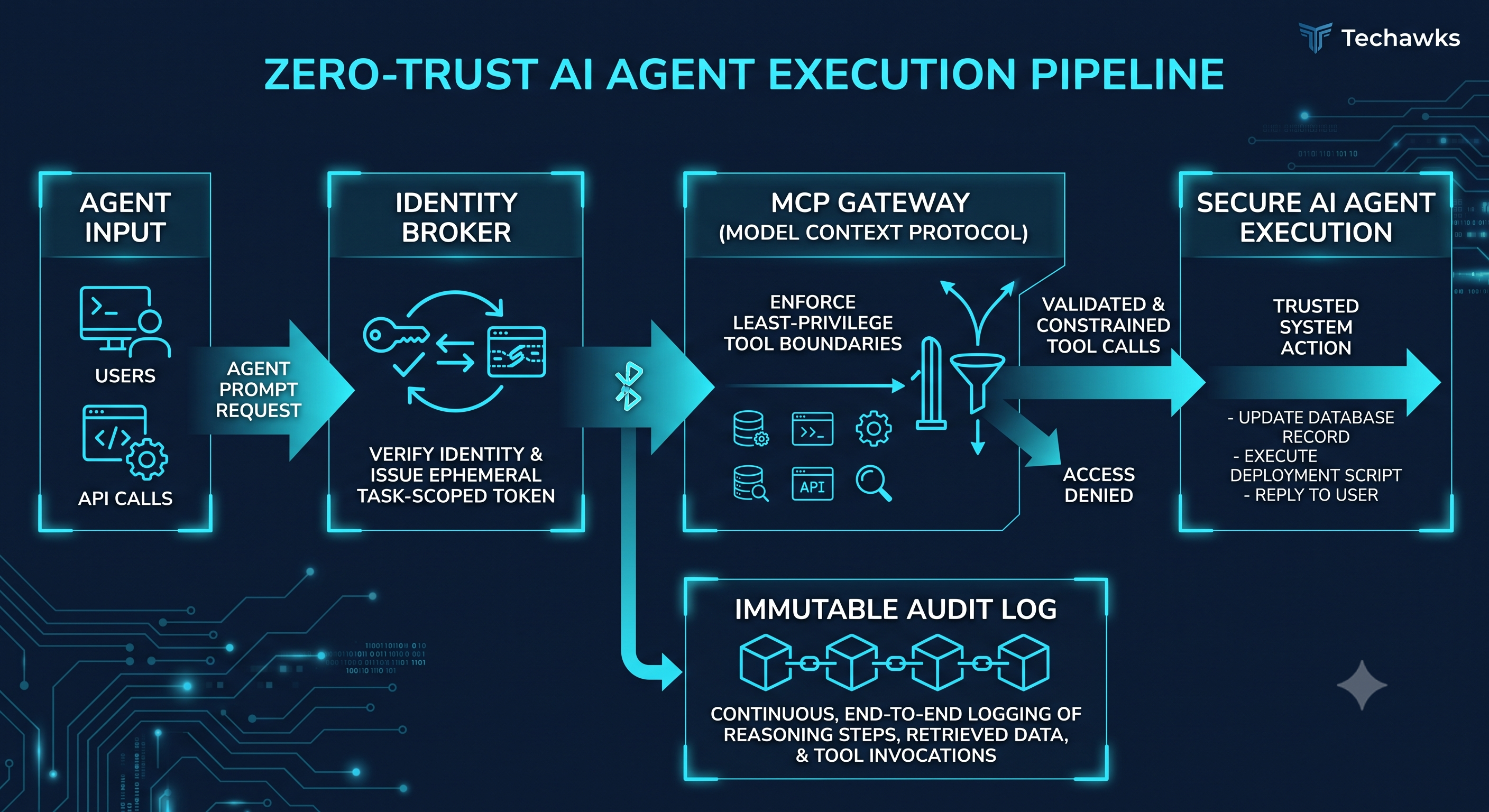
[ ] Ephemeral, Task-Scoped Identity: Does the agent hold long-lived credentials, or does it request short-lived, brokered tokens strictly bound to its current runtime task?
[ ] Tool-Level Blast Radius Bounds: Are MCP (Model Context Protocol) and API permissions constrained to least-privilege, blocking administrative escalation or unauthorized schema modifications?
[ ] Deterministic Step & Loop Caps: Have you established hard limits on execution retries, tool iteration cycles, and autonomous timeouts to prevent runaway API spend and deadlocks?
[ ] Indirect Prompt Injection Filters: Is incoming content from web pages, emails, or retrieval stores sanitized and isolated before parsing into the agent’s execution context?
[ ] Non-Repudiation Audit Trails: Can your security team reconstruct an immutable, end-to-end log of the agent’s reasoning steps, data retrieved, tool invocations, and user confirmations?
[ ] Context-Aware Human-in-the-Loop (HITL): Are irreversible actions (e.g., financial disbursements, record deletion) protected by intentional review gates rather than passive, click-through confirmations?
Autonomous systems need rigorous, zero-trust infrastructure. If you can’t isolate the agent's identity, you haven't built an automated workflow—you've built an ungoverned backdoor.
Discussion Question
What is your team’s biggest architectural bottleneck when moving autonomous agents from sandbox to production—identity management, prompt injection defense, or execution limits?
CTA
Join Techawks USA to connect with enterprise engineers, cloud architects, and security leaders building the next generation of resilient AI infrastructure.
As US enterprises shift from simple LLM wrappers to multi-step autonomous AI agents, enterprise security architecture is hitting a wall.
When an agent plans dynamically, executes tool calls, and accesses downstream databases, standard perimeter defenses and static service accounts fail. If an agent’s identity inherits broad user permissions or runs unchecked API tokens, a single prompt injection can trigger unintended writes, data leakage, or runaway tool execution.
Before you push that autonomous workflow to production, run your architecture against this Production AI Agent Readiness Checklist:
[ ] Ephemeral, Task-Scoped Identity: Does the agent hold long-lived credentials, or does it request short-lived, brokered tokens strictly bound to its current runtime task?
[ ] Tool-Level Blast Radius Bounds: Are MCP (Model Context Protocol) and API permissions constrained to least-privilege, blocking administrative escalation or unauthorized schema modifications?
[ ] Deterministic Step & Loop Caps: Have you established hard limits on execution retries, tool iteration cycles, and autonomous timeouts to prevent runaway API spend and deadlocks?
[ ] Indirect Prompt Injection Filters: Is incoming content from web pages, emails, or retrieval stores sanitized and isolated before parsing into the agent’s execution context?
[ ] Non-Repudiation Audit Trails: Can your security team reconstruct an immutable, end-to-end log of the agent’s reasoning steps, data retrieved, tool invocations, and user confirmations?
[ ] Context-Aware Human-in-the-Loop (HITL): Are irreversible actions (e.g., financial disbursements, record deletion) protected by intentional review gates rather than passive, click-through confirmations?
Autonomous systems need rigorous, zero-trust infrastructure. If you can’t isolate the agent's identity, you haven't built an automated workflow—you've built an ungoverned backdoor.
Discussion Question
What is your team’s biggest architectural bottleneck when moving autonomous agents from sandbox to production—identity management, prompt injection defense, or execution limits?
CTA
Join Techawks USA to connect with enterprise engineers, cloud architects, and security leaders building the next generation of resilient AI infrastructure.
Is Your AI Agent Production-Ready or an IAM Liability?
As US enterprises shift from simple LLM wrappers to multi-step autonomous AI agents, enterprise security architecture is hitting a wall.
When an agent plans dynamically, executes tool calls, and accesses downstream databases, standard perimeter defenses and static service accounts fail. If an agent’s identity inherits broad user permissions or runs unchecked API tokens, a single prompt injection can trigger unintended writes, data leakage, or runaway tool execution.
Before you push that autonomous workflow to production, run your architecture against this Production AI Agent Readiness Checklist:
[ ] Ephemeral, Task-Scoped Identity: Does the agent hold long-lived credentials, or does it request short-lived, brokered tokens strictly bound to its current runtime task?
[ ] Tool-Level Blast Radius Bounds: Are MCP (Model Context Protocol) and API permissions constrained to least-privilege, blocking administrative escalation or unauthorized schema modifications?
[ ] Deterministic Step & Loop Caps: Have you established hard limits on execution retries, tool iteration cycles, and autonomous timeouts to prevent runaway API spend and deadlocks?
[ ] Indirect Prompt Injection Filters: Is incoming content from web pages, emails, or retrieval stores sanitized and isolated before parsing into the agent’s execution context?
[ ] Non-Repudiation Audit Trails: Can your security team reconstruct an immutable, end-to-end log of the agent’s reasoning steps, data retrieved, tool invocations, and user confirmations?
[ ] Context-Aware Human-in-the-Loop (HITL): Are irreversible actions (e.g., financial disbursements, record deletion) protected by intentional review gates rather than passive, click-through confirmations?
Autonomous systems need rigorous, zero-trust infrastructure. If you can’t isolate the agent's identity, you haven't built an automated workflow—you've built an ungoverned backdoor.
Discussion Question
What is your team’s biggest architectural bottleneck when moving autonomous agents from sandbox to production—identity management, prompt injection defense, or execution limits?
CTA
Join Techawks USA to connect with enterprise engineers, cloud architects, and security leaders building the next generation of resilient AI infrastructure.

 English
 Arabic
 French
 Spanish
 Portuguese
 Deutsch
 Turkish
 Italiano
 Russian
 Romaian
 Portuguese (Brazil)
 Greek
Greek