


Canadian Tech’s Cloud Sovereignty Shift: Are Your Pipelines Actually Border-Proof?
As Canadian startups and scale-ups ramp up AI deployments, technical leads face a sharp divergence between physical server location and legal/operational data sovereignty.
Foreign-owned hyperscalers operating out of Montreal or Calgary are still subject to extraterritorial subpoena frameworks (such as the US CLOUD Act). Furthermore, emerging standards under Canada's Sovereign AI Compute initiatives mandate strict rules around data custody, pipeline provenance, and supply chain exposure.
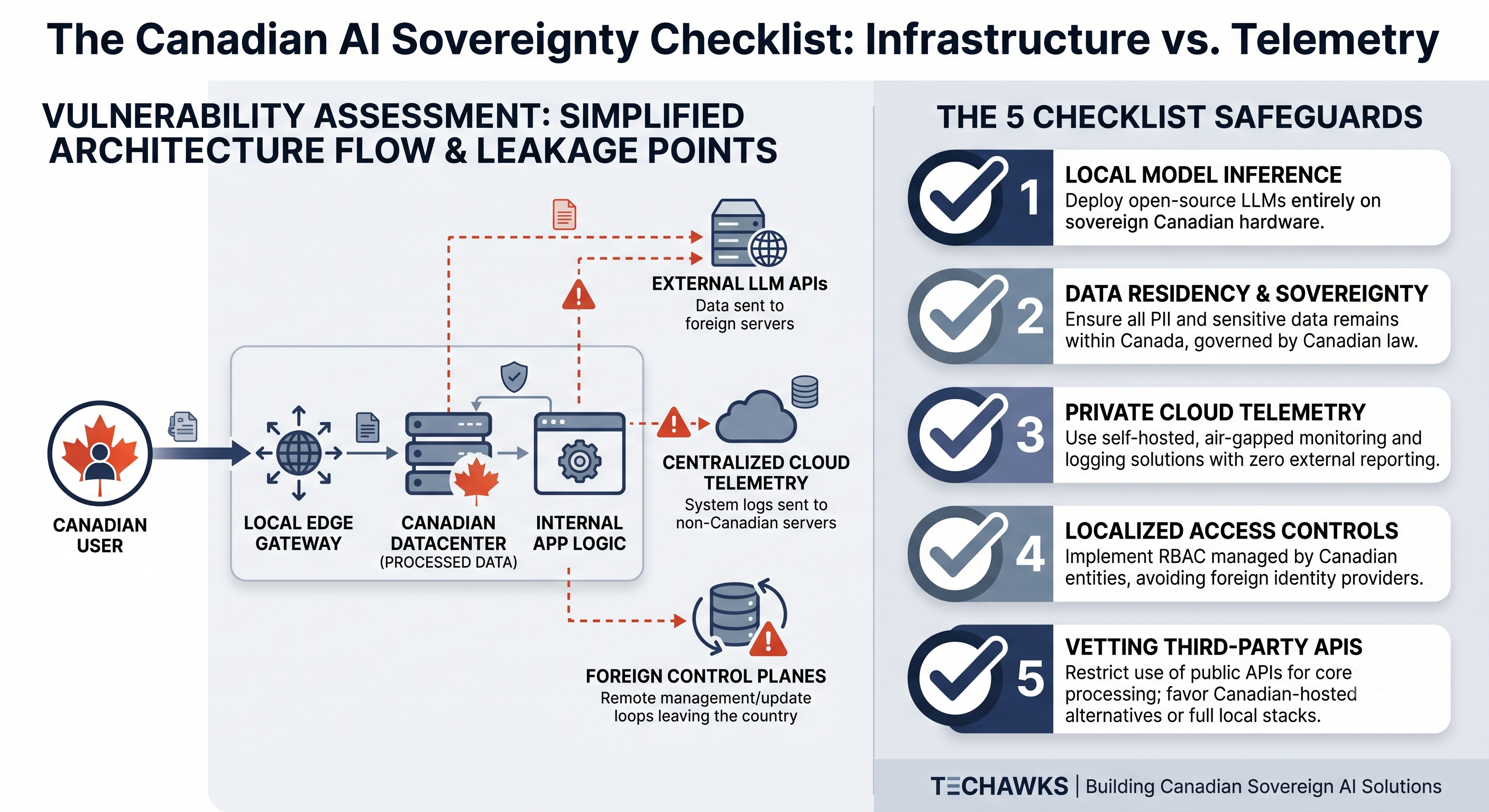
If your team is building or shipping AI products in Canada, run through this practical architectural checklist:
The Canadian Sovereign Data & AI Architecture Checklist
[ ] 1. Decouple Metadata from Model Telemetry
Storing primary weights or relational data in a Canadian availability zone is only half the battle. Verify that logging collectors (e.g., Datadog, LangSmith, cloud provider analytics) are not routing token prompts or telemetry logs to foreign control planes.
[ ] 2. Audit Third-Party Model Endpoints for Transit Compliance
If your app leverages proprietary LLM APIs via zero-data-retention agreements, confirm that traffic routing stays strictly within domestic edge routers. Many managed API gateways auto-route failover traffic to US-East clusters without explicit geographic route pinning.
[ ] 3. Implement Bring-Your-Own-KMS (Customer-Managed Encryption Keys)
Ensure all training datasets, vector stores, and blob caches are encrypted at rest using keys managed through an on-prem or sovereign Hardware Security Module (HSM) where the decryption key cannot be extracted via cloud provider administrative escalation.
[ ] 4. Build Data Lineage Maps for AIDA / CPPA Readiness
Maintain programmatic audit trails showing: (a) origin of training/fine-tuning sets, (b) consent verification tags per user record, and (c) explicit data isolation mechanisms for synthetic data vs. identifiable PII.
[ ] 5. Validate Multi-Cloud / Sovereign Compute Failover
Assess whether your core inferencing or batch pipeline can migrate to Canadian-controlled compute platforms (such as domestic supercompute clusters or regional GPU clouds) without deep proprietary API lock-in.
Discussion Question
For the engineering leaders and CTOs in our network: How are you managing cross-border data telemetry and API failover routes for your production AI features? Are you actively evaluating domestic Canadian sovereign compute alternatives?
CTA (Join Techawks Canada)
Building the future of Canadian tech requires staying ahead of architecture shifts, policy updates, and ecosystem milestones.
👉 Join Techawks Canada to connect with engineers, founders, and tech leaders driving innovation from Vancouver to Halifax. Follow the page and join the conversation today!
As Canadian startups and scale-ups ramp up AI deployments, technical leads face a sharp divergence between physical server location and legal/operational data sovereignty.
Foreign-owned hyperscalers operating out of Montreal or Calgary are still subject to extraterritorial subpoena frameworks (such as the US CLOUD Act). Furthermore, emerging standards under Canada's Sovereign AI Compute initiatives mandate strict rules around data custody, pipeline provenance, and supply chain exposure.
If your team is building or shipping AI products in Canada, run through this practical architectural checklist:
The Canadian Sovereign Data & AI Architecture Checklist
[ ] 1. Decouple Metadata from Model Telemetry
Storing primary weights or relational data in a Canadian availability zone is only half the battle. Verify that logging collectors (e.g., Datadog, LangSmith, cloud provider analytics) are not routing token prompts or telemetry logs to foreign control planes.
[ ] 2. Audit Third-Party Model Endpoints for Transit Compliance
If your app leverages proprietary LLM APIs via zero-data-retention agreements, confirm that traffic routing stays strictly within domestic edge routers. Many managed API gateways auto-route failover traffic to US-East clusters without explicit geographic route pinning.
[ ] 3. Implement Bring-Your-Own-KMS (Customer-Managed Encryption Keys)
Ensure all training datasets, vector stores, and blob caches are encrypted at rest using keys managed through an on-prem or sovereign Hardware Security Module (HSM) where the decryption key cannot be extracted via cloud provider administrative escalation.
[ ] 4. Build Data Lineage Maps for AIDA / CPPA Readiness
Maintain programmatic audit trails showing: (a) origin of training/fine-tuning sets, (b) consent verification tags per user record, and (c) explicit data isolation mechanisms for synthetic data vs. identifiable PII.
[ ] 5. Validate Multi-Cloud / Sovereign Compute Failover
Assess whether your core inferencing or batch pipeline can migrate to Canadian-controlled compute platforms (such as domestic supercompute clusters or regional GPU clouds) without deep proprietary API lock-in.
Discussion Question
For the engineering leaders and CTOs in our network: How are you managing cross-border data telemetry and API failover routes for your production AI features? Are you actively evaluating domestic Canadian sovereign compute alternatives?
CTA (Join Techawks Canada)
Building the future of Canadian tech requires staying ahead of architecture shifts, policy updates, and ecosystem milestones.
👉 Join Techawks Canada to connect with engineers, founders, and tech leaders driving innovation from Vancouver to Halifax. Follow the page and join the conversation today!
Canadian Tech’s Cloud Sovereignty Shift: Are Your Pipelines Actually Border-Proof?
As Canadian startups and scale-ups ramp up AI deployments, technical leads face a sharp divergence between physical server location and legal/operational data sovereignty.
Foreign-owned hyperscalers operating out of Montreal or Calgary are still subject to extraterritorial subpoena frameworks (such as the US CLOUD Act). Furthermore, emerging standards under Canada's Sovereign AI Compute initiatives mandate strict rules around data custody, pipeline provenance, and supply chain exposure.
If your team is building or shipping AI products in Canada, run through this practical architectural checklist:
The Canadian Sovereign Data & AI Architecture Checklist
[ ] 1. Decouple Metadata from Model Telemetry
Storing primary weights or relational data in a Canadian availability zone is only half the battle. Verify that logging collectors (e.g., Datadog, LangSmith, cloud provider analytics) are not routing token prompts or telemetry logs to foreign control planes.
[ ] 2. Audit Third-Party Model Endpoints for Transit Compliance
If your app leverages proprietary LLM APIs via zero-data-retention agreements, confirm that traffic routing stays strictly within domestic edge routers. Many managed API gateways auto-route failover traffic to US-East clusters without explicit geographic route pinning.
[ ] 3. Implement Bring-Your-Own-KMS (Customer-Managed Encryption Keys)
Ensure all training datasets, vector stores, and blob caches are encrypted at rest using keys managed through an on-prem or sovereign Hardware Security Module (HSM) where the decryption key cannot be extracted via cloud provider administrative escalation.
[ ] 4. Build Data Lineage Maps for AIDA / CPPA Readiness
Maintain programmatic audit trails showing: (a) origin of training/fine-tuning sets, (b) consent verification tags per user record, and (c) explicit data isolation mechanisms for synthetic data vs. identifiable PII.
[ ] 5. Validate Multi-Cloud / Sovereign Compute Failover
Assess whether your core inferencing or batch pipeline can migrate to Canadian-controlled compute platforms (such as domestic supercompute clusters or regional GPU clouds) without deep proprietary API lock-in.
Discussion Question
For the engineering leaders and CTOs in our network: How are you managing cross-border data telemetry and API failover routes for your production AI features? Are you actively evaluating domestic Canadian sovereign compute alternatives?
CTA (Join Techawks Canada)
Building the future of Canadian tech requires staying ahead of architecture shifts, policy updates, and ecosystem milestones.
👉 Join Techawks Canada to connect with engineers, founders, and tech leaders driving innovation from Vancouver to Halifax. Follow the page and join the conversation today!

 English
 Arabic
 French
 Portuguese
 Deutsch
 Turkish
 Dutch
Dutch
 Italiano
 Russian
 Romaian
 Portuguese (Brazil)
 Greek
Greek