


The UK Tech Career Crossroads: Permanent role vs. Outside IR35 contracting?
For years, the standard playbook for a mid-to-senior software engineer in the UK was simple: gain three years of full-time experience, then pivot to daily-rate contracting for an immediate bump in net earnings.
Today, navigating IR35 reforms, pension matching schemes, and startup equity packages means the gap isn’t as clear-cut as comparing an £85k salary to a £600 day rate.
Whether you're based around Old Street, Cambridge, Manchester, or working fully remote across the UK, which route currently yields the best balance of leverage, compensation, and career growth?
Poll Question:
Looking at long-term total compensation and stability in the UK market, where are you placing your bet today?
[ ] Permanent (Product-led firms with equity/RSUs)
[ ] Outside IR35 Contracting (Specialised niches)
[ ] Inside IR35 Contracting (Consistent high day rates)
[ ] Building an independent consultancy/agency
Key Takeaways
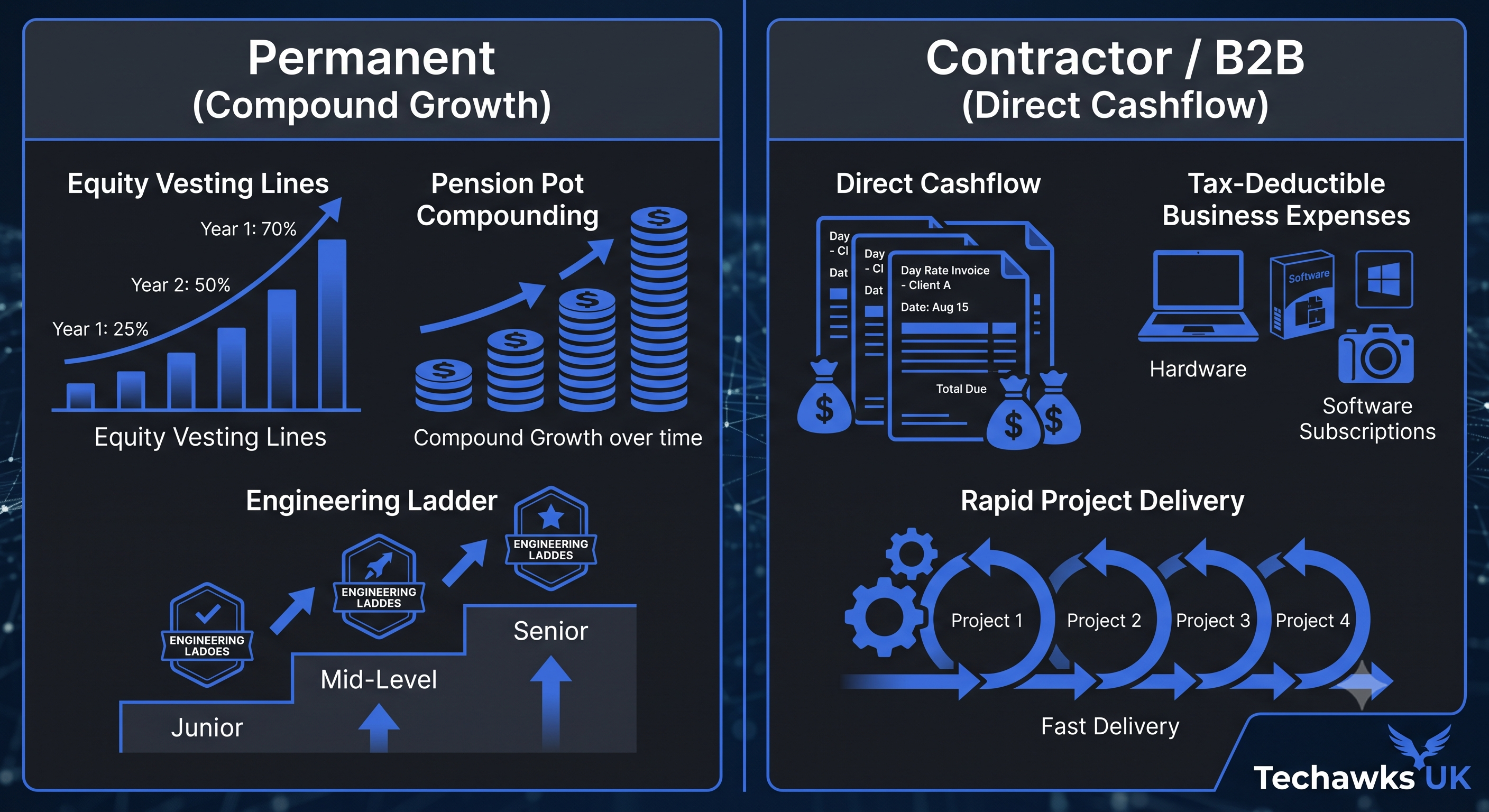
Pensions and equity narrow the cash gap: A competitive salary with an 8–10% non-contributory pension match, private healthcare, and liquid RSUs often outpaces the net take-home of an inside-IR35 umbrella contract once employer NICs and apprenticeship levies are deducted.
Specialisation defends the outside-IR35 boundary: True outside-IR35 contracts still exist, but they are increasingly reserved for distinct deliverables—such as cloud security compliance, platform migrations, or data engineering overhauls—rather than generic staff augmentation.
Ownership vs. velocity: Permanent roles at scaling tech firms offer compound equity value and team leadership experience, while contracting maximizes immediate cash flow and exposure to varied enterprise tech stacks.
CTA (Join Techawks UK)
Cast your vote above, share your breakdown in the comments, and follow Techawks UK for pragmatic, actionable career insights tailored to the British engineering ecosystem.
For years, the standard playbook for a mid-to-senior software engineer in the UK was simple: gain three years of full-time experience, then pivot to daily-rate contracting for an immediate bump in net earnings.
Today, navigating IR35 reforms, pension matching schemes, and startup equity packages means the gap isn’t as clear-cut as comparing an £85k salary to a £600 day rate.
Whether you're based around Old Street, Cambridge, Manchester, or working fully remote across the UK, which route currently yields the best balance of leverage, compensation, and career growth?
Poll Question:
Looking at long-term total compensation and stability in the UK market, where are you placing your bet today?
[ ] Permanent (Product-led firms with equity/RSUs)
[ ] Outside IR35 Contracting (Specialised niches)
[ ] Inside IR35 Contracting (Consistent high day rates)
[ ] Building an independent consultancy/agency
Key Takeaways
Pensions and equity narrow the cash gap: A competitive salary with an 8–10% non-contributory pension match, private healthcare, and liquid RSUs often outpaces the net take-home of an inside-IR35 umbrella contract once employer NICs and apprenticeship levies are deducted.
Specialisation defends the outside-IR35 boundary: True outside-IR35 contracts still exist, but they are increasingly reserved for distinct deliverables—such as cloud security compliance, platform migrations, or data engineering overhauls—rather than generic staff augmentation.
Ownership vs. velocity: Permanent roles at scaling tech firms offer compound equity value and team leadership experience, while contracting maximizes immediate cash flow and exposure to varied enterprise tech stacks.
CTA (Join Techawks UK)
Cast your vote above, share your breakdown in the comments, and follow Techawks UK for pragmatic, actionable career insights tailored to the British engineering ecosystem.
The UK Tech Career Crossroads: Permanent role vs. Outside IR35 contracting?
For years, the standard playbook for a mid-to-senior software engineer in the UK was simple: gain three years of full-time experience, then pivot to daily-rate contracting for an immediate bump in net earnings.
Today, navigating IR35 reforms, pension matching schemes, and startup equity packages means the gap isn’t as clear-cut as comparing an £85k salary to a £600 day rate.
Whether you're based around Old Street, Cambridge, Manchester, or working fully remote across the UK, which route currently yields the best balance of leverage, compensation, and career growth?
Poll Question:
Looking at long-term total compensation and stability in the UK market, where are you placing your bet today?
[ ] Permanent (Product-led firms with equity/RSUs)
[ ] Outside IR35 Contracting (Specialised niches)
[ ] Inside IR35 Contracting (Consistent high day rates)
[ ] Building an independent consultancy/agency
Key Takeaways
Pensions and equity narrow the cash gap: A competitive salary with an 8–10% non-contributory pension match, private healthcare, and liquid RSUs often outpaces the net take-home of an inside-IR35 umbrella contract once employer NICs and apprenticeship levies are deducted.
Specialisation defends the outside-IR35 boundary: True outside-IR35 contracts still exist, but they are increasingly reserved for distinct deliverables—such as cloud security compliance, platform migrations, or data engineering overhauls—rather than generic staff augmentation.
Ownership vs. velocity: Permanent roles at scaling tech firms offer compound equity value and team leadership experience, while contracting maximizes immediate cash flow and exposure to varied enterprise tech stacks.
CTA (Join Techawks UK)
Cast your vote above, share your breakdown in the comments, and follow Techawks UK for pragmatic, actionable career insights tailored to the British engineering ecosystem.

 English
 Arabic
 French
 Spanish
 Portuguese
 Turkish
 Dutch
Dutch
 Italiano
 Russian
 Romaian
 Portuguese (Brazil)
 Greek
Greek