


The "Generalist SWE" Squeeze: Why 31% of US Tech Postings Are Demanding AI System Design
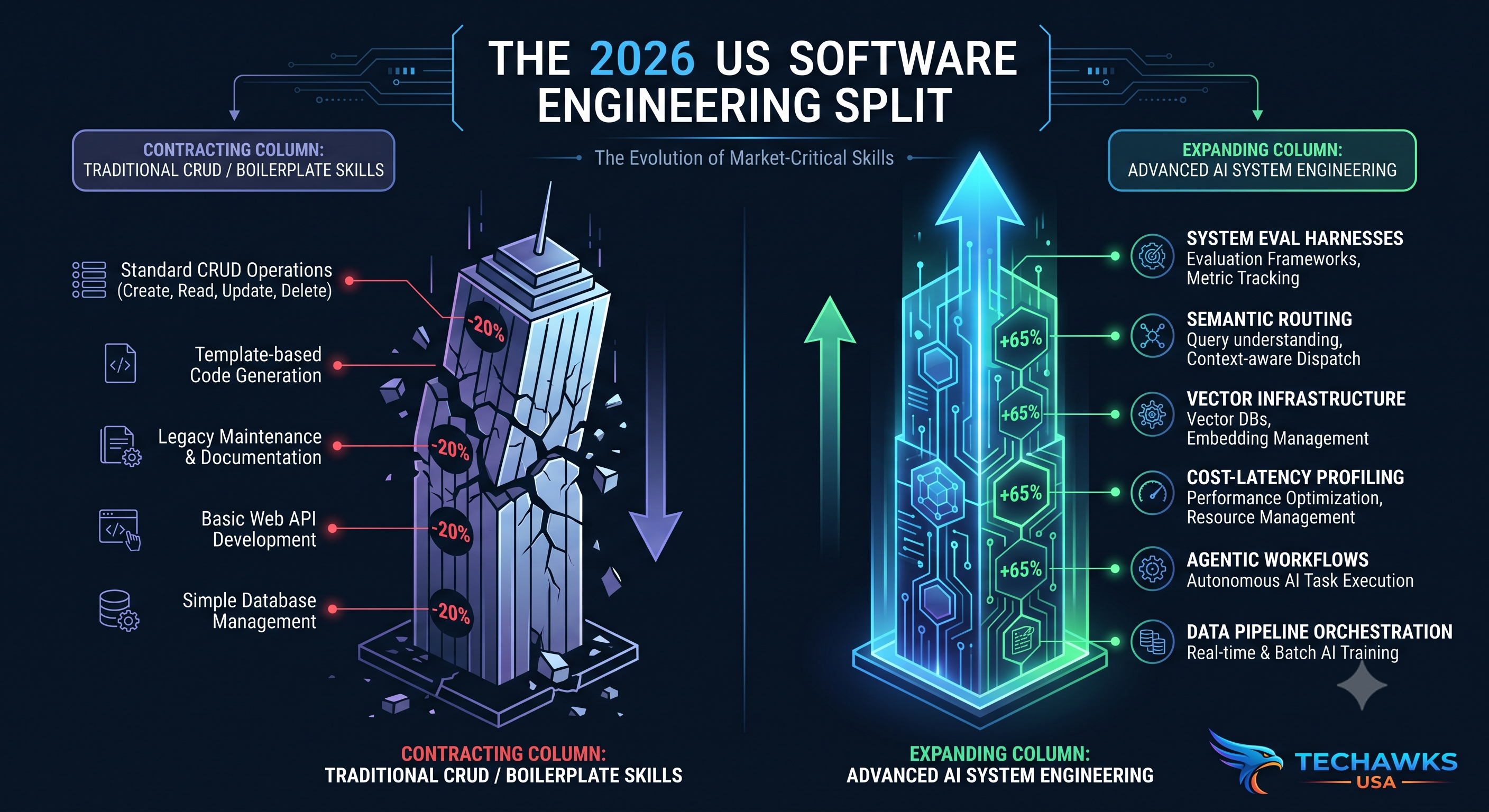
The US software job market hasn't evaporated; it has bifurcated. Across major tech hubs—from Seattle to Silicon Valley—non-AI software postings have fallen sharply from their 2022 peak, while AI-specialized software roles now make up over 31% of total US tech job openings (and over 55% in the Bay Area alone).
Hiring managers at Tier-1 tech firms and well-capitalized startups are no longer looking for engineers who simply write code—generative tooling already handles the boilerplate. The modern hiring bar has shifted toward compound AI engineering: building reliable, deterministic systems on top of non-deterministic models.
To stand out in US technical screens right now, focus on three specific capabilities:
Production Evals Over Prompting
Interviewers don't care if you know how to write a prompt. They care if you know how to benchmark it. Demonstrate how you build automated regression tests for LLM outputs, track context drift, and implement deterministic fallback chains using tools like LangSmith, Braintrust, or custom evaluation harnesses.
Mastering the P95 Latency & Token Economy
Real-world engineering is constrained by margins. Senior candidates are evaluated on operational trade-offs: when to leverage semantic caching, how to route between small open-weights (e.g., Llama 3) for inference vs. frontier reasoning models, and how to keep tail latency (p95) under 500ms in user-facing flows.
Data Ingestion and Vector Infrastructure
Modern software architecture is tightly coupled with the data plane. Show verifiable experience orchestrating high-throughput ingestion pipelines, handling hybrid search (dense vector retrieval alongside BM25 keyword matching), and mitigating vector database index fragmentation at scale.
Ship verifiable, production-grade architectures with measurable metrics—latency, cost-per-query, and accuracy drift—rather than generic side projects.
Discussion Question
For engineers currently interviewing in the US: Are your system design rounds pivoting more toward distributed AI pipelines and evals, or are companies still sticking to traditional microservice designs?
CTA (Join Techawks USA)
Level up your career with deep architectural breakdowns and direct insights into the US hiring market. Follow Techawks USA and connect with top engineers building the future of enterprise software.
The US software job market hasn't evaporated; it has bifurcated. Across major tech hubs—from Seattle to Silicon Valley—non-AI software postings have fallen sharply from their 2022 peak, while AI-specialized software roles now make up over 31% of total US tech job openings (and over 55% in the Bay Area alone).
Hiring managers at Tier-1 tech firms and well-capitalized startups are no longer looking for engineers who simply write code—generative tooling already handles the boilerplate. The modern hiring bar has shifted toward compound AI engineering: building reliable, deterministic systems on top of non-deterministic models.
To stand out in US technical screens right now, focus on three specific capabilities:
Production Evals Over Prompting
Interviewers don't care if you know how to write a prompt. They care if you know how to benchmark it. Demonstrate how you build automated regression tests for LLM outputs, track context drift, and implement deterministic fallback chains using tools like LangSmith, Braintrust, or custom evaluation harnesses.
Mastering the P95 Latency & Token Economy
Real-world engineering is constrained by margins. Senior candidates are evaluated on operational trade-offs: when to leverage semantic caching, how to route between small open-weights (e.g., Llama 3) for inference vs. frontier reasoning models, and how to keep tail latency (p95) under 500ms in user-facing flows.
Data Ingestion and Vector Infrastructure
Modern software architecture is tightly coupled with the data plane. Show verifiable experience orchestrating high-throughput ingestion pipelines, handling hybrid search (dense vector retrieval alongside BM25 keyword matching), and mitigating vector database index fragmentation at scale.
Ship verifiable, production-grade architectures with measurable metrics—latency, cost-per-query, and accuracy drift—rather than generic side projects.
Discussion Question
For engineers currently interviewing in the US: Are your system design rounds pivoting more toward distributed AI pipelines and evals, or are companies still sticking to traditional microservice designs?
CTA (Join Techawks USA)
Level up your career with deep architectural breakdowns and direct insights into the US hiring market. Follow Techawks USA and connect with top engineers building the future of enterprise software.
The "Generalist SWE" Squeeze: Why 31% of US Tech Postings Are Demanding AI System Design
The US software job market hasn't evaporated; it has bifurcated. Across major tech hubs—from Seattle to Silicon Valley—non-AI software postings have fallen sharply from their 2022 peak, while AI-specialized software roles now make up over 31% of total US tech job openings (and over 55% in the Bay Area alone).
Hiring managers at Tier-1 tech firms and well-capitalized startups are no longer looking for engineers who simply write code—generative tooling already handles the boilerplate. The modern hiring bar has shifted toward compound AI engineering: building reliable, deterministic systems on top of non-deterministic models.
To stand out in US technical screens right now, focus on three specific capabilities:
Production Evals Over Prompting
Interviewers don't care if you know how to write a prompt. They care if you know how to benchmark it. Demonstrate how you build automated regression tests for LLM outputs, track context drift, and implement deterministic fallback chains using tools like LangSmith, Braintrust, or custom evaluation harnesses.
Mastering the P95 Latency & Token Economy
Real-world engineering is constrained by margins. Senior candidates are evaluated on operational trade-offs: when to leverage semantic caching, how to route between small open-weights (e.g., Llama 3) for inference vs. frontier reasoning models, and how to keep tail latency (p95) under 500ms in user-facing flows.
Data Ingestion and Vector Infrastructure
Modern software architecture is tightly coupled with the data plane. Show verifiable experience orchestrating high-throughput ingestion pipelines, handling hybrid search (dense vector retrieval alongside BM25 keyword matching), and mitigating vector database index fragmentation at scale.
Ship verifiable, production-grade architectures with measurable metrics—latency, cost-per-query, and accuracy drift—rather than generic side projects.
Discussion Question
For engineers currently interviewing in the US: Are your system design rounds pivoting more toward distributed AI pipelines and evals, or are companies still sticking to traditional microservice designs?
CTA (Join Techawks USA)
Level up your career with deep architectural breakdowns and direct insights into the US hiring market. Follow Techawks USA and connect with top engineers building the future of enterprise software.

 English
 Arabic
 French
 Spanish
 Portuguese
 Turkish
 Dutch
Dutch
 Italiano
 Russian
 Romaian
 Portuguese (Brazil)
 Greek
Greek