


The UAE’s Sovereign AI Mandate: Why "Wrapper Devs" Are Getting Replaced by Agentic Infrastructure Engineers
Across the UAE, tech hiring has severed ties with superficial generative wrappers. With the federal government mandating that 50% of government operations transition to agentic AI systems and DIFC aggressively expanding as an AI-native financial hub, the regional talent deficit is acute: AI and ML engineering demand has jumped 45% year-over-year, yet local qualified talent grew by barely 12%.
Engineering leads at sovereign entities, fintech scaleups, and regional enterprises are not hiring for prompt craft—they are paying top-of-market premiums (often 15–25% above traditional software roles) for engineers who can build autonomous, sovereign, and compliant systems.
To stand out in UAE technical rounds right now, master these three enterprise architectural imperatives:
In-Country Data Sovereignty & Localized Deployment
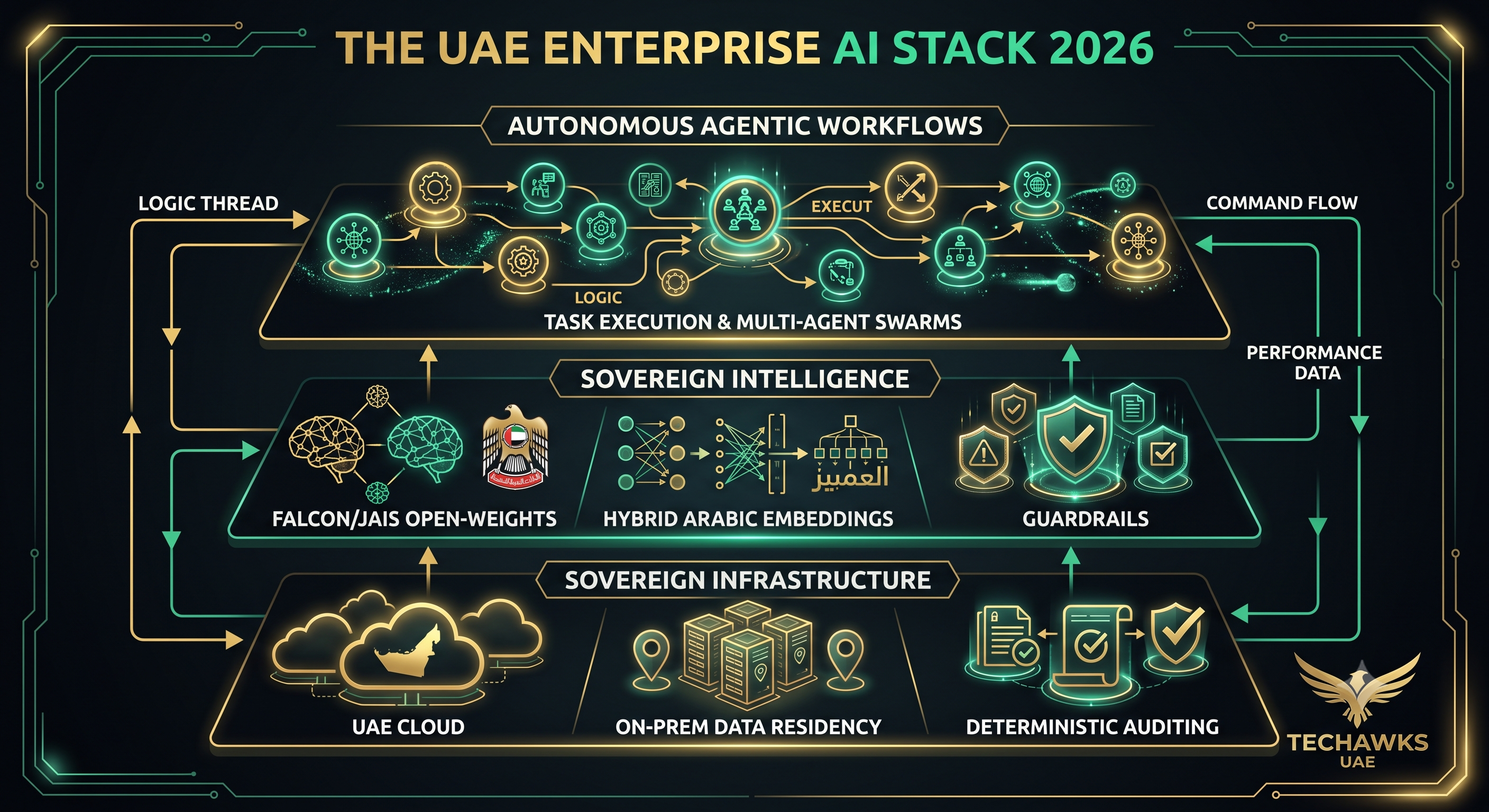
Under UAE data residency regulations and NESA/DESC compliance, sensitive enterprise and public-sector data cannot leave national borders. Candidates must know how to deploy, quantize, and serve sovereign open-weights (such as the UAE’s Falcon series or Jais) on local sovereign cloud stacks (e.g., Core42/G42 infrastructure) rather than blindly delegating inference to overseas third-party APIs.
Agentic State Machines Over Simple Chaining
Enterprise AI in the Emirates is transitioning from informational chatbots to autonomous transaction execution. Interviewers want to see multi-agent orchestration architectures with deterministic guardrails: handling state persistence, asynchronous tool-calling, and explicit human-in-the-loop approval gates that prevent cascading errors in mission-critical workflows.
Bilingual & Multi-Dialect Retrieval Benchmarking
Arabic-first or bilingual retrieval-augmented generation (RAG) is a core requirement across regional enterprise systems. Learn how to address morphological complexity in Arabic tokenization, construct hybrid dense-sparse vector indexes, and run automated evaluations against semantic drift across both Arabic and English query spaces.
Stop showcasing generic SaaS clones. Build systems that address in-country infrastructure, auditability, and autonomous task execution.
Discussion Question
For engineers building or interviewing in the UAE: What has been your biggest technical hurdle when adapting open-weight LLMs to local data sovereignty and Arabic tokenization requirements?
CTA (Join Techawks UAE)
Ready to navigate the Gulf’s fastest-growing tech corridor? Follow Techawks UAE for deep technical architecture teardowns, local hiring insights, and masterclasses designed for senior software and AI engineers.
Across the UAE, tech hiring has severed ties with superficial generative wrappers. With the federal government mandating that 50% of government operations transition to agentic AI systems and DIFC aggressively expanding as an AI-native financial hub, the regional talent deficit is acute: AI and ML engineering demand has jumped 45% year-over-year, yet local qualified talent grew by barely 12%.
Engineering leads at sovereign entities, fintech scaleups, and regional enterprises are not hiring for prompt craft—they are paying top-of-market premiums (often 15–25% above traditional software roles) for engineers who can build autonomous, sovereign, and compliant systems.
To stand out in UAE technical rounds right now, master these three enterprise architectural imperatives:
In-Country Data Sovereignty & Localized Deployment
Under UAE data residency regulations and NESA/DESC compliance, sensitive enterprise and public-sector data cannot leave national borders. Candidates must know how to deploy, quantize, and serve sovereign open-weights (such as the UAE’s Falcon series or Jais) on local sovereign cloud stacks (e.g., Core42/G42 infrastructure) rather than blindly delegating inference to overseas third-party APIs.
Agentic State Machines Over Simple Chaining
Enterprise AI in the Emirates is transitioning from informational chatbots to autonomous transaction execution. Interviewers want to see multi-agent orchestration architectures with deterministic guardrails: handling state persistence, asynchronous tool-calling, and explicit human-in-the-loop approval gates that prevent cascading errors in mission-critical workflows.
Bilingual & Multi-Dialect Retrieval Benchmarking
Arabic-first or bilingual retrieval-augmented generation (RAG) is a core requirement across regional enterprise systems. Learn how to address morphological complexity in Arabic tokenization, construct hybrid dense-sparse vector indexes, and run automated evaluations against semantic drift across both Arabic and English query spaces.
Stop showcasing generic SaaS clones. Build systems that address in-country infrastructure, auditability, and autonomous task execution.
Discussion Question
For engineers building or interviewing in the UAE: What has been your biggest technical hurdle when adapting open-weight LLMs to local data sovereignty and Arabic tokenization requirements?
CTA (Join Techawks UAE)
Ready to navigate the Gulf’s fastest-growing tech corridor? Follow Techawks UAE for deep technical architecture teardowns, local hiring insights, and masterclasses designed for senior software and AI engineers.
The UAE’s Sovereign AI Mandate: Why "Wrapper Devs" Are Getting Replaced by Agentic Infrastructure Engineers
Across the UAE, tech hiring has severed ties with superficial generative wrappers. With the federal government mandating that 50% of government operations transition to agentic AI systems and DIFC aggressively expanding as an AI-native financial hub, the regional talent deficit is acute: AI and ML engineering demand has jumped 45% year-over-year, yet local qualified talent grew by barely 12%.
Engineering leads at sovereign entities, fintech scaleups, and regional enterprises are not hiring for prompt craft—they are paying top-of-market premiums (often 15–25% above traditional software roles) for engineers who can build autonomous, sovereign, and compliant systems.
To stand out in UAE technical rounds right now, master these three enterprise architectural imperatives:
In-Country Data Sovereignty & Localized Deployment
Under UAE data residency regulations and NESA/DESC compliance, sensitive enterprise and public-sector data cannot leave national borders. Candidates must know how to deploy, quantize, and serve sovereign open-weights (such as the UAE’s Falcon series or Jais) on local sovereign cloud stacks (e.g., Core42/G42 infrastructure) rather than blindly delegating inference to overseas third-party APIs.
Agentic State Machines Over Simple Chaining
Enterprise AI in the Emirates is transitioning from informational chatbots to autonomous transaction execution. Interviewers want to see multi-agent orchestration architectures with deterministic guardrails: handling state persistence, asynchronous tool-calling, and explicit human-in-the-loop approval gates that prevent cascading errors in mission-critical workflows.
Bilingual & Multi-Dialect Retrieval Benchmarking
Arabic-first or bilingual retrieval-augmented generation (RAG) is a core requirement across regional enterprise systems. Learn how to address morphological complexity in Arabic tokenization, construct hybrid dense-sparse vector indexes, and run automated evaluations against semantic drift across both Arabic and English query spaces.
Stop showcasing generic SaaS clones. Build systems that address in-country infrastructure, auditability, and autonomous task execution.
Discussion Question
For engineers building or interviewing in the UAE: What has been your biggest technical hurdle when adapting open-weight LLMs to local data sovereignty and Arabic tokenization requirements?
CTA (Join Techawks UAE)
Ready to navigate the Gulf’s fastest-growing tech corridor? Follow Techawks UAE for deep technical architecture teardowns, local hiring insights, and masterclasses designed for senior software and AI engineers.

 English
 Arabic
 French
 Spanish
 Portuguese
 Deutsch
 Turkish
 Dutch
Dutch
 Russian
 Romaian
 Portuguese (Brazil)
 Greek
Greek