


Stop Writing YAML from Scratch: Why Platform Engineering Is Swallowing Traditional DevOps
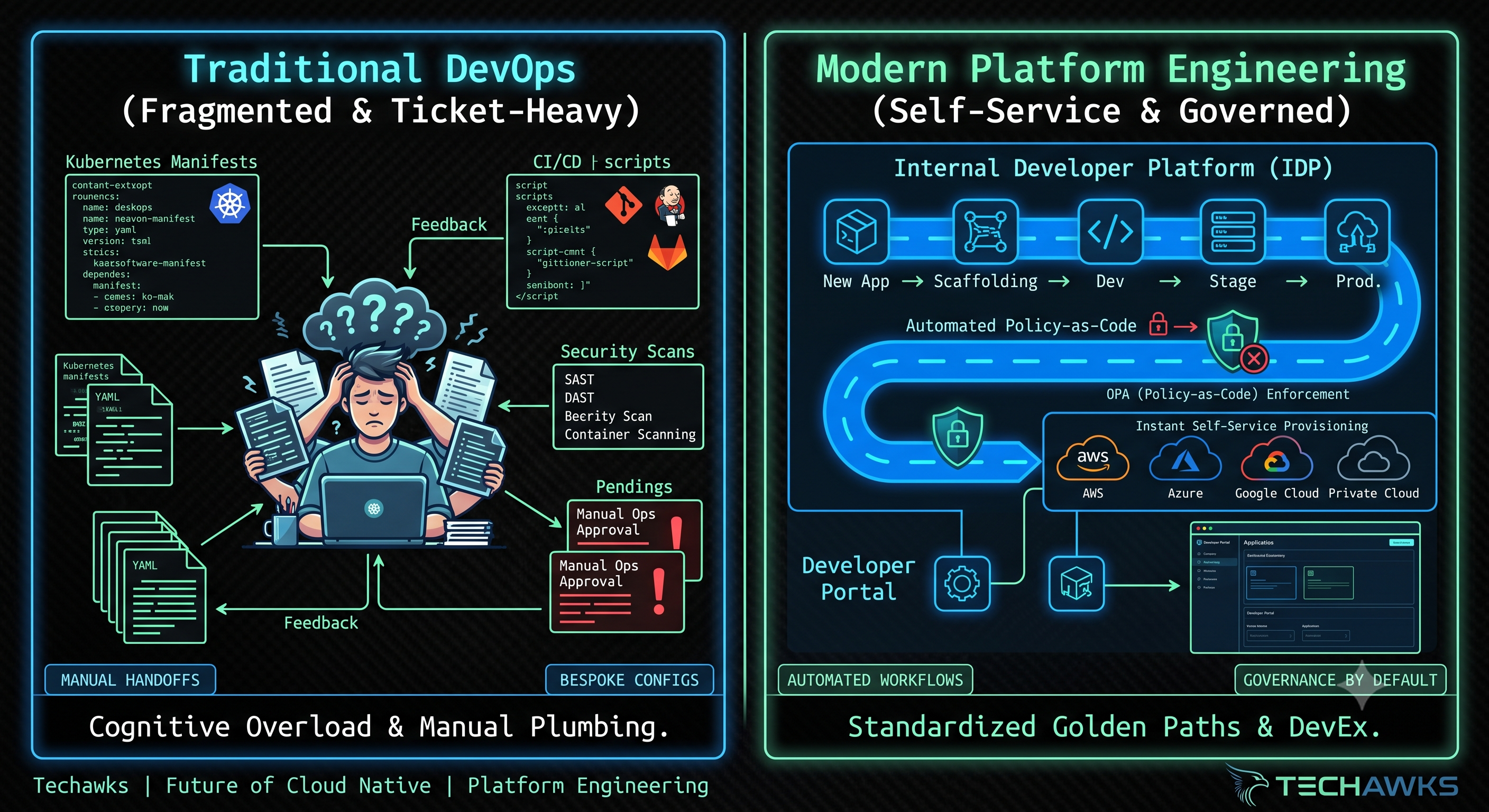
For years, the DevOps industry operated under a broken promise: "You build it, you run it." In practice, that dumped dozens of disparate tools—Kubernetes, CI/CD runners, secret managers, security scanners, and cloud IAM policies—straight onto feature developers. The outcome wasn't agility; it was cognitive overload and massive tool sprawl.
The cloud ecosystem has decisively moved past ad-hoc pipeline scripting into Internal Developer Platforms (IDPs) and Platform as a Product.
Why This Matters to Your Career
Automation scripts and declarative YAML are now easily synthesized by AI agents and platform orchestrators. The market no longer rewards engineers for manually plumbing infrastructure:
Yesterday's DevOps: Reactive gatekeeper. Writing one-off CI/CD configs, manually troubleshooting broken staging manifests, and approving access requests.
Tomorrow's Platform Engineer: Systems architect. Designing curated "Golden Paths," automated policy guardrails, and self-service abstractions where developers deploy safely without ever having to touch a cluster manifest.
The real leverage has migrated from running infrastructure to designing developer experience and governance systems.
The 3 High-Value Platform Capabilities to Build Now
Curated "Golden Paths" Over Endless Options: Replace custom deployment pipelines with opinionated, standardized templates. High-impact engineers build self-service portals (using frameworks like Backstage or open cloud primitives) that let devs ship to production in minutes with zero guesswork.
Policy-as-Code & Guardrails by Default: Instead of policing PRs manually, enforce security and compliance at runtime and compile time using tools like Open Policy Agent (OPA) or Kyverno. Shift the responsibility from human review to deterministic policy enforcement.
Observability & OpenTelemetry Integration: Raw cluster metrics are noise. Senior cloud engineers wire end-to-end distributed tracing and semantic conventions natively into the platform baseline so teams get instant root-cause diagnostics without configuring monitoring agents from scratch.
Discussion Question
Has your team transitioned toward true self-service platform engineering with governed "golden paths," or are your DevOps engineers still trapped acting as 24/7 infrastructure helpdesks for developers?
CTA
Share your deployment setup and operational reality in the comments. Where are the bottlenecks in your release lifecycle—tool fragmentation, brittle pipelines, or lack of developer self-service? Let's benchmark notes.
For years, the DevOps industry operated under a broken promise: "You build it, you run it." In practice, that dumped dozens of disparate tools—Kubernetes, CI/CD runners, secret managers, security scanners, and cloud IAM policies—straight onto feature developers. The outcome wasn't agility; it was cognitive overload and massive tool sprawl.
The cloud ecosystem has decisively moved past ad-hoc pipeline scripting into Internal Developer Platforms (IDPs) and Platform as a Product.
Why This Matters to Your Career
Automation scripts and declarative YAML are now easily synthesized by AI agents and platform orchestrators. The market no longer rewards engineers for manually plumbing infrastructure:
Yesterday's DevOps: Reactive gatekeeper. Writing one-off CI/CD configs, manually troubleshooting broken staging manifests, and approving access requests.
Tomorrow's Platform Engineer: Systems architect. Designing curated "Golden Paths," automated policy guardrails, and self-service abstractions where developers deploy safely without ever having to touch a cluster manifest.
The real leverage has migrated from running infrastructure to designing developer experience and governance systems.
The 3 High-Value Platform Capabilities to Build Now
Curated "Golden Paths" Over Endless Options: Replace custom deployment pipelines with opinionated, standardized templates. High-impact engineers build self-service portals (using frameworks like Backstage or open cloud primitives) that let devs ship to production in minutes with zero guesswork.
Policy-as-Code & Guardrails by Default: Instead of policing PRs manually, enforce security and compliance at runtime and compile time using tools like Open Policy Agent (OPA) or Kyverno. Shift the responsibility from human review to deterministic policy enforcement.
Observability & OpenTelemetry Integration: Raw cluster metrics are noise. Senior cloud engineers wire end-to-end distributed tracing and semantic conventions natively into the platform baseline so teams get instant root-cause diagnostics without configuring monitoring agents from scratch.
Discussion Question
Has your team transitioned toward true self-service platform engineering with governed "golden paths," or are your DevOps engineers still trapped acting as 24/7 infrastructure helpdesks for developers?
CTA
Share your deployment setup and operational reality in the comments. Where are the bottlenecks in your release lifecycle—tool fragmentation, brittle pipelines, or lack of developer self-service? Let's benchmark notes.
Stop Writing YAML from Scratch: Why Platform Engineering Is Swallowing Traditional DevOps
For years, the DevOps industry operated under a broken promise: "You build it, you run it." In practice, that dumped dozens of disparate tools—Kubernetes, CI/CD runners, secret managers, security scanners, and cloud IAM policies—straight onto feature developers. The outcome wasn't agility; it was cognitive overload and massive tool sprawl.
The cloud ecosystem has decisively moved past ad-hoc pipeline scripting into Internal Developer Platforms (IDPs) and Platform as a Product.
Why This Matters to Your Career
Automation scripts and declarative YAML are now easily synthesized by AI agents and platform orchestrators. The market no longer rewards engineers for manually plumbing infrastructure:
Yesterday's DevOps: Reactive gatekeeper. Writing one-off CI/CD configs, manually troubleshooting broken staging manifests, and approving access requests.
Tomorrow's Platform Engineer: Systems architect. Designing curated "Golden Paths," automated policy guardrails, and self-service abstractions where developers deploy safely without ever having to touch a cluster manifest.
The real leverage has migrated from running infrastructure to designing developer experience and governance systems.
The 3 High-Value Platform Capabilities to Build Now
Curated "Golden Paths" Over Endless Options: Replace custom deployment pipelines with opinionated, standardized templates. High-impact engineers build self-service portals (using frameworks like Backstage or open cloud primitives) that let devs ship to production in minutes with zero guesswork.
Policy-as-Code & Guardrails by Default: Instead of policing PRs manually, enforce security and compliance at runtime and compile time using tools like Open Policy Agent (OPA) or Kyverno. Shift the responsibility from human review to deterministic policy enforcement.
Observability & OpenTelemetry Integration: Raw cluster metrics are noise. Senior cloud engineers wire end-to-end distributed tracing and semantic conventions natively into the platform baseline so teams get instant root-cause diagnostics without configuring monitoring agents from scratch.
Discussion Question
Has your team transitioned toward true self-service platform engineering with governed "golden paths," or are your DevOps engineers still trapped acting as 24/7 infrastructure helpdesks for developers?
CTA
Share your deployment setup and operational reality in the comments. Where are the bottlenecks in your release lifecycle—tool fragmentation, brittle pipelines, or lack of developer self-service? Let's benchmark notes.

 English
 Arabic
 French
 Spanish
 Portuguese
 Deutsch
 Turkish
 Dutch
Dutch
 Italiano
 Romaian
 Portuguese (Brazil)
 Greek
Greek