


Your Server Actions Are Quietly Breaking API Security Boundaries
The rise of integrated full-stack frameworks (Next.js, Nuxt, Remix/React Router) blurred the line between client and backend logic. Writing 'use server' or inline RPC-style server actions lets you run backend database calls directly from UI components without setting up a dedicated REST or GraphQL route.
It feels like magic. But architectural convenience is masking a critical security anti-pattern.
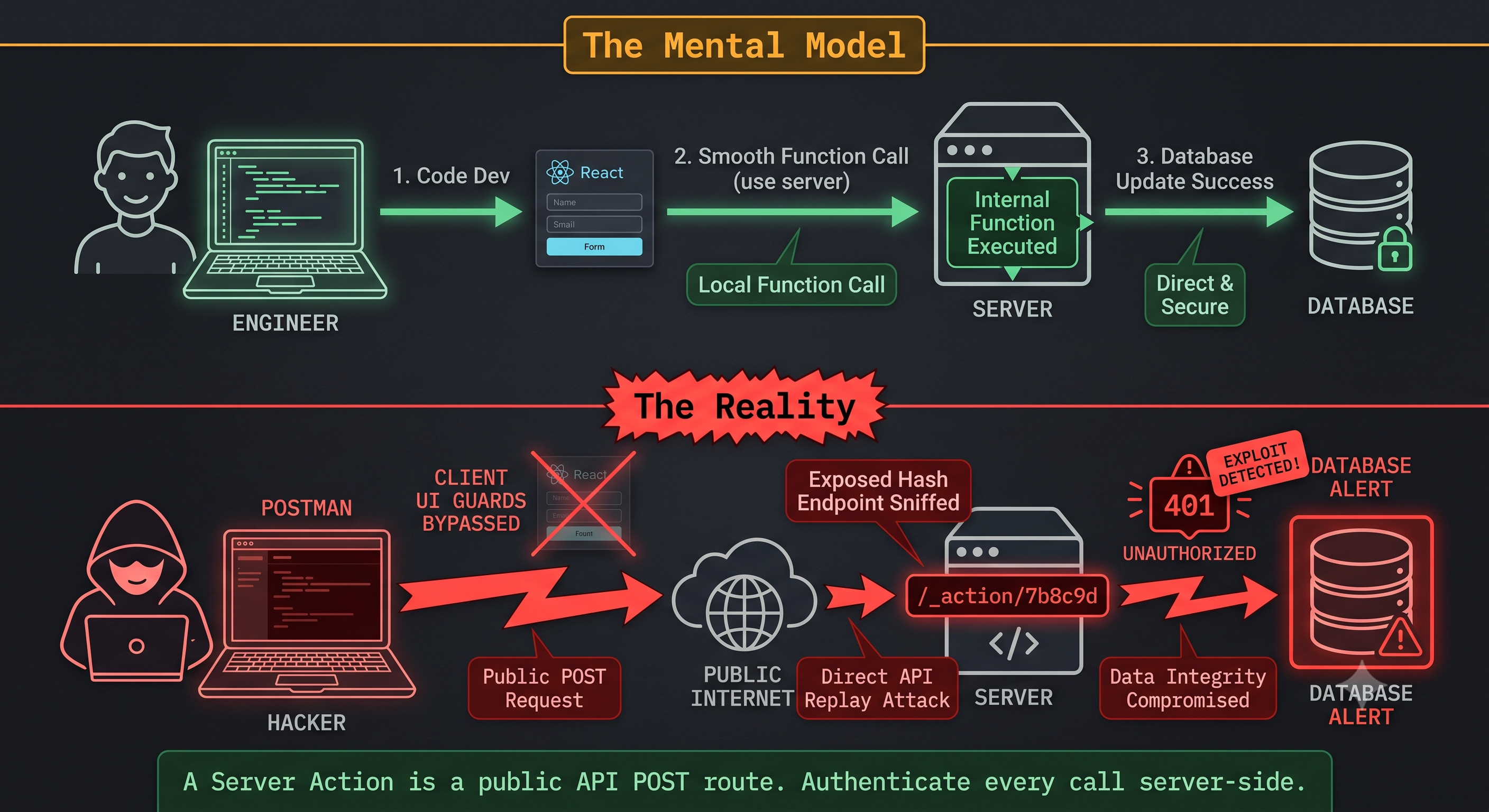
A server action is not an internal private method; it is an open, publicly addressable HTTP POST endpoint generated automatically by your framework bundler. When developers treat server functions like standard module code, they forget standard API defense layers:
Hidden Endpoints Are Not Private Endpoints: Obfuscated hash routes generated by bundlers are easily sniffed in network inspect panels. Anyone can replay, manipulate, or script requests directly against your action ID without touching your UI components.
UI Checks Do Not Guard Invocations: Disabling a submit button or hiding an element behind client-side role checks does zero server-side enforcement. If the authorization check isn't running inside the boundary of the server function itself, an attacker can invoke it with arbitrary payloads.
Missing Schema Parsers: Calling an internal database ORM call directly with function arguments skips runtime validation. Without tools like Zod or Valibot explicitly parsing formData or objects inside the action, you are vulnerable to mass-assignment attacks and unsanitized parameters.
The Golden Rule for Modern Full-Stack Functions:
Treat every single server action exactly like an exposed public webhook. Validate the incoming schema, verify the session/tenant identity inside the action body, and apply explicit rate limits at the handler boundary.
Discussion Question
Do you write centralized middleware wrappers for your inline server actions, or are authorization checks still being manually copy-pasted across individual function files?
CTA (Join Developers & Coding)
Tired of framework magic turning into production vulnerabilities?
👉 Join the Techawks Developers & Coding Community to break down real-world full-stack architecture, master clean defensive patterns, and build secure systems with engineers who value fundamentals:
The rise of integrated full-stack frameworks (Next.js, Nuxt, Remix/React Router) blurred the line between client and backend logic. Writing 'use server' or inline RPC-style server actions lets you run backend database calls directly from UI components without setting up a dedicated REST or GraphQL route.
It feels like magic. But architectural convenience is masking a critical security anti-pattern.
A server action is not an internal private method; it is an open, publicly addressable HTTP POST endpoint generated automatically by your framework bundler. When developers treat server functions like standard module code, they forget standard API defense layers:
Hidden Endpoints Are Not Private Endpoints: Obfuscated hash routes generated by bundlers are easily sniffed in network inspect panels. Anyone can replay, manipulate, or script requests directly against your action ID without touching your UI components.
UI Checks Do Not Guard Invocations: Disabling a submit button or hiding an element behind client-side role checks does zero server-side enforcement. If the authorization check isn't running inside the boundary of the server function itself, an attacker can invoke it with arbitrary payloads.
Missing Schema Parsers: Calling an internal database ORM call directly with function arguments skips runtime validation. Without tools like Zod or Valibot explicitly parsing formData or objects inside the action, you are vulnerable to mass-assignment attacks and unsanitized parameters.
The Golden Rule for Modern Full-Stack Functions:
Treat every single server action exactly like an exposed public webhook. Validate the incoming schema, verify the session/tenant identity inside the action body, and apply explicit rate limits at the handler boundary.
Discussion Question
Do you write centralized middleware wrappers for your inline server actions, or are authorization checks still being manually copy-pasted across individual function files?
CTA (Join Developers & Coding)
Tired of framework magic turning into production vulnerabilities?
👉 Join the Techawks Developers & Coding Community to break down real-world full-stack architecture, master clean defensive patterns, and build secure systems with engineers who value fundamentals:
Your Server Actions Are Quietly Breaking API Security Boundaries
The rise of integrated full-stack frameworks (Next.js, Nuxt, Remix/React Router) blurred the line between client and backend logic. Writing 'use server' or inline RPC-style server actions lets you run backend database calls directly from UI components without setting up a dedicated REST or GraphQL route.
It feels like magic. But architectural convenience is masking a critical security anti-pattern.
A server action is not an internal private method; it is an open, publicly addressable HTTP POST endpoint generated automatically by your framework bundler. When developers treat server functions like standard module code, they forget standard API defense layers:
Hidden Endpoints Are Not Private Endpoints: Obfuscated hash routes generated by bundlers are easily sniffed in network inspect panels. Anyone can replay, manipulate, or script requests directly against your action ID without touching your UI components.
UI Checks Do Not Guard Invocations: Disabling a submit button or hiding an element behind client-side role checks does zero server-side enforcement. If the authorization check isn't running inside the boundary of the server function itself, an attacker can invoke it with arbitrary payloads.
Missing Schema Parsers: Calling an internal database ORM call directly with function arguments skips runtime validation. Without tools like Zod or Valibot explicitly parsing formData or objects inside the action, you are vulnerable to mass-assignment attacks and unsanitized parameters.
The Golden Rule for Modern Full-Stack Functions:
Treat every single server action exactly like an exposed public webhook. Validate the incoming schema, verify the session/tenant identity inside the action body, and apply explicit rate limits at the handler boundary.
Discussion Question
Do you write centralized middleware wrappers for your inline server actions, or are authorization checks still being manually copy-pasted across individual function files?
CTA (Join Developers & Coding)
Tired of framework magic turning into production vulnerabilities?
👉 Join the Techawks Developers & Coding Community to break down real-world full-stack architecture, master clean defensive patterns, and build secure systems with engineers who value fundamentals:

 English
 Arabic
 French
 Spanish
 Portuguese
 Deutsch
 Turkish
 Italiano
 Russian
 Romaian
 Portuguese (Brazil)
 Greek
Greek