


Why Autonomous AI Agents Will Break Traditional API Gateways (And How NPCI’s New Protocol Changes System Design)
NPCI recently began architecting an official registry and authorization protocol for autonomous AI agents operating on UPI rails.
This is not just another fintech update; it exposes a structural flaw in how we design distributed systems.
For the past decade, Indian engineering teams solved scale using a standard recipe: OAuth tokens, rate-limiting per user session, two-factor SMS/device binding, and reactive fraud scoring.
Autonomous AI agents break this model completely:
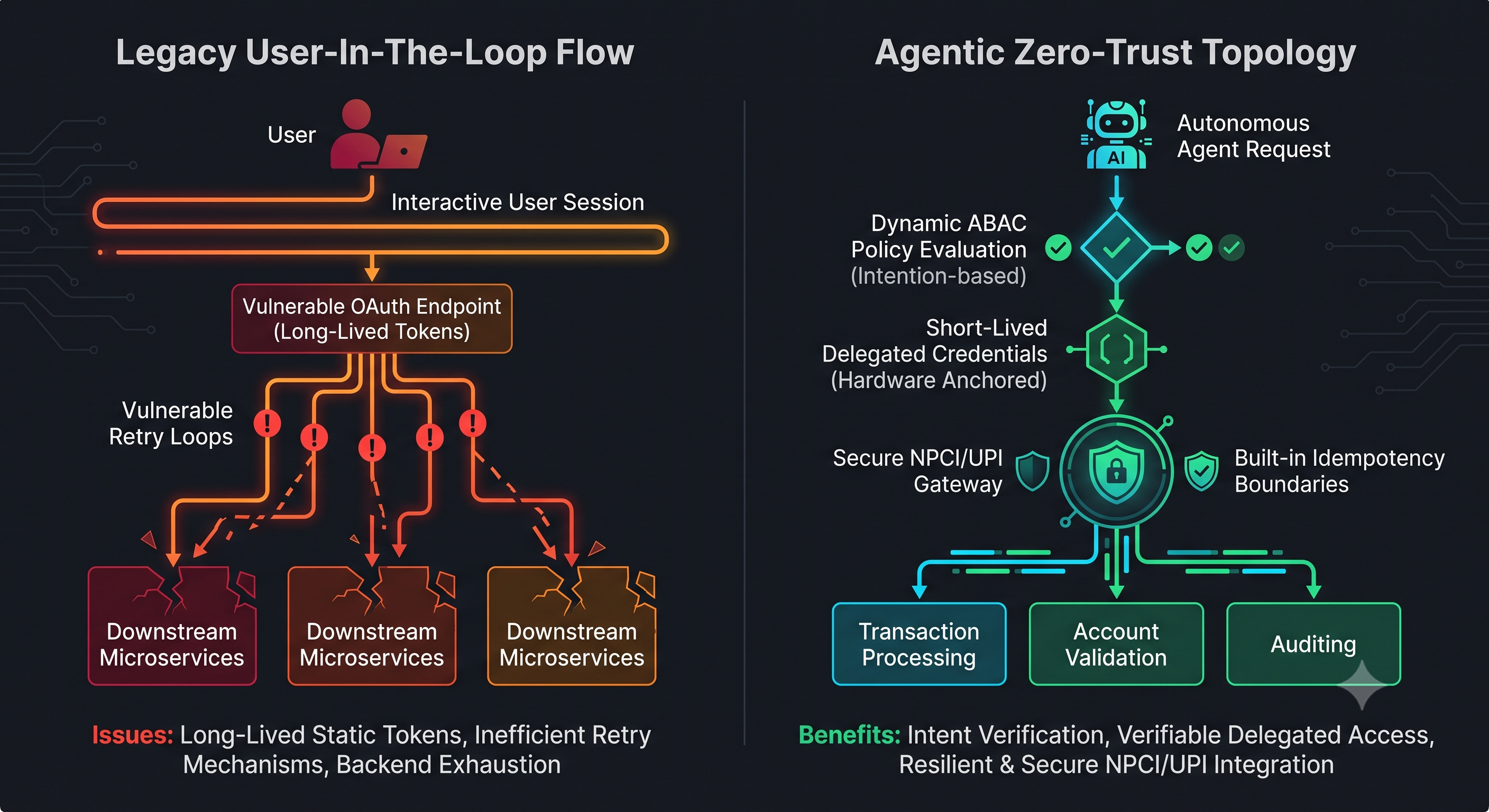
The Non-Human Identity (NHI) Crisis: When an agent acts on behalf of a user across multi-step execution chains (e.g., booking tickets, negotiating prices, and settling balances), static tokens and session cookies become prime attack surfaces. Over-privileged machine credentials leak context and create authorization blindspots.
Cascading Retries & Thundering Herds: Human users pause when a transaction stalls. Deterministic LLM agents programmed to complete tasks trigger automated, concurrent retries that can drown stateless orchestration switches and core banking adapters in milliseconds.
State Drift in Distributed Transactions: UPI relies on choreography-based SAGA patterns for eventual consistency between the payer PSP, the NPCI switch, and issuer/acquirer banks. If an autonomous agent cancels or pivots a workflow mid-execution while a multi-party ledger settlement is asynchronous, traditional reconciliation pipelines fail.
How to architect for the agentic era:
Move from RBAC to ABAC (Attribute-Based Access Control): Bind permissions not just to a machine identity, but dynamically evaluate intent, spending caps, and environmental context per invocation.
Implement Idempotency Keys with Cryptographic Proof: Ensure agent-triggered actions carry deterministic client-generated idempotency keys bound to the user’s master identity, preventing duplicate debits during agent orchestration retries.
Hardware-Anchored Delegation: Require agents to carry short-lived, verifiable credentials issued by user-authenticated enclaves, rather than storing long-lived payment-capable API tokens on third-party servers.
Discussion Question
Is your backend ready to distinguish between an intentional API burst and an autonomous AI agent caught in a recursive execution loop? How are you tackling non-human identity governance today?
CTA
Sharpen your engineering chops with India’s sharpest tech minds. Join Techawks India to debate real-world system architecture, scaling patterns, and engineering edge-cases.
NPCI recently began architecting an official registry and authorization protocol for autonomous AI agents operating on UPI rails.
This is not just another fintech update; it exposes a structural flaw in how we design distributed systems.
For the past decade, Indian engineering teams solved scale using a standard recipe: OAuth tokens, rate-limiting per user session, two-factor SMS/device binding, and reactive fraud scoring.
Autonomous AI agents break this model completely:
The Non-Human Identity (NHI) Crisis: When an agent acts on behalf of a user across multi-step execution chains (e.g., booking tickets, negotiating prices, and settling balances), static tokens and session cookies become prime attack surfaces. Over-privileged machine credentials leak context and create authorization blindspots.
Cascading Retries & Thundering Herds: Human users pause when a transaction stalls. Deterministic LLM agents programmed to complete tasks trigger automated, concurrent retries that can drown stateless orchestration switches and core banking adapters in milliseconds.
State Drift in Distributed Transactions: UPI relies on choreography-based SAGA patterns for eventual consistency between the payer PSP, the NPCI switch, and issuer/acquirer banks. If an autonomous agent cancels or pivots a workflow mid-execution while a multi-party ledger settlement is asynchronous, traditional reconciliation pipelines fail.
How to architect for the agentic era:
Move from RBAC to ABAC (Attribute-Based Access Control): Bind permissions not just to a machine identity, but dynamically evaluate intent, spending caps, and environmental context per invocation.
Implement Idempotency Keys with Cryptographic Proof: Ensure agent-triggered actions carry deterministic client-generated idempotency keys bound to the user’s master identity, preventing duplicate debits during agent orchestration retries.
Hardware-Anchored Delegation: Require agents to carry short-lived, verifiable credentials issued by user-authenticated enclaves, rather than storing long-lived payment-capable API tokens on third-party servers.
Discussion Question
Is your backend ready to distinguish between an intentional API burst and an autonomous AI agent caught in a recursive execution loop? How are you tackling non-human identity governance today?
CTA
Sharpen your engineering chops with India’s sharpest tech minds. Join Techawks India to debate real-world system architecture, scaling patterns, and engineering edge-cases.
Why Autonomous AI Agents Will Break Traditional API Gateways (And How NPCI’s New Protocol Changes System Design)
NPCI recently began architecting an official registry and authorization protocol for autonomous AI agents operating on UPI rails.
This is not just another fintech update; it exposes a structural flaw in how we design distributed systems.
For the past decade, Indian engineering teams solved scale using a standard recipe: OAuth tokens, rate-limiting per user session, two-factor SMS/device binding, and reactive fraud scoring.
Autonomous AI agents break this model completely:
The Non-Human Identity (NHI) Crisis: When an agent acts on behalf of a user across multi-step execution chains (e.g., booking tickets, negotiating prices, and settling balances), static tokens and session cookies become prime attack surfaces. Over-privileged machine credentials leak context and create authorization blindspots.
Cascading Retries & Thundering Herds: Human users pause when a transaction stalls. Deterministic LLM agents programmed to complete tasks trigger automated, concurrent retries that can drown stateless orchestration switches and core banking adapters in milliseconds.
State Drift in Distributed Transactions: UPI relies on choreography-based SAGA patterns for eventual consistency between the payer PSP, the NPCI switch, and issuer/acquirer banks. If an autonomous agent cancels or pivots a workflow mid-execution while a multi-party ledger settlement is asynchronous, traditional reconciliation pipelines fail.
How to architect for the agentic era:
Move from RBAC to ABAC (Attribute-Based Access Control): Bind permissions not just to a machine identity, but dynamically evaluate intent, spending caps, and environmental context per invocation.
Implement Idempotency Keys with Cryptographic Proof: Ensure agent-triggered actions carry deterministic client-generated idempotency keys bound to the user’s master identity, preventing duplicate debits during agent orchestration retries.
Hardware-Anchored Delegation: Require agents to carry short-lived, verifiable credentials issued by user-authenticated enclaves, rather than storing long-lived payment-capable API tokens on third-party servers.
Discussion Question
Is your backend ready to distinguish between an intentional API burst and an autonomous AI agent caught in a recursive execution loop? How are you tackling non-human identity governance today?
CTA
Sharpen your engineering chops with India’s sharpest tech minds. Join Techawks India to debate real-world system architecture, scaling patterns, and engineering edge-cases.

 English
 Arabic
 French
 Spanish
 Portuguese
 Turkish
 Dutch
Dutch
 Italiano
 Russian
 Romaian
 Portuguese (Brazil)
 Greek
Greek