


Why Bearer Tokens Are Dead: NIST IR 8587 Just Broke Every "Quick" Microservices Architecture
NIST and CISA just published their final technical guidance under NIST IR 8587, targeting token theft, forging, and replay attacks across identity federation, single sign-on (SSO), and machine-to-machine (M2M) APIs.
For years, software teams treated bearer tokens as an architectural shortcut. A client authenticates, gets a cryptographically signed JWT, and attaches it to every outbound HTTP header:
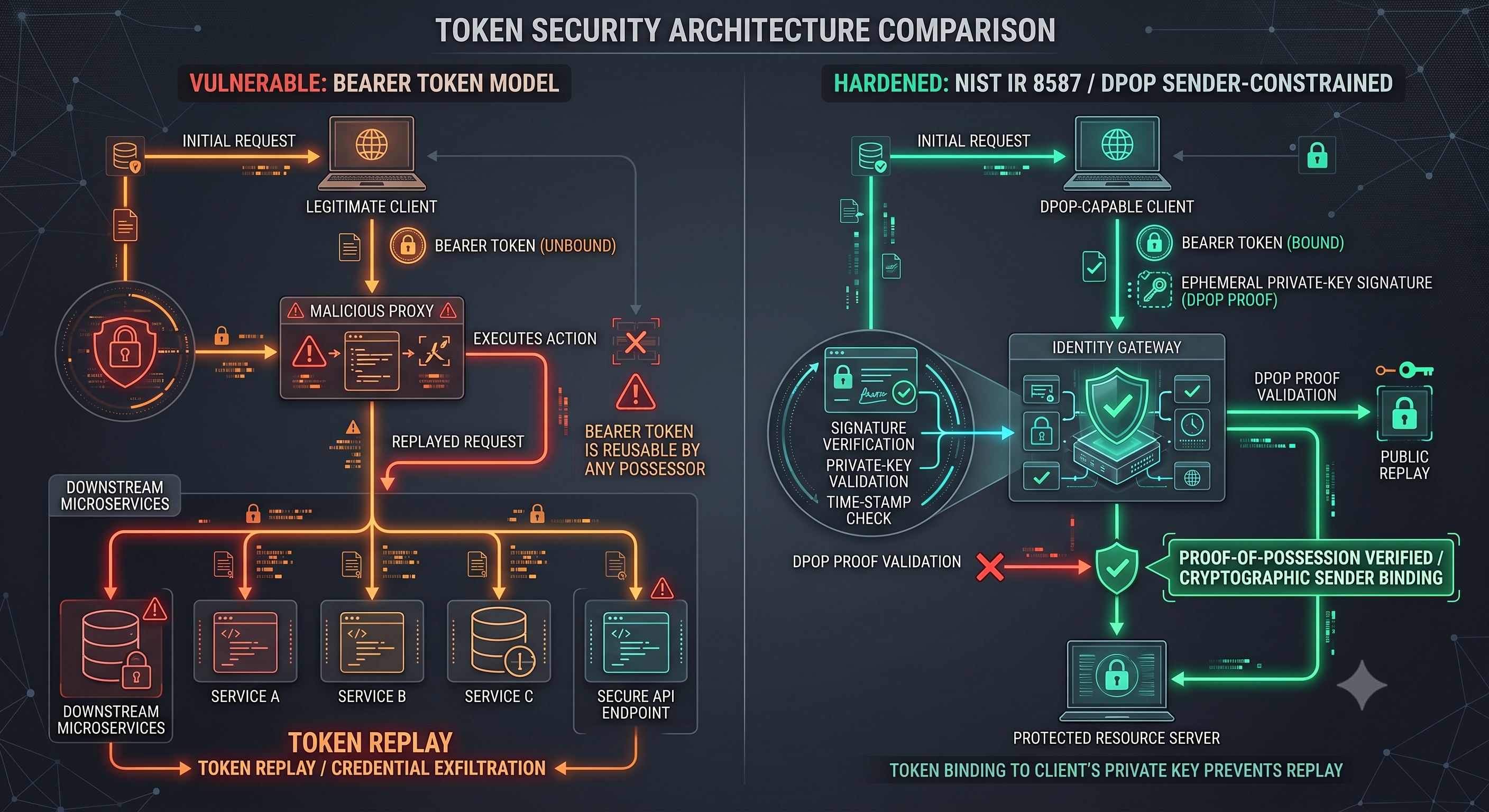
The fundamental flaw? Bearer tokens act like cash—whoever holds them owns them. If an orchestration worker leaks credentials via memory dumps, debug logs, or an indirect prompt injection in an AI workflow, possession equals full access.
NIST IR 8587 is a death knell for static bearer authentication in distributed US cloud environments. Here is the architectural shift your team needs to implement:
Cryptographic Sender-Constrained Tokens: Move away from pure bearer validation. Under standard specifications like RFC 8705 (mTLS OAuth) and RFC 9449 (DPoP — Demonstrating Proof-of-Possession), tokens are mathematically bound to the sender’s asymmetric private key. Even if an attacker intercepts the token in flight, it is cryptographically useless without the client’s ephemeral private key.
Continuous Access Evaluation Protocol (CAEP / RFC 9493): Stop relying exclusively on short-lived JWT expiry intervals (e.g., 5–15 minutes). Implement webhook/event-driven signal protocols between your Identity Provider (IdP) and downstream resource servers. When device posture, session risk, or non-human identity policies trigger, token revocation must happen in sub-second event streams, not after TTL expiration.
Granular Audience & Scope Scaffolding: Eliminate monolithic wildcard audience tags (aud: "*") across microservice clusters. Strict audience-binding limits the blast radius so a credential scoped for an internal analytics service cannot execute administrative queries on a transactional database.
Discussion Question
Are you enforcing DPoP or mTLS client bindings on your external and service-to-service endpoints yet, or is your infrastructure still vulnerable to raw token replay?
CTA
Level up your systems design and cloud security engineering. Join Techawks USA to discuss modern architecture, resilience patterns, and distributed systems best practices.
NIST and CISA just published their final technical guidance under NIST IR 8587, targeting token theft, forging, and replay attacks across identity federation, single sign-on (SSO), and machine-to-machine (M2M) APIs.
For years, software teams treated bearer tokens as an architectural shortcut. A client authenticates, gets a cryptographically signed JWT, and attaches it to every outbound HTTP header:
The fundamental flaw? Bearer tokens act like cash—whoever holds them owns them. If an orchestration worker leaks credentials via memory dumps, debug logs, or an indirect prompt injection in an AI workflow, possession equals full access.
NIST IR 8587 is a death knell for static bearer authentication in distributed US cloud environments. Here is the architectural shift your team needs to implement:
Cryptographic Sender-Constrained Tokens: Move away from pure bearer validation. Under standard specifications like RFC 8705 (mTLS OAuth) and RFC 9449 (DPoP — Demonstrating Proof-of-Possession), tokens are mathematically bound to the sender’s asymmetric private key. Even if an attacker intercepts the token in flight, it is cryptographically useless without the client’s ephemeral private key.
Continuous Access Evaluation Protocol (CAEP / RFC 9493): Stop relying exclusively on short-lived JWT expiry intervals (e.g., 5–15 minutes). Implement webhook/event-driven signal protocols between your Identity Provider (IdP) and downstream resource servers. When device posture, session risk, or non-human identity policies trigger, token revocation must happen in sub-second event streams, not after TTL expiration.
Granular Audience & Scope Scaffolding: Eliminate monolithic wildcard audience tags (aud: "*") across microservice clusters. Strict audience-binding limits the blast radius so a credential scoped for an internal analytics service cannot execute administrative queries on a transactional database.
Discussion Question
Are you enforcing DPoP or mTLS client bindings on your external and service-to-service endpoints yet, or is your infrastructure still vulnerable to raw token replay?
CTA
Level up your systems design and cloud security engineering. Join Techawks USA to discuss modern architecture, resilience patterns, and distributed systems best practices.
Why Bearer Tokens Are Dead: NIST IR 8587 Just Broke Every "Quick" Microservices Architecture
NIST and CISA just published their final technical guidance under NIST IR 8587, targeting token theft, forging, and replay attacks across identity federation, single sign-on (SSO), and machine-to-machine (M2M) APIs.
For years, software teams treated bearer tokens as an architectural shortcut. A client authenticates, gets a cryptographically signed JWT, and attaches it to every outbound HTTP header:
The fundamental flaw? Bearer tokens act like cash—whoever holds them owns them. If an orchestration worker leaks credentials via memory dumps, debug logs, or an indirect prompt injection in an AI workflow, possession equals full access.
NIST IR 8587 is a death knell for static bearer authentication in distributed US cloud environments. Here is the architectural shift your team needs to implement:
Cryptographic Sender-Constrained Tokens: Move away from pure bearer validation. Under standard specifications like RFC 8705 (mTLS OAuth) and RFC 9449 (DPoP — Demonstrating Proof-of-Possession), tokens are mathematically bound to the sender’s asymmetric private key. Even if an attacker intercepts the token in flight, it is cryptographically useless without the client’s ephemeral private key.
Continuous Access Evaluation Protocol (CAEP / RFC 9493): Stop relying exclusively on short-lived JWT expiry intervals (e.g., 5–15 minutes). Implement webhook/event-driven signal protocols between your Identity Provider (IdP) and downstream resource servers. When device posture, session risk, or non-human identity policies trigger, token revocation must happen in sub-second event streams, not after TTL expiration.
Granular Audience & Scope Scaffolding: Eliminate monolithic wildcard audience tags (aud: "*") across microservice clusters. Strict audience-binding limits the blast radius so a credential scoped for an internal analytics service cannot execute administrative queries on a transactional database.
Discussion Question
Are you enforcing DPoP or mTLS client bindings on your external and service-to-service endpoints yet, or is your infrastructure still vulnerable to raw token replay?
CTA
Level up your systems design and cloud security engineering. Join Techawks USA to discuss modern architecture, resilience patterns, and distributed systems best practices.

 English
 Arabic
 French
 Spanish
 Portuguese
 Turkish
 Dutch
Dutch
 Italiano
 Russian
 Romaian
 Portuguese (Brazil)
 Greek
Greek