


The Death of "Shared Responsibility": How the UK Cyber Security & Resilience Bill Changes Cloud Architecture
For years, UK engineering teams leaned heavily on a convenient abstraction: "We own the app logic; AWS, Azure, and our MSPs own the infrastructure resilience."
The UK's Cyber Security and Resilience Bill (CSRB)—now progressing through Parliament alongside strict 24-hour mandatory reporting windows and penalties reaching 4% of global turnover—demolishes this passive reliance. Crucially, the bill directly expands the scope of the 2018 NIS Regulations to pull Managed Service Providers (MSPs), data centres, and digital supply chains into legal liability.
If your critical systems depend on downstream third parties, you cannot treat vendor dependencies as black-box SLA agreements anymore.
Here is how systems design must adapt for UK-facing platforms:
From Black-Box SaaS to Dynamic SBOM & SLSA Level 3: Static spreadsheets tracking third-party libraries won’t pass regulatory audits. You need real-time, machine-readable Software Bills of Materials (SBOMs) generated in CI/CD pipelines, tied to cryptographic provenance (attestations using Sigstore/Cosign).
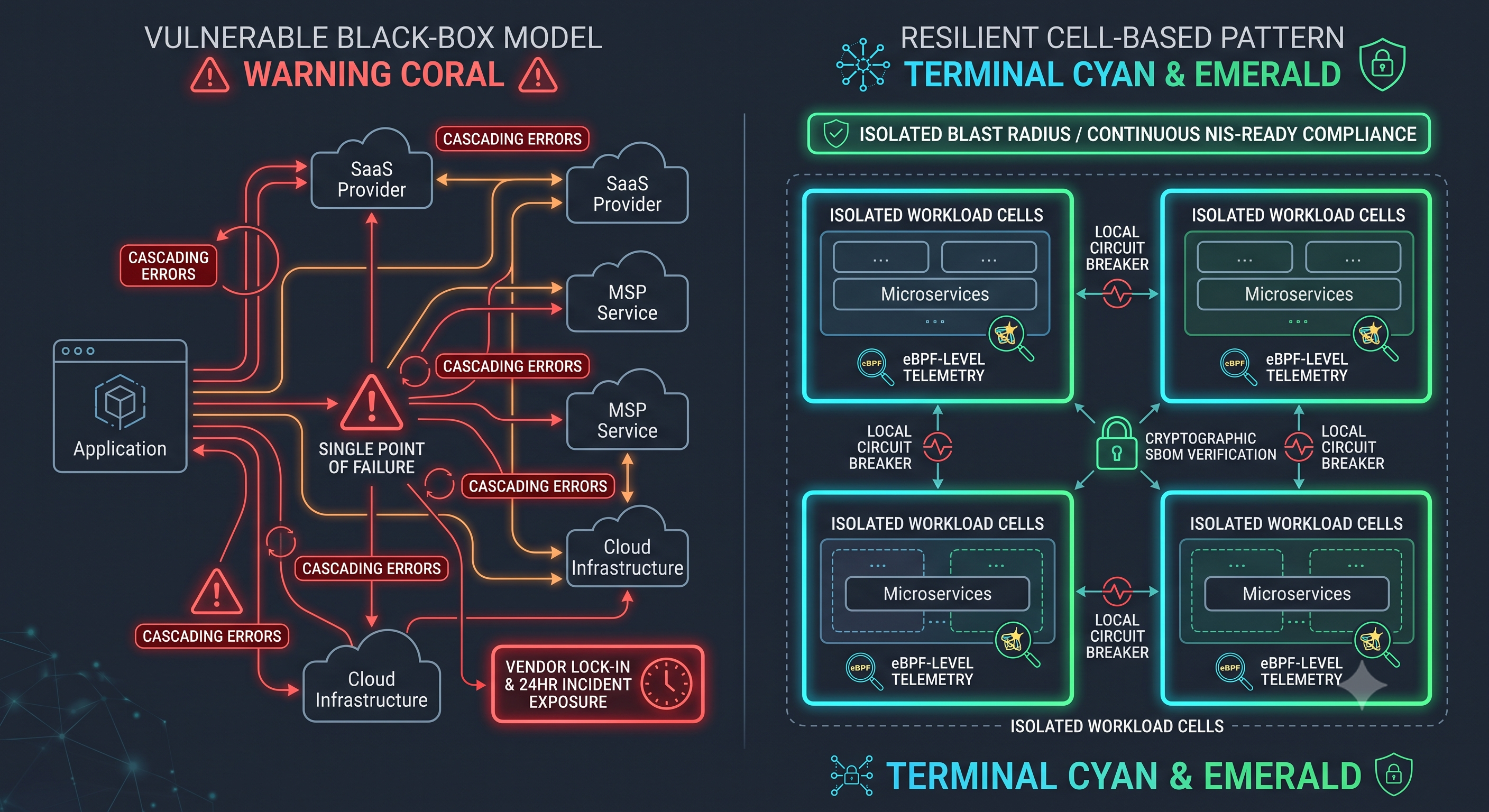
Designing for Blast-Radius Isolation (Cell-Based Architecture): Monolithic architectures dependent on external API endpoints create systemic single points of failure. Partition workloads into independent "cells" with deterministic circuit breakers and local fallback caches. If a downstream cloud identity or billing vendor fails, the cell degrades gracefully rather than triggering a cascading failure.
Continuous In-Memory Telemetry for "Near-Miss" Auditing: The new regime introduces reporting mandates not just for catastrophic breaches, but for critical incidents and near-misses within 24 hours. Traditional log shipping via batch pipelines is too slow. Teams must instrument eBPF-driven kernel observability to detect credential stuffing, anomalous lateral RPC hops, and supply-chain tampering in sub-second streams.
Discussion Question
If your primary cloud region or critical SaaS vendor goes dark right now, does your application cleanly degrade into an offline fallback cell, or does your entire platform fail hard?
CTA
Build resilient, fault-tolerant infrastructure built for the next decade of cloud engineering. Join Techawks UK to connect with senior systems architects, SREs, and DevOps leads.
For years, UK engineering teams leaned heavily on a convenient abstraction: "We own the app logic; AWS, Azure, and our MSPs own the infrastructure resilience."
The UK's Cyber Security and Resilience Bill (CSRB)—now progressing through Parliament alongside strict 24-hour mandatory reporting windows and penalties reaching 4% of global turnover—demolishes this passive reliance. Crucially, the bill directly expands the scope of the 2018 NIS Regulations to pull Managed Service Providers (MSPs), data centres, and digital supply chains into legal liability.
If your critical systems depend on downstream third parties, you cannot treat vendor dependencies as black-box SLA agreements anymore.
Here is how systems design must adapt for UK-facing platforms:
From Black-Box SaaS to Dynamic SBOM & SLSA Level 3: Static spreadsheets tracking third-party libraries won’t pass regulatory audits. You need real-time, machine-readable Software Bills of Materials (SBOMs) generated in CI/CD pipelines, tied to cryptographic provenance (attestations using Sigstore/Cosign).
Designing for Blast-Radius Isolation (Cell-Based Architecture): Monolithic architectures dependent on external API endpoints create systemic single points of failure. Partition workloads into independent "cells" with deterministic circuit breakers and local fallback caches. If a downstream cloud identity or billing vendor fails, the cell degrades gracefully rather than triggering a cascading failure.
Continuous In-Memory Telemetry for "Near-Miss" Auditing: The new regime introduces reporting mandates not just for catastrophic breaches, but for critical incidents and near-misses within 24 hours. Traditional log shipping via batch pipelines is too slow. Teams must instrument eBPF-driven kernel observability to detect credential stuffing, anomalous lateral RPC hops, and supply-chain tampering in sub-second streams.
Discussion Question
If your primary cloud region or critical SaaS vendor goes dark right now, does your application cleanly degrade into an offline fallback cell, or does your entire platform fail hard?
CTA
Build resilient, fault-tolerant infrastructure built for the next decade of cloud engineering. Join Techawks UK to connect with senior systems architects, SREs, and DevOps leads.
The Death of "Shared Responsibility": How the UK Cyber Security & Resilience Bill Changes Cloud Architecture
For years, UK engineering teams leaned heavily on a convenient abstraction: "We own the app logic; AWS, Azure, and our MSPs own the infrastructure resilience."
The UK's Cyber Security and Resilience Bill (CSRB)—now progressing through Parliament alongside strict 24-hour mandatory reporting windows and penalties reaching 4% of global turnover—demolishes this passive reliance. Crucially, the bill directly expands the scope of the 2018 NIS Regulations to pull Managed Service Providers (MSPs), data centres, and digital supply chains into legal liability.
If your critical systems depend on downstream third parties, you cannot treat vendor dependencies as black-box SLA agreements anymore.
Here is how systems design must adapt for UK-facing platforms:
From Black-Box SaaS to Dynamic SBOM & SLSA Level 3: Static spreadsheets tracking third-party libraries won’t pass regulatory audits. You need real-time, machine-readable Software Bills of Materials (SBOMs) generated in CI/CD pipelines, tied to cryptographic provenance (attestations using Sigstore/Cosign).
Designing for Blast-Radius Isolation (Cell-Based Architecture): Monolithic architectures dependent on external API endpoints create systemic single points of failure. Partition workloads into independent "cells" with deterministic circuit breakers and local fallback caches. If a downstream cloud identity or billing vendor fails, the cell degrades gracefully rather than triggering a cascading failure.
Continuous In-Memory Telemetry for "Near-Miss" Auditing: The new regime introduces reporting mandates not just for catastrophic breaches, but for critical incidents and near-misses within 24 hours. Traditional log shipping via batch pipelines is too slow. Teams must instrument eBPF-driven kernel observability to detect credential stuffing, anomalous lateral RPC hops, and supply-chain tampering in sub-second streams.
Discussion Question
If your primary cloud region or critical SaaS vendor goes dark right now, does your application cleanly degrade into an offline fallback cell, or does your entire platform fail hard?
CTA
Build resilient, fault-tolerant infrastructure built for the next decade of cloud engineering. Join Techawks UK to connect with senior systems architects, SREs, and DevOps leads.

 English
 Arabic
 French
 Spanish
 Portuguese
 Deutsch
 Turkish
 Dutch
Dutch
 Italiano
 Russian
 Portuguese (Brazil)
 Greek
Greek