


The Sovereign Cloud Illusion: Why "Hosting in Dubai" Fails UAE AI & PDPL Audits
With the establishment of the UAE Federal Artificial Intelligence and Data Authority (FAIDA) and active sovereign cloud rollouts across GISEC this week, UAE engineering teams face an architectural reckoning: Data Residency is not Data Sovereignty.
Too many engineering teams believe choosing me-central-1 (UAE) on global hyperscalers ticks the box for UAE Federal Decree-Law No. 45/2021 (PDPL) and NESA compliance.
Under the hood, typical cloud deployments trigger subtle cross-border breaches:
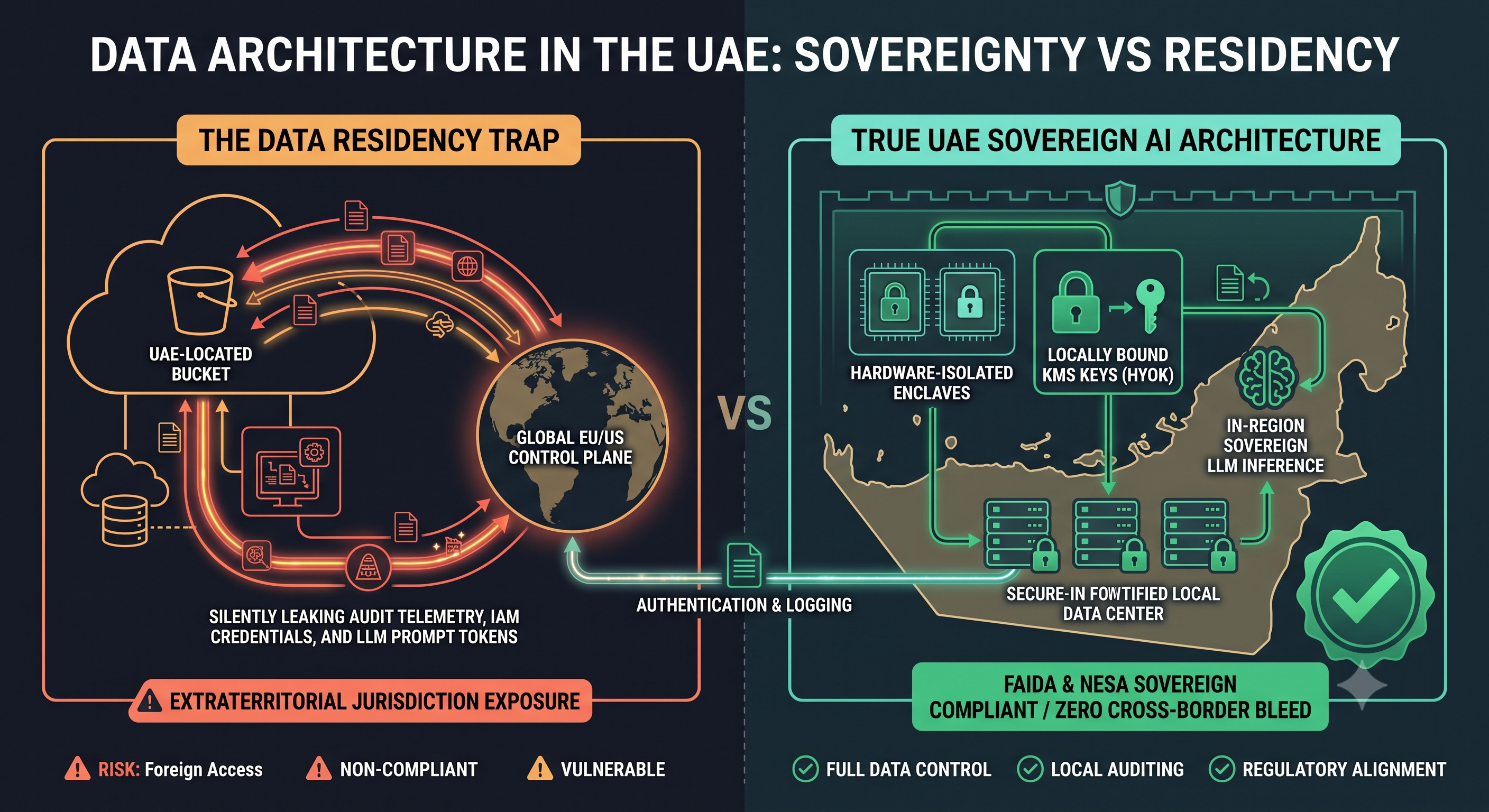
The Global Control Plane Leak: Even if persistent storage resides in Abu Dhabi or Dubai, IAM authentication handshakes, telemetry, cloud provider support tickets, and global billing pipelines routinely route through servers in the EU or US. Under true sovereign scrutiny, extraterritorial control plane access is a regulatory violation.
RAG & Inference Pipeline Bleed: Sending enterprise context into external foundation model endpoints—even ephemeral inference calls—violates sovereign guarantees if prompt embeddings or token caches hit multi-tenant clusters outside UAE jurisdiction.
Shared Key Custody: Storing KMS keys inside standard multi-tenant cloud HSMs leaves cryptographic control subject to foreign extraterritorial warrants (such as the US CLOUD Act).
The Sovereign AI Architecture Pattern:
Air-Gapped / Isolated Control Planes: Decouple system telemetry and identity management from global control planes. Rely on sovereign clusters where the orchestrator, IAM, and control API terminate inside UAE jurisdiction.
Hold Your Own Key (HYOK) & Enclave KMS: Keep root key encryption material inside locally managed, physically resident Hardware Security Modules (HSMs), preventing hyperscaler operators from decrypting data at rest or in transit.
In-Region Inference Isolation: Deploy open-weight foundation models (such as Falcon or localized LLMs) on isolated, hardware-dedicated nodes with strictly bound local vector databases, ensuring zero cross-border prompt leakage.
Discussion Question
When your cloud provider’s automated telemetry, prompt caches, or IAM tokens sync, can you prove zero bytes leave the Emirates? How is your team tackling true sovereign isolation?
CTA
Architect next-generation, high-performance systems built for the Gulf’s regulatory frontier. Join Techawks UAE to exchange insights with leading architects, CTOs, and AI engineers across the Emirates.
With the establishment of the UAE Federal Artificial Intelligence and Data Authority (FAIDA) and active sovereign cloud rollouts across GISEC this week, UAE engineering teams face an architectural reckoning: Data Residency is not Data Sovereignty.
Too many engineering teams believe choosing me-central-1 (UAE) on global hyperscalers ticks the box for UAE Federal Decree-Law No. 45/2021 (PDPL) and NESA compliance.
Under the hood, typical cloud deployments trigger subtle cross-border breaches:
The Global Control Plane Leak: Even if persistent storage resides in Abu Dhabi or Dubai, IAM authentication handshakes, telemetry, cloud provider support tickets, and global billing pipelines routinely route through servers in the EU or US. Under true sovereign scrutiny, extraterritorial control plane access is a regulatory violation.
RAG & Inference Pipeline Bleed: Sending enterprise context into external foundation model endpoints—even ephemeral inference calls—violates sovereign guarantees if prompt embeddings or token caches hit multi-tenant clusters outside UAE jurisdiction.
Shared Key Custody: Storing KMS keys inside standard multi-tenant cloud HSMs leaves cryptographic control subject to foreign extraterritorial warrants (such as the US CLOUD Act).
The Sovereign AI Architecture Pattern:
Air-Gapped / Isolated Control Planes: Decouple system telemetry and identity management from global control planes. Rely on sovereign clusters where the orchestrator, IAM, and control API terminate inside UAE jurisdiction.
Hold Your Own Key (HYOK) & Enclave KMS: Keep root key encryption material inside locally managed, physically resident Hardware Security Modules (HSMs), preventing hyperscaler operators from decrypting data at rest or in transit.
In-Region Inference Isolation: Deploy open-weight foundation models (such as Falcon or localized LLMs) on isolated, hardware-dedicated nodes with strictly bound local vector databases, ensuring zero cross-border prompt leakage.
Discussion Question
When your cloud provider’s automated telemetry, prompt caches, or IAM tokens sync, can you prove zero bytes leave the Emirates? How is your team tackling true sovereign isolation?
CTA
Architect next-generation, high-performance systems built for the Gulf’s regulatory frontier. Join Techawks UAE to exchange insights with leading architects, CTOs, and AI engineers across the Emirates.
The Sovereign Cloud Illusion: Why "Hosting in Dubai" Fails UAE AI & PDPL Audits
With the establishment of the UAE Federal Artificial Intelligence and Data Authority (FAIDA) and active sovereign cloud rollouts across GISEC this week, UAE engineering teams face an architectural reckoning: Data Residency is not Data Sovereignty.
Too many engineering teams believe choosing me-central-1 (UAE) on global hyperscalers ticks the box for UAE Federal Decree-Law No. 45/2021 (PDPL) and NESA compliance.
Under the hood, typical cloud deployments trigger subtle cross-border breaches:
The Global Control Plane Leak: Even if persistent storage resides in Abu Dhabi or Dubai, IAM authentication handshakes, telemetry, cloud provider support tickets, and global billing pipelines routinely route through servers in the EU or US. Under true sovereign scrutiny, extraterritorial control plane access is a regulatory violation.
RAG & Inference Pipeline Bleed: Sending enterprise context into external foundation model endpoints—even ephemeral inference calls—violates sovereign guarantees if prompt embeddings or token caches hit multi-tenant clusters outside UAE jurisdiction.
Shared Key Custody: Storing KMS keys inside standard multi-tenant cloud HSMs leaves cryptographic control subject to foreign extraterritorial warrants (such as the US CLOUD Act).
The Sovereign AI Architecture Pattern:
Air-Gapped / Isolated Control Planes: Decouple system telemetry and identity management from global control planes. Rely on sovereign clusters where the orchestrator, IAM, and control API terminate inside UAE jurisdiction.
Hold Your Own Key (HYOK) & Enclave KMS: Keep root key encryption material inside locally managed, physically resident Hardware Security Modules (HSMs), preventing hyperscaler operators from decrypting data at rest or in transit.
In-Region Inference Isolation: Deploy open-weight foundation models (such as Falcon or localized LLMs) on isolated, hardware-dedicated nodes with strictly bound local vector databases, ensuring zero cross-border prompt leakage.
Discussion Question
When your cloud provider’s automated telemetry, prompt caches, or IAM tokens sync, can you prove zero bytes leave the Emirates? How is your team tackling true sovereign isolation?
CTA
Architect next-generation, high-performance systems built for the Gulf’s regulatory frontier. Join Techawks UAE to exchange insights with leading architects, CTOs, and AI engineers across the Emirates.

 English
 French
 Spanish
 Portuguese
 Deutsch
 Turkish
 Dutch
Dutch
 Italiano
 Russian
 Romaian
 Portuguese (Brazil)
 Greek
Greek