


Tired of Postman Cloud Lock-in? Why Indian Dev Teams Are Switching to Bruno
For years, Postman was the default choice across engineering teams in Bangalore, Pune, and Hyderabad. But recent shifts toward mandatory cloud sync, account requirements, and team-tier paywalls have made it a friction point for fast-moving developers.
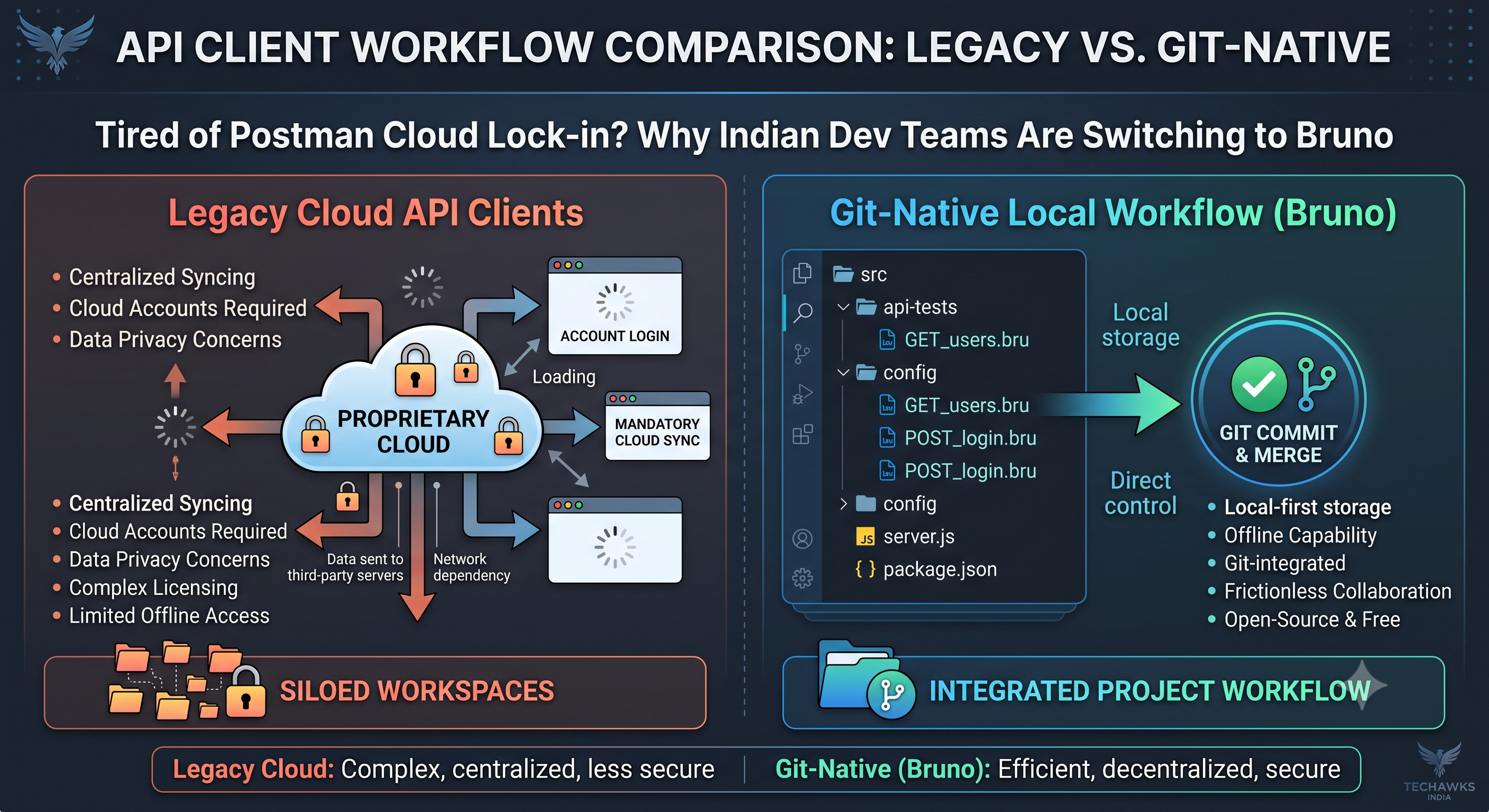
Enter Bruno—an open-source, offline-first API client that stores your collections directly in your filesystem using a plain-text markup language (Bru).
Here is how Bruno solves the everyday pain points of building and testing APIs:
Git-Native Collaboration: Instead of syncing to a third-party proprietary cloud, your collections live inside your project repo alongside your code. Team members review API changes via standard Git Pull Requests—no sync errors or out-of-date shared workspaces.
Zero Data Leakage: Sensitive environment variables, internal staging URLs, and auth secrets stay entirely on your local machine. Nothing ever leaves your network unless you make the actual API call.
Lightweight & Blazing Fast: Built without unnecessary telemetry or background sync loops, Bruno launches in seconds and uses a fraction of the memory that legacy tools demand.
Scripting Without Paywalls: Write pre-request scripts and post-response assertions in standard JavaScript directly inside the app, with zero tier restrictions.
When to stick with Postman: If your non-technical stakeholders rely heavily on hosted mock servers or automated cloud monitors, Postman still holds an edge. But for daily development, debugging microservices, and clean Git workflows, Bruno is the better developer experience.
Key Takeaways
Local-first storage: API collections are saved as plain .bru files directly in your repository.
Standard Git reviews: Manage API contract changes and versioning through standard Git PR workflows.
Enterprise security compliant: Built-in offline architecture ensures API secrets and payload data never touch an external cloud.
Free and open source: Full scripting, environment variable switching, and automated test runners without user seat limits.
CTA (Join Techawks India)
Building better developer workflows across India? Join the Techawks India community to discuss system design, modern tooling, and open-source stacks with fellow engineers. Drop your thoughts below: Has your team already moved away from cloud-dependent API clients, or is the migration too painful?
For years, Postman was the default choice across engineering teams in Bangalore, Pune, and Hyderabad. But recent shifts toward mandatory cloud sync, account requirements, and team-tier paywalls have made it a friction point for fast-moving developers.
Enter Bruno—an open-source, offline-first API client that stores your collections directly in your filesystem using a plain-text markup language (Bru).
Here is how Bruno solves the everyday pain points of building and testing APIs:
Git-Native Collaboration: Instead of syncing to a third-party proprietary cloud, your collections live inside your project repo alongside your code. Team members review API changes via standard Git Pull Requests—no sync errors or out-of-date shared workspaces.
Zero Data Leakage: Sensitive environment variables, internal staging URLs, and auth secrets stay entirely on your local machine. Nothing ever leaves your network unless you make the actual API call.
Lightweight & Blazing Fast: Built without unnecessary telemetry or background sync loops, Bruno launches in seconds and uses a fraction of the memory that legacy tools demand.
Scripting Without Paywalls: Write pre-request scripts and post-response assertions in standard JavaScript directly inside the app, with zero tier restrictions.
When to stick with Postman: If your non-technical stakeholders rely heavily on hosted mock servers or automated cloud monitors, Postman still holds an edge. But for daily development, debugging microservices, and clean Git workflows, Bruno is the better developer experience.
Key Takeaways
Local-first storage: API collections are saved as plain .bru files directly in your repository.
Standard Git reviews: Manage API contract changes and versioning through standard Git PR workflows.
Enterprise security compliant: Built-in offline architecture ensures API secrets and payload data never touch an external cloud.
Free and open source: Full scripting, environment variable switching, and automated test runners without user seat limits.
CTA (Join Techawks India)
Building better developer workflows across India? Join the Techawks India community to discuss system design, modern tooling, and open-source stacks with fellow engineers. Drop your thoughts below: Has your team already moved away from cloud-dependent API clients, or is the migration too painful?
Tired of Postman Cloud Lock-in? Why Indian Dev Teams Are Switching to Bruno
For years, Postman was the default choice across engineering teams in Bangalore, Pune, and Hyderabad. But recent shifts toward mandatory cloud sync, account requirements, and team-tier paywalls have made it a friction point for fast-moving developers.
Enter Bruno—an open-source, offline-first API client that stores your collections directly in your filesystem using a plain-text markup language (Bru).
Here is how Bruno solves the everyday pain points of building and testing APIs:
Git-Native Collaboration: Instead of syncing to a third-party proprietary cloud, your collections live inside your project repo alongside your code. Team members review API changes via standard Git Pull Requests—no sync errors or out-of-date shared workspaces.
Zero Data Leakage: Sensitive environment variables, internal staging URLs, and auth secrets stay entirely on your local machine. Nothing ever leaves your network unless you make the actual API call.
Lightweight & Blazing Fast: Built without unnecessary telemetry or background sync loops, Bruno launches in seconds and uses a fraction of the memory that legacy tools demand.
Scripting Without Paywalls: Write pre-request scripts and post-response assertions in standard JavaScript directly inside the app, with zero tier restrictions.
When to stick with Postman: If your non-technical stakeholders rely heavily on hosted mock servers or automated cloud monitors, Postman still holds an edge. But for daily development, debugging microservices, and clean Git workflows, Bruno is the better developer experience.
Key Takeaways
Local-first storage: API collections are saved as plain .bru files directly in your repository.
Standard Git reviews: Manage API contract changes and versioning through standard Git PR workflows.
Enterprise security compliant: Built-in offline architecture ensures API secrets and payload data never touch an external cloud.
Free and open source: Full scripting, environment variable switching, and automated test runners without user seat limits.
CTA (Join Techawks India)
Building better developer workflows across India? Join the Techawks India community to discuss system design, modern tooling, and open-source stacks with fellow engineers. Drop your thoughts below: Has your team already moved away from cloud-dependent API clients, or is the migration too painful?

 English
 Arabic
 French
 Spanish
 Portuguese
 Deutsch
 Turkish
 Dutch
Dutch
 Italiano
 Russian
 Portuguese (Brazil)
 Greek
Greek