


OpenTofu vs. Terraform: How US Engineering Teams Are Navigating the Fork
For enterprise platform teams in Seattle, Austin, and the Bay Area, Infrastructure as Code (IaC) isn't just about provisioning VMs—it’s about auditability, licensing risk, and CI/CD integration.
OpenTofu emerged as the community-driven, truly open-source drop-in replacement for Terraform under the Linux Foundation. But moving beyond the license debate, how does it actually hold up in production environments?
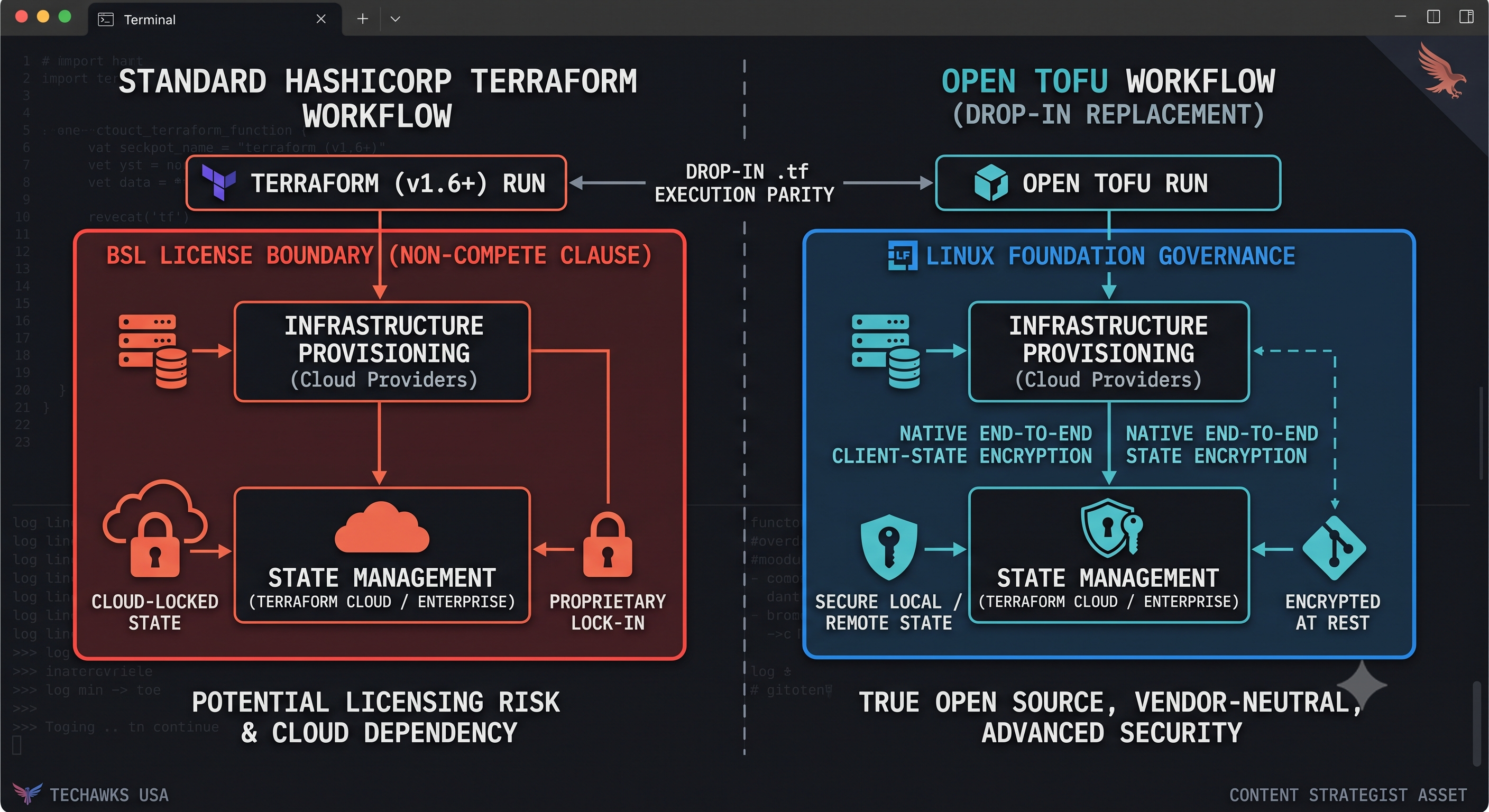
True Drop-In Parity: OpenTofu maintains backward compatibility with Terraform configuration files (.tf), existing providers, and remote state backends (S3, GCS, Azure Blob). Teams running standard AWS or GCP stacks can often switch binaries with zero rewrite of existing code.
Licensing Safety for Platform Builders: If your company builds commercial SaaS, developer platforms, or internal developer portals (IDPs) that wrap around IaC tooling, OpenTofu eliminates the ambiguous competitive-use clauses introduced by the BSL.
State Encryption Built-In: Unlike legacy Terraform which historically required third-party tooling or raw bucket permissions to secure state files, OpenTofu introduced native client-side state encryption out of the box, strengthening SOC 2 and HIPAA compliance workflows.
Registry Independence: OpenTofu maintains its own decentralized, openly accessible provider registry, shielding pipelines from upstream policy changes or potential access throttling.
When to stay with Terraform: If your enterprise relies heavily on Terraform Cloud/Enterprise SaaS capabilities (like hosted run tasks, native VCS drift triggers, or proprietary Sentinel policies), the operational cost of migrating to self-hosted orchestration on OpenTofu may outweigh the licensing savings.
Key Takeaways
Drop-in compatibility: Zero syntax changes required for standard HCL infrastructure configurations.
Enterprise compliance: Native state encryption simplifies data security for regulated US industries (healthcare, fintech).
Vendor-neutral governance: Hosted under the Linux Foundation, preventing sudden licensing shifts or commercial usage locks.
Ecosystem parity: Full access to existing cloud provider registries (AWS, GCP, Azure, Cloudflare).
CTA (Join Techawks USA)
Scaling cloud platforms and modern infrastructure? Join the Techawks USA community to trade notes on platform engineering, open-source governance, and production architecture. Drop your thoughts below: Has
For enterprise platform teams in Seattle, Austin, and the Bay Area, Infrastructure as Code (IaC) isn't just about provisioning VMs—it’s about auditability, licensing risk, and CI/CD integration.
OpenTofu emerged as the community-driven, truly open-source drop-in replacement for Terraform under the Linux Foundation. But moving beyond the license debate, how does it actually hold up in production environments?
True Drop-In Parity: OpenTofu maintains backward compatibility with Terraform configuration files (.tf), existing providers, and remote state backends (S3, GCS, Azure Blob). Teams running standard AWS or GCP stacks can often switch binaries with zero rewrite of existing code.
Licensing Safety for Platform Builders: If your company builds commercial SaaS, developer platforms, or internal developer portals (IDPs) that wrap around IaC tooling, OpenTofu eliminates the ambiguous competitive-use clauses introduced by the BSL.
State Encryption Built-In: Unlike legacy Terraform which historically required third-party tooling or raw bucket permissions to secure state files, OpenTofu introduced native client-side state encryption out of the box, strengthening SOC 2 and HIPAA compliance workflows.
Registry Independence: OpenTofu maintains its own decentralized, openly accessible provider registry, shielding pipelines from upstream policy changes or potential access throttling.
When to stay with Terraform: If your enterprise relies heavily on Terraform Cloud/Enterprise SaaS capabilities (like hosted run tasks, native VCS drift triggers, or proprietary Sentinel policies), the operational cost of migrating to self-hosted orchestration on OpenTofu may outweigh the licensing savings.
Key Takeaways
Drop-in compatibility: Zero syntax changes required for standard HCL infrastructure configurations.
Enterprise compliance: Native state encryption simplifies data security for regulated US industries (healthcare, fintech).
Vendor-neutral governance: Hosted under the Linux Foundation, preventing sudden licensing shifts or commercial usage locks.
Ecosystem parity: Full access to existing cloud provider registries (AWS, GCP, Azure, Cloudflare).
CTA (Join Techawks USA)
Scaling cloud platforms and modern infrastructure? Join the Techawks USA community to trade notes on platform engineering, open-source governance, and production architecture. Drop your thoughts below: Has
OpenTofu vs. Terraform: How US Engineering Teams Are Navigating the Fork
For enterprise platform teams in Seattle, Austin, and the Bay Area, Infrastructure as Code (IaC) isn't just about provisioning VMs—it’s about auditability, licensing risk, and CI/CD integration.
OpenTofu emerged as the community-driven, truly open-source drop-in replacement for Terraform under the Linux Foundation. But moving beyond the license debate, how does it actually hold up in production environments?
True Drop-In Parity: OpenTofu maintains backward compatibility with Terraform configuration files (.tf), existing providers, and remote state backends (S3, GCS, Azure Blob). Teams running standard AWS or GCP stacks can often switch binaries with zero rewrite of existing code.
Licensing Safety for Platform Builders: If your company builds commercial SaaS, developer platforms, or internal developer portals (IDPs) that wrap around IaC tooling, OpenTofu eliminates the ambiguous competitive-use clauses introduced by the BSL.
State Encryption Built-In: Unlike legacy Terraform which historically required third-party tooling or raw bucket permissions to secure state files, OpenTofu introduced native client-side state encryption out of the box, strengthening SOC 2 and HIPAA compliance workflows.
Registry Independence: OpenTofu maintains its own decentralized, openly accessible provider registry, shielding pipelines from upstream policy changes or potential access throttling.
When to stay with Terraform: If your enterprise relies heavily on Terraform Cloud/Enterprise SaaS capabilities (like hosted run tasks, native VCS drift triggers, or proprietary Sentinel policies), the operational cost of migrating to self-hosted orchestration on OpenTofu may outweigh the licensing savings.
Key Takeaways
Drop-in compatibility: Zero syntax changes required for standard HCL infrastructure configurations.
Enterprise compliance: Native state encryption simplifies data security for regulated US industries (healthcare, fintech).
Vendor-neutral governance: Hosted under the Linux Foundation, preventing sudden licensing shifts or commercial usage locks.
Ecosystem parity: Full access to existing cloud provider registries (AWS, GCP, Azure, Cloudflare).
CTA (Join Techawks USA)
Scaling cloud platforms and modern infrastructure? Join the Techawks USA community to trade notes on platform engineering, open-source governance, and production architecture. Drop your thoughts below: Has

 English
 Arabic
 French
 Spanish
 Portuguese
 Turkish
 Dutch
Dutch
 Italiano
 Russian
 Romaian
 Portuguese (Brazil)
 Greek
Greek