


Infracost Review: How UK Platform Teams Are Halting Cloud Spend Before Deployment
For engineering and platform teams across London, Cambridge, and Manchester, cloud efficiency has evolved from an annual audit headache into a daily CI/CD discipline. UK enterprise tech—particularly across heavily governed fintech, public sector, and healthtech stacks—demands tight FinOps governance without slowing down delivery pipelines.
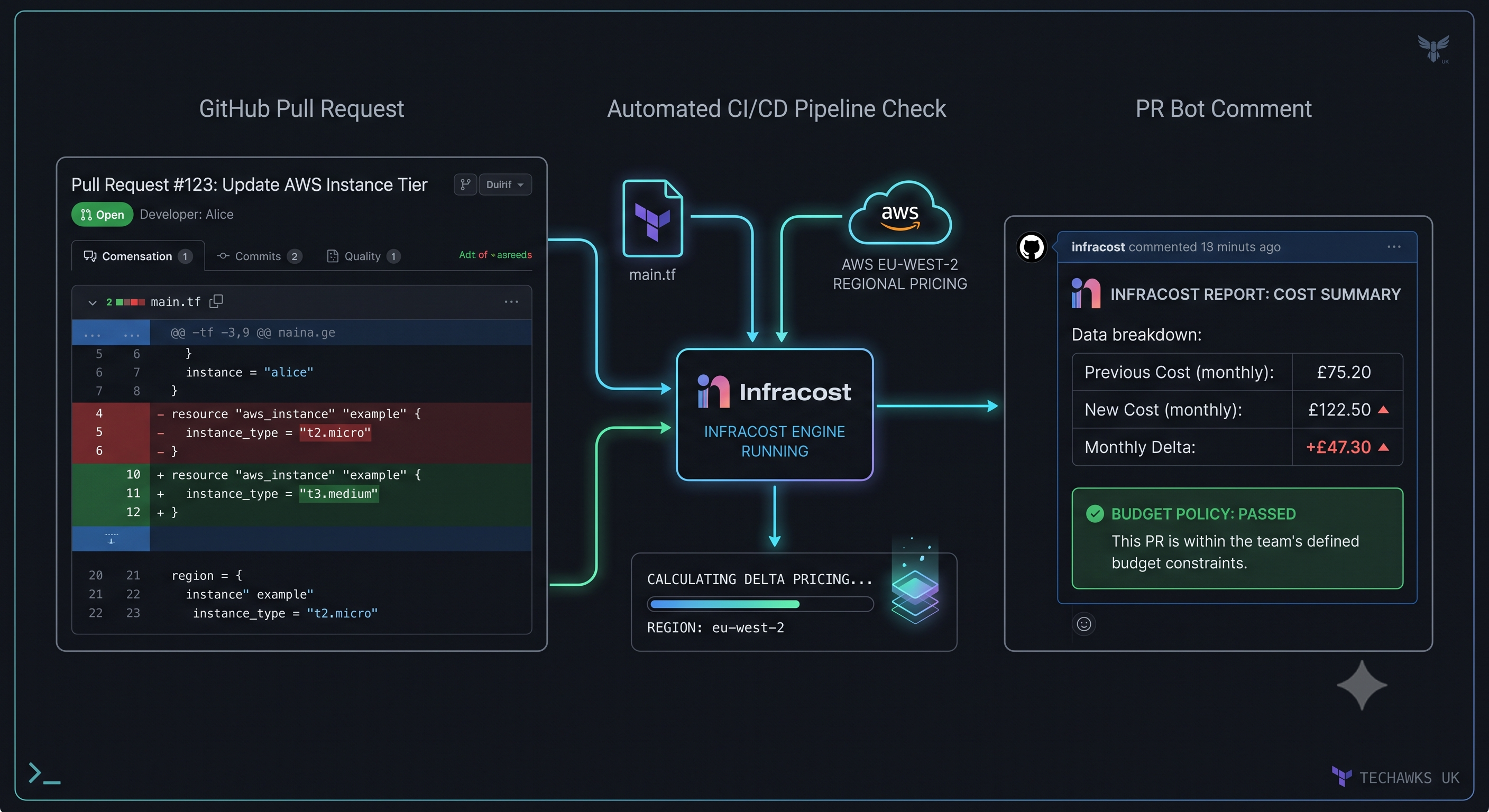
Infracost bridges this gap by acting as a cost linter for your Infrastructure as Code (Terraform, OpenTofu, and Terragrunt). Instead of waiting for billing reports, developers get instant cloud cost feedback before resources are ever provisioned.
Pull Request Cost Diffs: Infracost integrates natively with GitHub, GitLab, and Bitbucket. Every time an engineer updates an instance size, provisions a managed database, or scales storage, Infracost posts a clean breakdown comment detailing the exact monthly delta (e.g., +$142/mo).
Guardrails and Policy Checks: You can set strict FinOps policies directly in your pipeline. If an infrastructure pull request exceeds a pre-set threshold (such as a 20% budget jump on a non-production environment), the check can fail automatically or mandate FinOps lead approval.
Accurate Regional Pricing: It dynamically queries real-time vendor pricing across eu-west-2 (London), AWS, Azure, and Google Cloud, taking into account usage-based parameters like IOPS, egress, and storage tiers.
Developer Empathy Over Blame: Instead of finance teams policing infrastructure weeks later, engineers retain full visibility into how their architecture choices directly affect operational runway in real time.
When it’s not essential: If your infrastructure runs almost exclusively on fixed-capacity bare metal or simple static VMs that rarely change, Infracost won't offer much value. But for dynamic, multi-environment cloud pipelines, it transforms FinOps from a bottleneck into automated code reviews.
Key Takeaways
Shift-left FinOps: Surface accurate cloud cost projections directly in developer pull requests before deployment.
Policy-as-Code guardrails: Automatically block or flag unbudgeted cloud cost spikes in CI/CD workflows.
Regional precision: Supports granular, regional pricing schemas (including UK and European availability zones).
Cross-framework support: Integrates cleanly with Terraform, OpenTofu, and Terragrunt repositories.
CTA (Join Techawks UK)
Optimising cloud reliability and engineering efficiency across the UK? Join the Techawks UK community to connect with DevOps leads, platform engineers, and software architects tackling real-world production stacks. Share your perspective below: Do your developers have visibility into cloud costs during code review, or does FinOps still happen after the monthly invoice arrives?
For engineering and platform teams across London, Cambridge, and Manchester, cloud efficiency has evolved from an annual audit headache into a daily CI/CD discipline. UK enterprise tech—particularly across heavily governed fintech, public sector, and healthtech stacks—demands tight FinOps governance without slowing down delivery pipelines.
Infracost bridges this gap by acting as a cost linter for your Infrastructure as Code (Terraform, OpenTofu, and Terragrunt). Instead of waiting for billing reports, developers get instant cloud cost feedback before resources are ever provisioned.
Pull Request Cost Diffs: Infracost integrates natively with GitHub, GitLab, and Bitbucket. Every time an engineer updates an instance size, provisions a managed database, or scales storage, Infracost posts a clean breakdown comment detailing the exact monthly delta (e.g., +$142/mo).
Guardrails and Policy Checks: You can set strict FinOps policies directly in your pipeline. If an infrastructure pull request exceeds a pre-set threshold (such as a 20% budget jump on a non-production environment), the check can fail automatically or mandate FinOps lead approval.
Accurate Regional Pricing: It dynamically queries real-time vendor pricing across eu-west-2 (London), AWS, Azure, and Google Cloud, taking into account usage-based parameters like IOPS, egress, and storage tiers.
Developer Empathy Over Blame: Instead of finance teams policing infrastructure weeks later, engineers retain full visibility into how their architecture choices directly affect operational runway in real time.
When it’s not essential: If your infrastructure runs almost exclusively on fixed-capacity bare metal or simple static VMs that rarely change, Infracost won't offer much value. But for dynamic, multi-environment cloud pipelines, it transforms FinOps from a bottleneck into automated code reviews.
Key Takeaways
Shift-left FinOps: Surface accurate cloud cost projections directly in developer pull requests before deployment.
Policy-as-Code guardrails: Automatically block or flag unbudgeted cloud cost spikes in CI/CD workflows.
Regional precision: Supports granular, regional pricing schemas (including UK and European availability zones).
Cross-framework support: Integrates cleanly with Terraform, OpenTofu, and Terragrunt repositories.
CTA (Join Techawks UK)
Optimising cloud reliability and engineering efficiency across the UK? Join the Techawks UK community to connect with DevOps leads, platform engineers, and software architects tackling real-world production stacks. Share your perspective below: Do your developers have visibility into cloud costs during code review, or does FinOps still happen after the monthly invoice arrives?
Infracost Review: How UK Platform Teams Are Halting Cloud Spend Before Deployment
For engineering and platform teams across London, Cambridge, and Manchester, cloud efficiency has evolved from an annual audit headache into a daily CI/CD discipline. UK enterprise tech—particularly across heavily governed fintech, public sector, and healthtech stacks—demands tight FinOps governance without slowing down delivery pipelines.
Infracost bridges this gap by acting as a cost linter for your Infrastructure as Code (Terraform, OpenTofu, and Terragrunt). Instead of waiting for billing reports, developers get instant cloud cost feedback before resources are ever provisioned.
Pull Request Cost Diffs: Infracost integrates natively with GitHub, GitLab, and Bitbucket. Every time an engineer updates an instance size, provisions a managed database, or scales storage, Infracost posts a clean breakdown comment detailing the exact monthly delta (e.g., +$142/mo).
Guardrails and Policy Checks: You can set strict FinOps policies directly in your pipeline. If an infrastructure pull request exceeds a pre-set threshold (such as a 20% budget jump on a non-production environment), the check can fail automatically or mandate FinOps lead approval.
Accurate Regional Pricing: It dynamically queries real-time vendor pricing across eu-west-2 (London), AWS, Azure, and Google Cloud, taking into account usage-based parameters like IOPS, egress, and storage tiers.
Developer Empathy Over Blame: Instead of finance teams policing infrastructure weeks later, engineers retain full visibility into how their architecture choices directly affect operational runway in real time.
When it’s not essential: If your infrastructure runs almost exclusively on fixed-capacity bare metal or simple static VMs that rarely change, Infracost won't offer much value. But for dynamic, multi-environment cloud pipelines, it transforms FinOps from a bottleneck into automated code reviews.
Key Takeaways
Shift-left FinOps: Surface accurate cloud cost projections directly in developer pull requests before deployment.
Policy-as-Code guardrails: Automatically block or flag unbudgeted cloud cost spikes in CI/CD workflows.
Regional precision: Supports granular, regional pricing schemas (including UK and European availability zones).
Cross-framework support: Integrates cleanly with Terraform, OpenTofu, and Terragrunt repositories.
CTA (Join Techawks UK)
Optimising cloud reliability and engineering efficiency across the UK? Join the Techawks UK community to connect with DevOps leads, platform engineers, and software architects tackling real-world production stacks. Share your perspective below: Do your developers have visibility into cloud costs during code review, or does FinOps still happen after the monthly invoice arrives?

 Arabic
 French
 Spanish
 Portuguese
 Deutsch
 Turkish
 Dutch
Dutch
 Italiano
 Russian
 Romaian
 Portuguese (Brazil)
 Greek
Greek