


Tool Review: OpenTofu vs. Terraform—Is the Fork Worth the Migration Overhead?
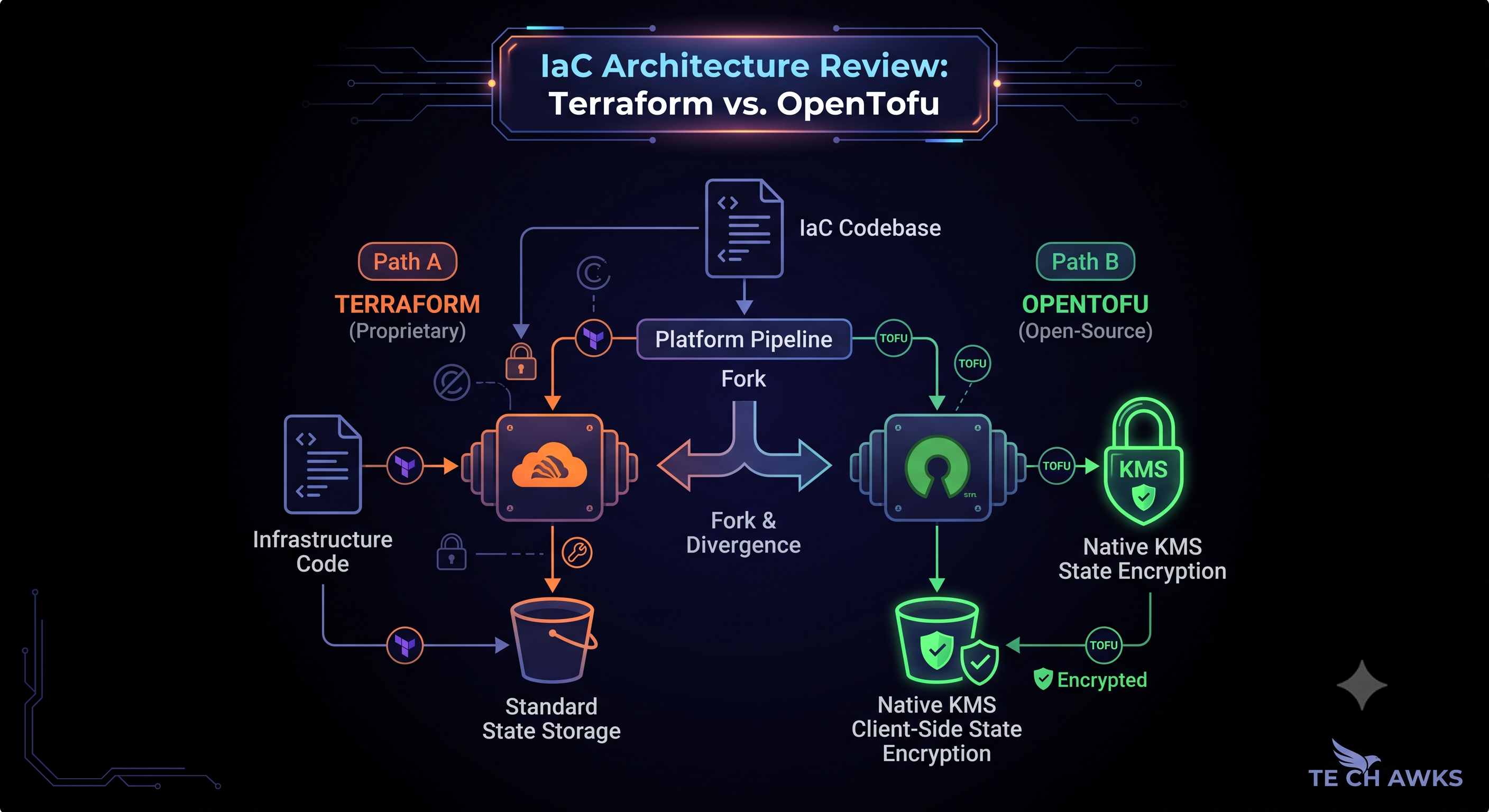
OpenTofu was launched as a Linux Foundation-backed, open-source fork of Terraform, preserving the MPL-2.0 spirit while ensuring community-driven evolution. For most teams, day-to-day Infrastructure as Code (IaC) syntax looks nearly identical, but the architectural divergence under the hood is beginning to compound.
Where OpenTofu Excels:
Truly Open Governance: Governed by the Linux Foundation, OpenTofu guarantees that roadmap priorities, provider registries, and core engine patches remain neutral and unencumbered by restrictive licensing terms.
State File Encryption: OpenTofu introduced native client-side state file encryption at rest (supporting AWS KMS, GCP KMS, and Azure Key Vault), resolving a long-standing vulnerability in core Terraform where sensitive secrets sat unencrypted in state files.
Drop-in Compatibility: For teams running standard configurations, OpenTofu functions as an exact binary replacement (tofu init, tofu plan, tofu apply) with zero code refactoring required for pre-1.6 Terraform modules.
Where Engineering Teams Face Friction:
Ecosystem Parity & Proprietary Provider Drift: As enterprise features diverge, providers optimized specifically for commercial cloud platforms or proprietary orchestration runtimes may lag in official support or require community-maintained mirrors.
Pipeline Tooling Re-certification: Migrating isn’t just swapping a binary; it requires updating CI/CD runners, drift detection agents, security linters (like tfsec or Checkov), and wrapper platforms across your deployment ecosystem.
Organizational Conservatism: In enterprise environments, risk-averse security and compliance boards often prefer incumbent commercial SLAs over community foundation backing, regardless of technical merits.
Key Takeaways
State security is the differentiator: OpenTofu's native client-side state encryption alone solves a major compliance headache without requiring external secret-masking wrappers.
Migration risk is low, validation cost is real: The binary swap is trivial; the actual effort lies in testing your automated CI/CD pipelines, linting tools, and custom provider registries.
Forks eventually diverge: While compatibility is near-total today, architectural divergences in module syntax and testing frameworks will force platform teams to choose a long-term path.
CTA (Share deployment experiences)
For DevOps and platform engineers running multi-cloud infrastructure: Has your team migrated production environments to OpenTofu, or are you staying on the Terraform track? If you made the leap, did your automated CI/CD pipelines hit any unexpected provider registry roadblocks? Share your real-world deployment lessons below.
OpenTofu was launched as a Linux Foundation-backed, open-source fork of Terraform, preserving the MPL-2.0 spirit while ensuring community-driven evolution. For most teams, day-to-day Infrastructure as Code (IaC) syntax looks nearly identical, but the architectural divergence under the hood is beginning to compound.
Where OpenTofu Excels:
Truly Open Governance: Governed by the Linux Foundation, OpenTofu guarantees that roadmap priorities, provider registries, and core engine patches remain neutral and unencumbered by restrictive licensing terms.
State File Encryption: OpenTofu introduced native client-side state file encryption at rest (supporting AWS KMS, GCP KMS, and Azure Key Vault), resolving a long-standing vulnerability in core Terraform where sensitive secrets sat unencrypted in state files.
Drop-in Compatibility: For teams running standard configurations, OpenTofu functions as an exact binary replacement (tofu init, tofu plan, tofu apply) with zero code refactoring required for pre-1.6 Terraform modules.
Where Engineering Teams Face Friction:
Ecosystem Parity & Proprietary Provider Drift: As enterprise features diverge, providers optimized specifically for commercial cloud platforms or proprietary orchestration runtimes may lag in official support or require community-maintained mirrors.
Pipeline Tooling Re-certification: Migrating isn’t just swapping a binary; it requires updating CI/CD runners, drift detection agents, security linters (like tfsec or Checkov), and wrapper platforms across your deployment ecosystem.
Organizational Conservatism: In enterprise environments, risk-averse security and compliance boards often prefer incumbent commercial SLAs over community foundation backing, regardless of technical merits.
Key Takeaways
State security is the differentiator: OpenTofu's native client-side state encryption alone solves a major compliance headache without requiring external secret-masking wrappers.
Migration risk is low, validation cost is real: The binary swap is trivial; the actual effort lies in testing your automated CI/CD pipelines, linting tools, and custom provider registries.
Forks eventually diverge: While compatibility is near-total today, architectural divergences in module syntax and testing frameworks will force platform teams to choose a long-term path.
CTA (Share deployment experiences)
For DevOps and platform engineers running multi-cloud infrastructure: Has your team migrated production environments to OpenTofu, or are you staying on the Terraform track? If you made the leap, did your automated CI/CD pipelines hit any unexpected provider registry roadblocks? Share your real-world deployment lessons below.
Tool Review: OpenTofu vs. Terraform—Is the Fork Worth the Migration Overhead?
OpenTofu was launched as a Linux Foundation-backed, open-source fork of Terraform, preserving the MPL-2.0 spirit while ensuring community-driven evolution. For most teams, day-to-day Infrastructure as Code (IaC) syntax looks nearly identical, but the architectural divergence under the hood is beginning to compound.
Where OpenTofu Excels:
Truly Open Governance: Governed by the Linux Foundation, OpenTofu guarantees that roadmap priorities, provider registries, and core engine patches remain neutral and unencumbered by restrictive licensing terms.
State File Encryption: OpenTofu introduced native client-side state file encryption at rest (supporting AWS KMS, GCP KMS, and Azure Key Vault), resolving a long-standing vulnerability in core Terraform where sensitive secrets sat unencrypted in state files.
Drop-in Compatibility: For teams running standard configurations, OpenTofu functions as an exact binary replacement (tofu init, tofu plan, tofu apply) with zero code refactoring required for pre-1.6 Terraform modules.
Where Engineering Teams Face Friction:
Ecosystem Parity & Proprietary Provider Drift: As enterprise features diverge, providers optimized specifically for commercial cloud platforms or proprietary orchestration runtimes may lag in official support or require community-maintained mirrors.
Pipeline Tooling Re-certification: Migrating isn’t just swapping a binary; it requires updating CI/CD runners, drift detection agents, security linters (like tfsec or Checkov), and wrapper platforms across your deployment ecosystem.
Organizational Conservatism: In enterprise environments, risk-averse security and compliance boards often prefer incumbent commercial SLAs over community foundation backing, regardless of technical merits.
Key Takeaways
State security is the differentiator: OpenTofu's native client-side state encryption alone solves a major compliance headache without requiring external secret-masking wrappers.
Migration risk is low, validation cost is real: The binary swap is trivial; the actual effort lies in testing your automated CI/CD pipelines, linting tools, and custom provider registries.
Forks eventually diverge: While compatibility is near-total today, architectural divergences in module syntax and testing frameworks will force platform teams to choose a long-term path.
CTA (Share deployment experiences)
For DevOps and platform engineers running multi-cloud infrastructure: Has your team migrated production environments to OpenTofu, or are you staying on the Terraform track? If you made the leap, did your automated CI/CD pipelines hit any unexpected provider registry roadblocks? Share your real-world deployment lessons below.

 English
 Arabic
 French
 Spanish
 Portuguese
 Deutsch
 Turkish
 Italiano
 Russian
 Romaian
 Portuguese (Brazil)
 Greek
Greek