


Stop Replacing Deterministic Code with Reasoning Tokens: The Inference Scaling Trap
A dangerous assumption is quietly taking over AI engineering:
“Now that models have test-time compute and internal chain-of-thought, we can ditch complex state machines and deterministic evaluators.”
Here is the hard truth: Test-time compute scales search, not deterministic truth.
When you hand an open-ended reasoning model a multi-step task without rigid structural scaffolding, three costly architectural bottlenecks happen:
The Reasoning Token Tax
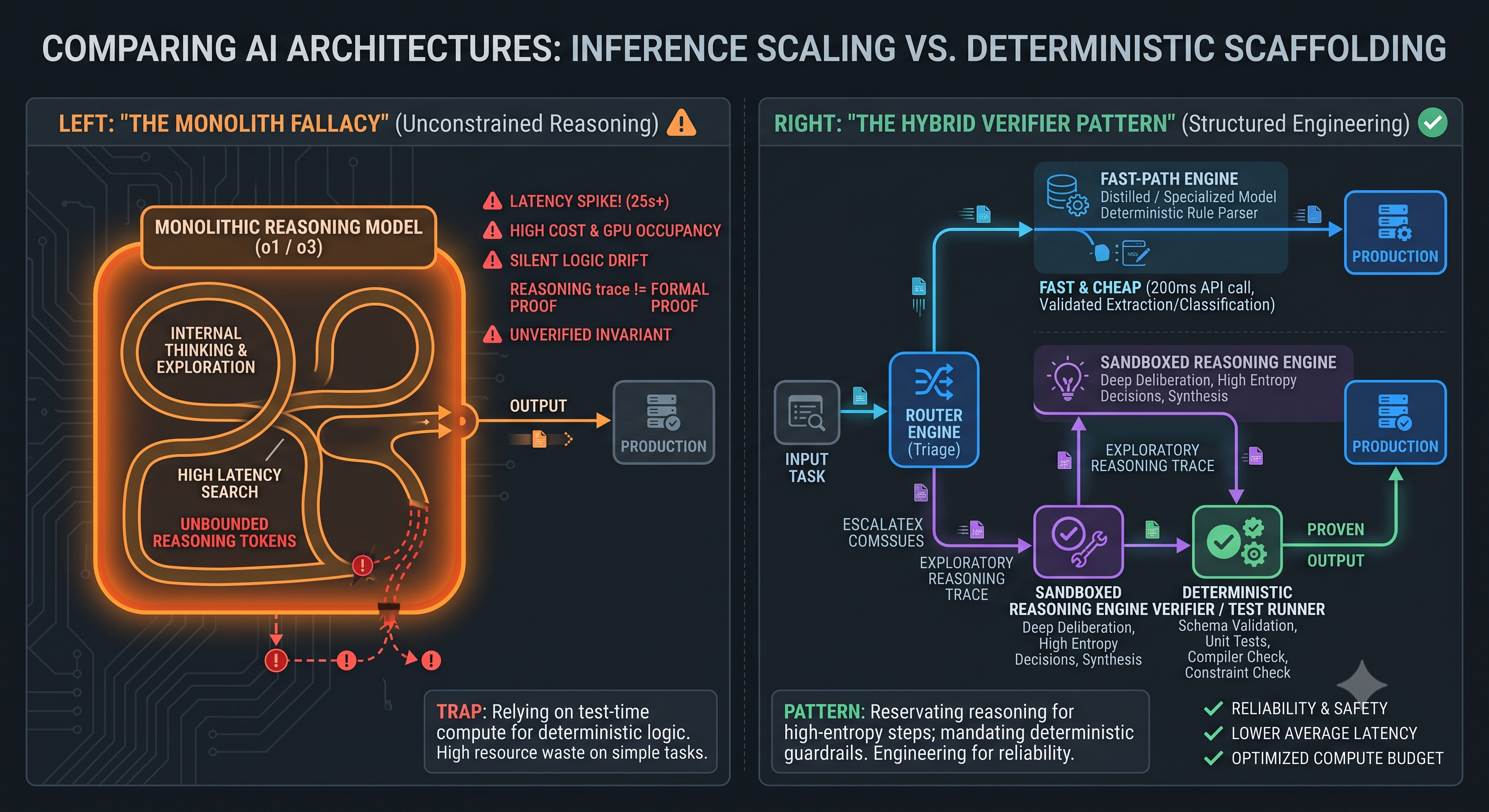
Reasoning models don't just generate visible outputs; they burn hundreds—often thousands—of hidden thinking tokens exploring dead-end paths. For edge cases in production, you trade a 200ms API call for a 25-second GPU-occupancy spike, obliterating p95 latency and spiking compute bills.
Step Validity vs. Faithfulness
A model can produce an impeccably rationalized intermediate chain of thought and still output a hallucinated invariant. Internal reasoning traces are exploratory sampling paths, not formal proofs. If your system relies on the model self-policing its own state transitions, you will hit silent logic drift.
Overthinking Simple Tasks
Reasoning models struggle with dynamic token budgeting unless strictly constrained. Given an unstructured extraction or classification task under vague instructions, a reasoner will frequently deploy thousands of tokens debating trivial syntactic rules before returning a simple JSON payload.
The Architectural Fix: The Hybrid Verification Pattern
Don’t treat reasoning models as monolithic solvers. Treat them as isolated node engines in an explicit directed acyclic graph (DAG):
Fast-Path Triage: Route standard extraction, classification, and predictable deterministic logic through fast, distilled, lightweight models (or rule-based parsers).
Constrained Deliberation: Reserve test-time compute exclusively for high-entropy decision forks (e.g., dynamic planning, ambiguous code synthesis, diagnostic anomaly search).
Deterministic Sandboxing: Never let a reasoning trace decide if its own output is valid. Pair every reasoning step with an automated verifier—a compiler, a schema validator, a unit test, or an environment execution check.
Inference compute is a powerful tool, but structured engineering remains your ultimate safety barrier.
Discussion Question
Where have you seen reasoning models fail hardest in your production pipelines: unpredictable latency spikes, rationalized hallucinations, or burning tokens on simple subtasks?
CTA
Want to stay ahead of cutting-edge architectures and production-grade design patterns? Join AI Builders & Enthusiasts at Techawks AI to build reliable, high-performance intelligent systems together.
A dangerous assumption is quietly taking over AI engineering:
“Now that models have test-time compute and internal chain-of-thought, we can ditch complex state machines and deterministic evaluators.”
Here is the hard truth: Test-time compute scales search, not deterministic truth.
When you hand an open-ended reasoning model a multi-step task without rigid structural scaffolding, three costly architectural bottlenecks happen:
The Reasoning Token Tax
Reasoning models don't just generate visible outputs; they burn hundreds—often thousands—of hidden thinking tokens exploring dead-end paths. For edge cases in production, you trade a 200ms API call for a 25-second GPU-occupancy spike, obliterating p95 latency and spiking compute bills.
Step Validity vs. Faithfulness
A model can produce an impeccably rationalized intermediate chain of thought and still output a hallucinated invariant. Internal reasoning traces are exploratory sampling paths, not formal proofs. If your system relies on the model self-policing its own state transitions, you will hit silent logic drift.
Overthinking Simple Tasks
Reasoning models struggle with dynamic token budgeting unless strictly constrained. Given an unstructured extraction or classification task under vague instructions, a reasoner will frequently deploy thousands of tokens debating trivial syntactic rules before returning a simple JSON payload.
The Architectural Fix: The Hybrid Verification Pattern
Don’t treat reasoning models as monolithic solvers. Treat them as isolated node engines in an explicit directed acyclic graph (DAG):
Fast-Path Triage: Route standard extraction, classification, and predictable deterministic logic through fast, distilled, lightweight models (or rule-based parsers).
Constrained Deliberation: Reserve test-time compute exclusively for high-entropy decision forks (e.g., dynamic planning, ambiguous code synthesis, diagnostic anomaly search).
Deterministic Sandboxing: Never let a reasoning trace decide if its own output is valid. Pair every reasoning step with an automated verifier—a compiler, a schema validator, a unit test, or an environment execution check.
Inference compute is a powerful tool, but structured engineering remains your ultimate safety barrier.
Discussion Question
Where have you seen reasoning models fail hardest in your production pipelines: unpredictable latency spikes, rationalized hallucinations, or burning tokens on simple subtasks?
CTA
Want to stay ahead of cutting-edge architectures and production-grade design patterns? Join AI Builders & Enthusiasts at Techawks AI to build reliable, high-performance intelligent systems together.
Stop Replacing Deterministic Code with Reasoning Tokens: The Inference Scaling Trap
A dangerous assumption is quietly taking over AI engineering:
“Now that models have test-time compute and internal chain-of-thought, we can ditch complex state machines and deterministic evaluators.”
Here is the hard truth: Test-time compute scales search, not deterministic truth.
When you hand an open-ended reasoning model a multi-step task without rigid structural scaffolding, three costly architectural bottlenecks happen:
The Reasoning Token Tax
Reasoning models don't just generate visible outputs; they burn hundreds—often thousands—of hidden thinking tokens exploring dead-end paths. For edge cases in production, you trade a 200ms API call for a 25-second GPU-occupancy spike, obliterating p95 latency and spiking compute bills.
Step Validity vs. Faithfulness
A model can produce an impeccably rationalized intermediate chain of thought and still output a hallucinated invariant. Internal reasoning traces are exploratory sampling paths, not formal proofs. If your system relies on the model self-policing its own state transitions, you will hit silent logic drift.
Overthinking Simple Tasks
Reasoning models struggle with dynamic token budgeting unless strictly constrained. Given an unstructured extraction or classification task under vague instructions, a reasoner will frequently deploy thousands of tokens debating trivial syntactic rules before returning a simple JSON payload.
The Architectural Fix: The Hybrid Verification Pattern
Don’t treat reasoning models as monolithic solvers. Treat them as isolated node engines in an explicit directed acyclic graph (DAG):
Fast-Path Triage: Route standard extraction, classification, and predictable deterministic logic through fast, distilled, lightweight models (or rule-based parsers).
Constrained Deliberation: Reserve test-time compute exclusively for high-entropy decision forks (e.g., dynamic planning, ambiguous code synthesis, diagnostic anomaly search).
Deterministic Sandboxing: Never let a reasoning trace decide if its own output is valid. Pair every reasoning step with an automated verifier—a compiler, a schema validator, a unit test, or an environment execution check.
Inference compute is a powerful tool, but structured engineering remains your ultimate safety barrier.
Discussion Question
Where have you seen reasoning models fail hardest in your production pipelines: unpredictable latency spikes, rationalized hallucinations, or burning tokens on simple subtasks?
CTA
Want to stay ahead of cutting-edge architectures and production-grade design patterns? Join AI Builders & Enthusiasts at Techawks AI to build reliable, high-performance intelligent systems together.

 Arabic
 French
 Spanish
 Portuguese
 Deutsch
 Turkish
 Dutch
Dutch
 Italiano
 Russian
 Romaian
 Portuguese (Brazil)
 Greek
Greek