


The Concurrency Illusion: Why async/await Won’t Save You From Data Races
A pervasive bug pattern keeps surfacing across modern backends: developers conflate asynchronous scheduling with mutual exclusion.
Async runtimes (like Node's Event Loop, Go runtimes, Tokio in Rust, or Python’s AsyncIO) solve I/O blocking. They do not serialize logic interleaved across execution yields.
Consider a classic balance check:
JavaScript
// A catastrophic race condition hidden in plain sight
async function withdraw(userId, amount) {
const balance = await db.getBalance(userId); // Yield point
if (balance >= amount) {
const newBalance = balance - amount;
await db.setBalance(userId, newBalance); // Yield point
return true;
}
return false;
}
What goes wrong under concurrency:
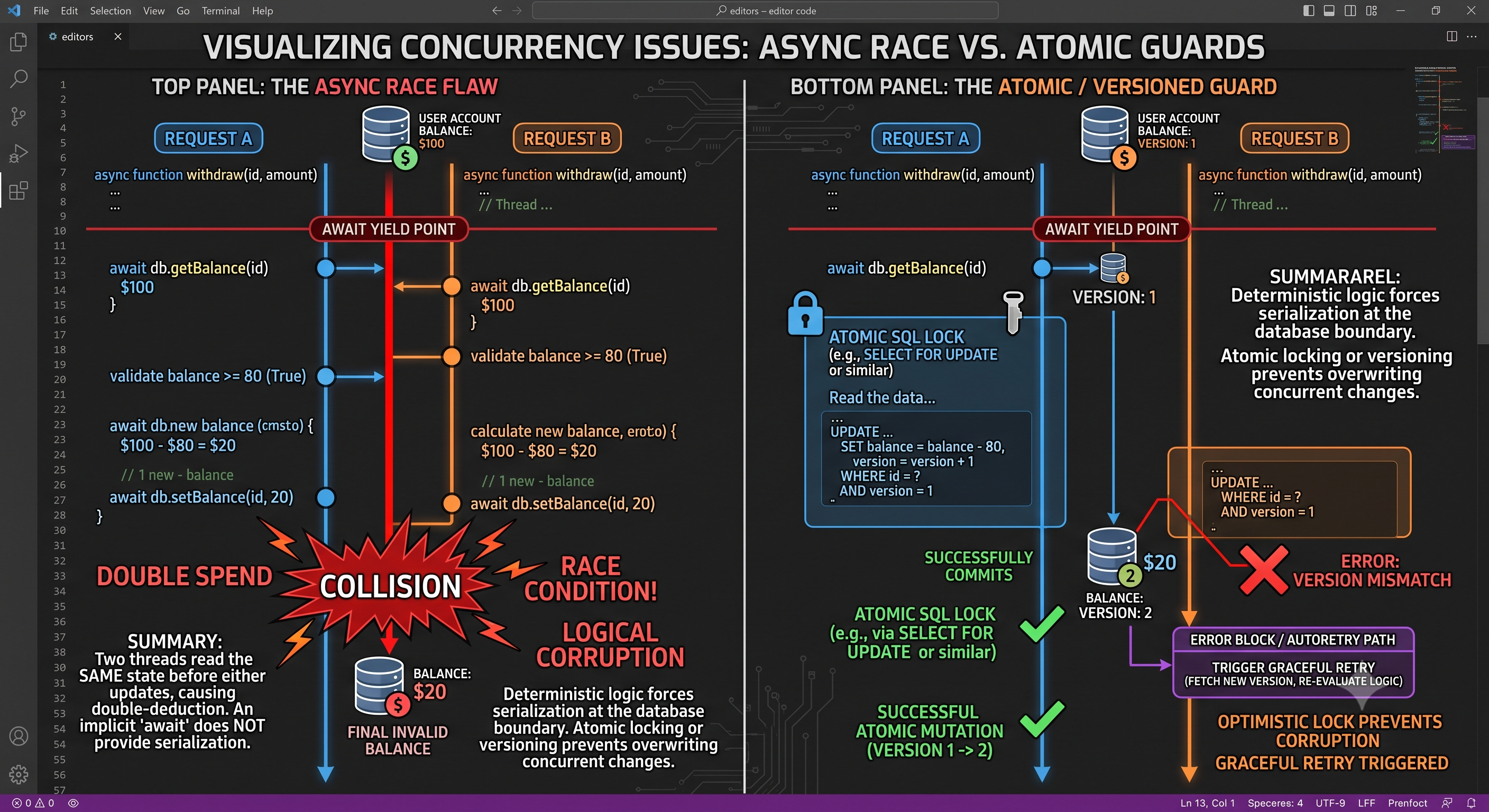
Request A fetches the balance ($100) and yields while waiting on I/O.
Before Request A resumes, Request B fetches the exact same balance ($100).
Both evaluate balance >= amount as true.
Both write back decremented totals independently.
You’ve double-spent the account because an await statement is an explicit surrender of execution control.
The Fix: Move Concurrency Control to the State Boundary
Don't patch this by sprinkling arbitrary in-memory mutexes across distributed nodes. Use these three patterns instead:
Atomic Database Mutations: Never read-modify-write in the application layer if your storage engine can do it atomically:
UPDATE accounts SET balance = balance - :amount WHERE id = :id AND balance >= :amount;
Optimistic Locking: Introduce an internal monotonic version column. Fail or retry transactions when UPDATE ... WHERE id = :id AND version = :currentVersion returns zero modified rows.
Partition-Keyed Actor Queues: If state must live in memory, route all updates for a specific userId through a dedicated single-threaded FIFO worker queue or stateful actor.
Asynchronous code makes waiting cheap, but state coordination remains expensive. Write code that assumes interleaving will happen at every yield point.
Discussion Question
What’s the nastiest concurrency bug you’ve had to debug in production—and was the fix in application memory or the database layer?
CTA
Sharpen your engineering fundamentals, master system patterns, and write bulletproof code. Join Developers & Coding at Techawks Developers.
A pervasive bug pattern keeps surfacing across modern backends: developers conflate asynchronous scheduling with mutual exclusion.
Async runtimes (like Node's Event Loop, Go runtimes, Tokio in Rust, or Python’s AsyncIO) solve I/O blocking. They do not serialize logic interleaved across execution yields.
Consider a classic balance check:
JavaScript
// A catastrophic race condition hidden in plain sight
async function withdraw(userId, amount) {
const balance = await db.getBalance(userId); // Yield point
if (balance >= amount) {
const newBalance = balance - amount;
await db.setBalance(userId, newBalance); // Yield point
return true;
}
return false;
}
What goes wrong under concurrency:
Request A fetches the balance ($100) and yields while waiting on I/O.
Before Request A resumes, Request B fetches the exact same balance ($100).
Both evaluate balance >= amount as true.
Both write back decremented totals independently.
You’ve double-spent the account because an await statement is an explicit surrender of execution control.
The Fix: Move Concurrency Control to the State Boundary
Don't patch this by sprinkling arbitrary in-memory mutexes across distributed nodes. Use these three patterns instead:
Atomic Database Mutations: Never read-modify-write in the application layer if your storage engine can do it atomically:
UPDATE accounts SET balance = balance - :amount WHERE id = :id AND balance >= :amount;
Optimistic Locking: Introduce an internal monotonic version column. Fail or retry transactions when UPDATE ... WHERE id = :id AND version = :currentVersion returns zero modified rows.
Partition-Keyed Actor Queues: If state must live in memory, route all updates for a specific userId through a dedicated single-threaded FIFO worker queue or stateful actor.
Asynchronous code makes waiting cheap, but state coordination remains expensive. Write code that assumes interleaving will happen at every yield point.
Discussion Question
What’s the nastiest concurrency bug you’ve had to debug in production—and was the fix in application memory or the database layer?
CTA
Sharpen your engineering fundamentals, master system patterns, and write bulletproof code. Join Developers & Coding at Techawks Developers.
The Concurrency Illusion: Why async/await Won’t Save You From Data Races
A pervasive bug pattern keeps surfacing across modern backends: developers conflate asynchronous scheduling with mutual exclusion.
Async runtimes (like Node's Event Loop, Go runtimes, Tokio in Rust, or Python’s AsyncIO) solve I/O blocking. They do not serialize logic interleaved across execution yields.
Consider a classic balance check:
JavaScript
// A catastrophic race condition hidden in plain sight
async function withdraw(userId, amount) {
const balance = await db.getBalance(userId); // Yield point
if (balance >= amount) {
const newBalance = balance - amount;
await db.setBalance(userId, newBalance); // Yield point
return true;
}
return false;
}
What goes wrong under concurrency:
Request A fetches the balance ($100) and yields while waiting on I/O.
Before Request A resumes, Request B fetches the exact same balance ($100).
Both evaluate balance >= amount as true.
Both write back decremented totals independently.
You’ve double-spent the account because an await statement is an explicit surrender of execution control.
The Fix: Move Concurrency Control to the State Boundary
Don't patch this by sprinkling arbitrary in-memory mutexes across distributed nodes. Use these three patterns instead:
Atomic Database Mutations: Never read-modify-write in the application layer if your storage engine can do it atomically:
UPDATE accounts SET balance = balance - :amount WHERE id = :id AND balance >= :amount;
Optimistic Locking: Introduce an internal monotonic version column. Fail or retry transactions when UPDATE ... WHERE id = :id AND version = :currentVersion returns zero modified rows.
Partition-Keyed Actor Queues: If state must live in memory, route all updates for a specific userId through a dedicated single-threaded FIFO worker queue or stateful actor.
Asynchronous code makes waiting cheap, but state coordination remains expensive. Write code that assumes interleaving will happen at every yield point.
Discussion Question
What’s the nastiest concurrency bug you’ve had to debug in production—and was the fix in application memory or the database layer?
CTA
Sharpen your engineering fundamentals, master system patterns, and write bulletproof code. Join Developers & Coding at Techawks Developers.

 Arabic
 French
 Spanish
 Portuguese
 Deutsch
 Turkish
 Dutch
Dutch
 Italiano
 Russian
 Romaian
 Portuguese (Brazil)
 Greek
Greek