


The Chat Window Is a UX Failure: Why Enterprise Workflows Are Rejecting Conversational Interfaces
Product teams across SaaS made a collective design bet: “Natural language is the universal interface. Replace complex dashboards with a chat bar, and users will type their way to value.”
Users aren’t adopting it. Instead, they bounce back to rigid tables and buttons.
The conversational paradigm collapses in enterprise software due to three core interaction design breakdowns:
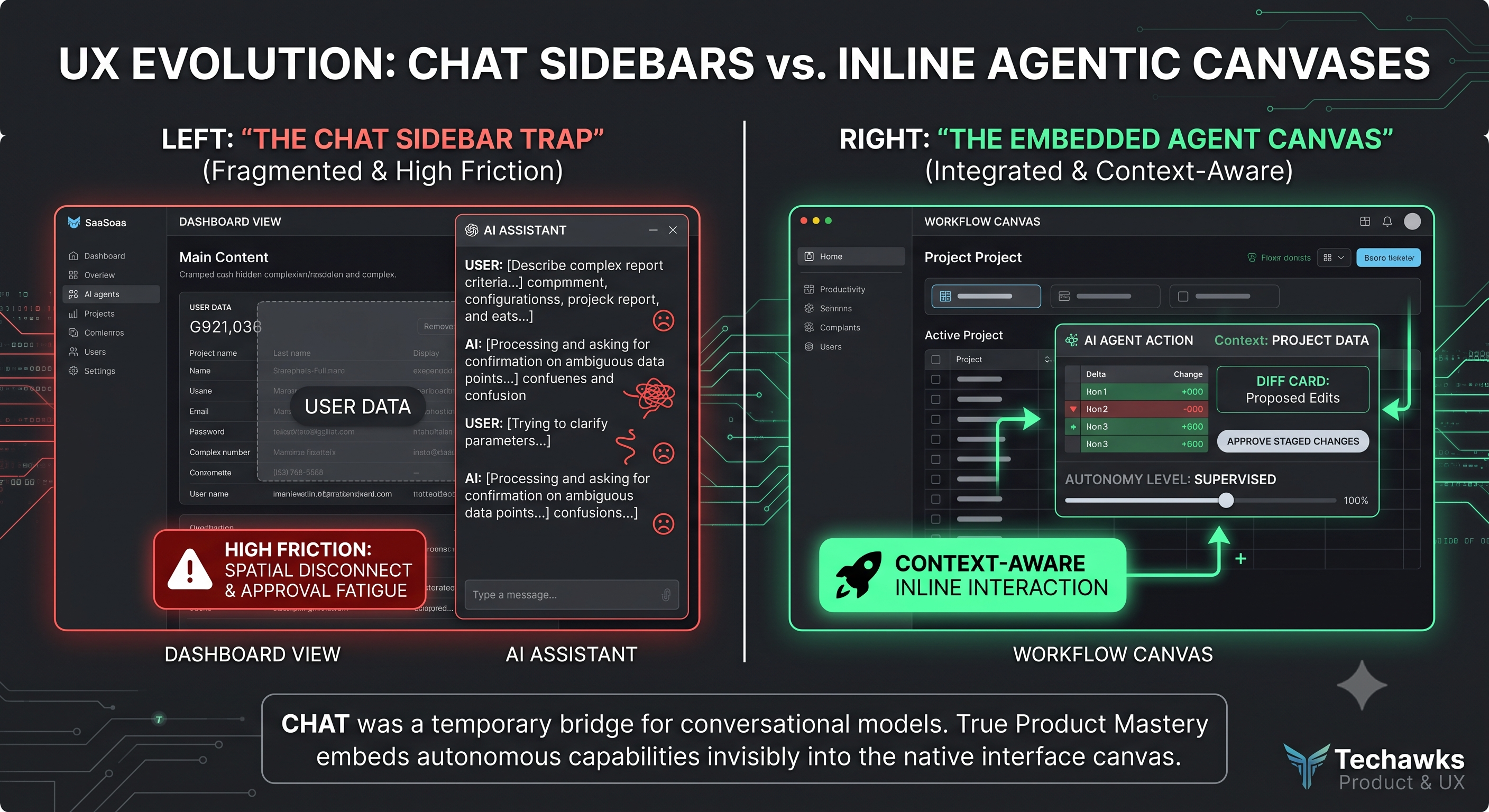
The Blank Canvas Tax (Zero Affordance): A text input offers zero visual discovery. Users don’t want to guess magical prompt syntax to extract a report; traditional UI buttons and filter chips visually map system capabilities directly into the user’s mental model.
Context Fragmentation: Forcing a user to jump out of their working canvas into a narrow side-drawer chat window fragments spatial context. When an agent acts on complex tables or canvas nodes, forcing the explanation into a vertical text stream forces users to read through terminal-like walls of prose just to verify an edit.
The "Confirm Everything" Approval Fatigue: Chatbot workflows often alternate between two extremes: executing actions blindly (destroying trust) or asking "Are you sure?" at every trivial step (destroying velocity).
The Product Shift: Embedded, Inline Agentic UX
High-performing product designers are ditching chat sidebars for Contextual Canvas Primitives:
Diff Over Dialogue: Don't tell the user what changed in conversational text. Render inline visual diffs (strikethroughs, color-coded delta rows, preview cards) directly inside the artifact where the work lives.
Granular Checkpoint Cards: Reserve human-in-the-loop gates strictly for high-blast-radius mutations (e.g., spending budget, deleting records, emailing external clients). Make low-stakes, reversible edits instant, backed by a persistent global undo/replay buffer.
The Shared Autonomy Dial: Allow users to calibrate agent delegation per task:
Draft/Propose Mode: Agent produces editable staged states.
Supervised Mode: Agent auto-executes routine steps and pauses at critical branches.
Delegated Mode: Agent executes autonomously with a clean historical audit log.
Chat was a temporary bridge for conversational models. True product mastery embeds autonomous capabilities invisibly into the native interface canvas.
Discussion Question
Where in your product has a conversational interface actually reduced friction, and where did it just add an unnecessary layer of prompt-typing over a button?
CTA
Design intuitive user journeys, master AI interaction paradigms, and lead the future of user experience. Join Product, UX & Design at Techawks Product & UX.
Product teams across SaaS made a collective design bet: “Natural language is the universal interface. Replace complex dashboards with a chat bar, and users will type their way to value.”
Users aren’t adopting it. Instead, they bounce back to rigid tables and buttons.
The conversational paradigm collapses in enterprise software due to three core interaction design breakdowns:
The Blank Canvas Tax (Zero Affordance): A text input offers zero visual discovery. Users don’t want to guess magical prompt syntax to extract a report; traditional UI buttons and filter chips visually map system capabilities directly into the user’s mental model.
Context Fragmentation: Forcing a user to jump out of their working canvas into a narrow side-drawer chat window fragments spatial context. When an agent acts on complex tables or canvas nodes, forcing the explanation into a vertical text stream forces users to read through terminal-like walls of prose just to verify an edit.
The "Confirm Everything" Approval Fatigue: Chatbot workflows often alternate between two extremes: executing actions blindly (destroying trust) or asking "Are you sure?" at every trivial step (destroying velocity).
The Product Shift: Embedded, Inline Agentic UX
High-performing product designers are ditching chat sidebars for Contextual Canvas Primitives:
Diff Over Dialogue: Don't tell the user what changed in conversational text. Render inline visual diffs (strikethroughs, color-coded delta rows, preview cards) directly inside the artifact where the work lives.
Granular Checkpoint Cards: Reserve human-in-the-loop gates strictly for high-blast-radius mutations (e.g., spending budget, deleting records, emailing external clients). Make low-stakes, reversible edits instant, backed by a persistent global undo/replay buffer.
The Shared Autonomy Dial: Allow users to calibrate agent delegation per task:
Draft/Propose Mode: Agent produces editable staged states.
Supervised Mode: Agent auto-executes routine steps and pauses at critical branches.
Delegated Mode: Agent executes autonomously with a clean historical audit log.
Chat was a temporary bridge for conversational models. True product mastery embeds autonomous capabilities invisibly into the native interface canvas.
Discussion Question
Where in your product has a conversational interface actually reduced friction, and where did it just add an unnecessary layer of prompt-typing over a button?
CTA
Design intuitive user journeys, master AI interaction paradigms, and lead the future of user experience. Join Product, UX & Design at Techawks Product & UX.
The Chat Window Is a UX Failure: Why Enterprise Workflows Are Rejecting Conversational Interfaces
Product teams across SaaS made a collective design bet: “Natural language is the universal interface. Replace complex dashboards with a chat bar, and users will type their way to value.”
Users aren’t adopting it. Instead, they bounce back to rigid tables and buttons.
The conversational paradigm collapses in enterprise software due to three core interaction design breakdowns:
The Blank Canvas Tax (Zero Affordance): A text input offers zero visual discovery. Users don’t want to guess magical prompt syntax to extract a report; traditional UI buttons and filter chips visually map system capabilities directly into the user’s mental model.
Context Fragmentation: Forcing a user to jump out of their working canvas into a narrow side-drawer chat window fragments spatial context. When an agent acts on complex tables or canvas nodes, forcing the explanation into a vertical text stream forces users to read through terminal-like walls of prose just to verify an edit.
The "Confirm Everything" Approval Fatigue: Chatbot workflows often alternate between two extremes: executing actions blindly (destroying trust) or asking "Are you sure?" at every trivial step (destroying velocity).
The Product Shift: Embedded, Inline Agentic UX
High-performing product designers are ditching chat sidebars for Contextual Canvas Primitives:
Diff Over Dialogue: Don't tell the user what changed in conversational text. Render inline visual diffs (strikethroughs, color-coded delta rows, preview cards) directly inside the artifact where the work lives.
Granular Checkpoint Cards: Reserve human-in-the-loop gates strictly for high-blast-radius mutations (e.g., spending budget, deleting records, emailing external clients). Make low-stakes, reversible edits instant, backed by a persistent global undo/replay buffer.
The Shared Autonomy Dial: Allow users to calibrate agent delegation per task:
Draft/Propose Mode: Agent produces editable staged states.
Supervised Mode: Agent auto-executes routine steps and pauses at critical branches.
Delegated Mode: Agent executes autonomously with a clean historical audit log.
Chat was a temporary bridge for conversational models. True product mastery embeds autonomous capabilities invisibly into the native interface canvas.
Discussion Question
Where in your product has a conversational interface actually reduced friction, and where did it just add an unnecessary layer of prompt-typing over a button?
CTA
Design intuitive user journeys, master AI interaction paradigms, and lead the future of user experience. Join Product, UX & Design at Techawks Product & UX.

 English
 Arabic
 French
 Spanish
 Portuguese
 Deutsch
 Dutch
Dutch
 Italiano
 Russian
 Romaian
 Portuguese (Brazil)
 Greek
Greek