


The DPI Illusion: Why Building on Open Rails Won’t Automatically Save You From Churn
India’s Digital Public Infrastructure (DPI) transformed engineering in the country. In less than a decade, open protocols collapsed onboarding friction: eKYC dropped customer verification costs, UPI made payment rails near-instant, and the Account Aggregator (AA) framework standardized financial data sharing.
Because the underlying rails are so robust, Indian engineering teams fall into a strategic trap: confusing protocol integration with product defensibility.
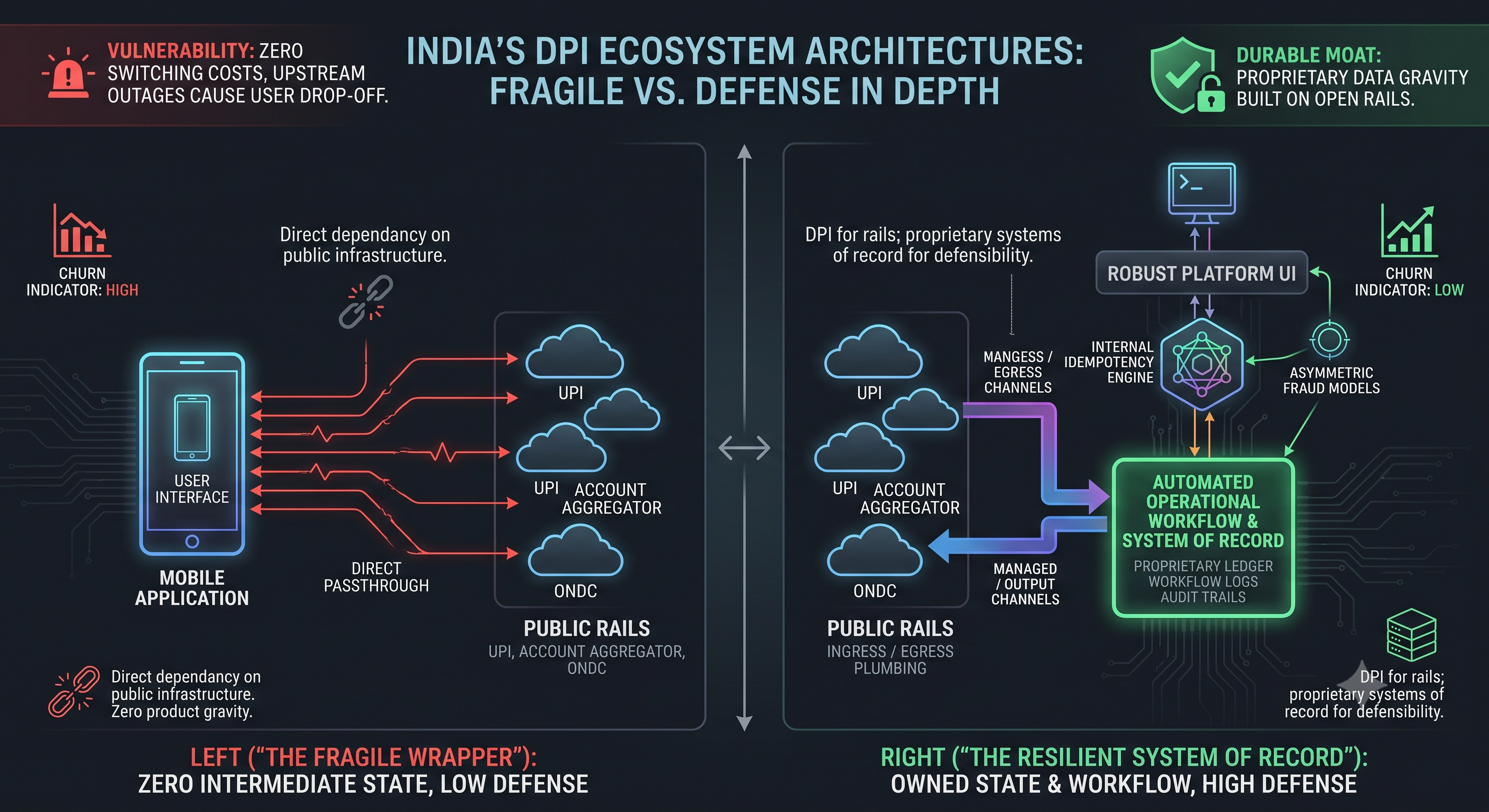
When you build a consumer or B2B product whose core loop relies purely on public APIs, your architecture inherits a unique set of structural vulnerabilities:
Near-Zero Switching Costs: The exact feature that lets you onboard a user in 60 seconds lets a competitor steal that same user in 30 seconds. When payment, authentication, and transaction layers are commoditized public goods, customer loyalty to your interface approaches zero.
The Aggregator Parity Trap: On open protocols like ONDC or AA, discovery and data formats are democratized. If your product simply surfaces catalog entries or credit scoring derived from public endpoints, you are competing on thin margins against players with massive balance sheets.
Upstream Latency & Failure Boundaries: Public rails operate at unprecedented population scale, but when upstream banking gateways or network node syncs experience latency spikes, the user blames your app. If you don't engineer resilience against asynchronous failure modes, your app experience degrades quickly.
The Engineering Shift: How to Build Moats on Top of Public Rails
Stop treating DPI as the product. Treat it strictly as settlement plumbing while engineering proprietary value at the edges:
Stateful Intelligence Over Stateless Plumbing: While the protocol handles the transfer (the transaction or consent artifact), build localized, proprietary intelligence around the data stream—such as offline-first reconciliation, custom fraud-detection heuristics, or domain-tuned predictive cash-flow models.
Aggressive Circuit Breaking & Idempotency: Public APIs will fail or time out under peak traffic. Implement strict idempotent request consumers and automated fallback routing across payment aggregators or data brokers so transient upstream blips never drop your user's transaction.
Vertical Integration Around the Workflow: The real barrier to entry isn't initiating the UPI intent or pulling the AA statement; it’s embedding the data into an automated ledger, vendor payout flow, or supply-chain ERP that the business cannot easily replace.
India’s public rails give your application instant reach, but only your proprietary systems of record give you survival.
Discussion Question
When building products on top of India Stack (UPI, AA, ONDC), what percentage of your engineering effort goes into core product differentiation versus handling upstream gateway edge cases and timeouts?
CTA
Sharpen your engineering strategy, navigate world-class public tech infrastructure, and build high-impact platforms for Bharat and the world. Join Techawks India.
India’s Digital Public Infrastructure (DPI) transformed engineering in the country. In less than a decade, open protocols collapsed onboarding friction: eKYC dropped customer verification costs, UPI made payment rails near-instant, and the Account Aggregator (AA) framework standardized financial data sharing.
Because the underlying rails are so robust, Indian engineering teams fall into a strategic trap: confusing protocol integration with product defensibility.
When you build a consumer or B2B product whose core loop relies purely on public APIs, your architecture inherits a unique set of structural vulnerabilities:
Near-Zero Switching Costs: The exact feature that lets you onboard a user in 60 seconds lets a competitor steal that same user in 30 seconds. When payment, authentication, and transaction layers are commoditized public goods, customer loyalty to your interface approaches zero.
The Aggregator Parity Trap: On open protocols like ONDC or AA, discovery and data formats are democratized. If your product simply surfaces catalog entries or credit scoring derived from public endpoints, you are competing on thin margins against players with massive balance sheets.
Upstream Latency & Failure Boundaries: Public rails operate at unprecedented population scale, but when upstream banking gateways or network node syncs experience latency spikes, the user blames your app. If you don't engineer resilience against asynchronous failure modes, your app experience degrades quickly.
The Engineering Shift: How to Build Moats on Top of Public Rails
Stop treating DPI as the product. Treat it strictly as settlement plumbing while engineering proprietary value at the edges:
Stateful Intelligence Over Stateless Plumbing: While the protocol handles the transfer (the transaction or consent artifact), build localized, proprietary intelligence around the data stream—such as offline-first reconciliation, custom fraud-detection heuristics, or domain-tuned predictive cash-flow models.
Aggressive Circuit Breaking & Idempotency: Public APIs will fail or time out under peak traffic. Implement strict idempotent request consumers and automated fallback routing across payment aggregators or data brokers so transient upstream blips never drop your user's transaction.
Vertical Integration Around the Workflow: The real barrier to entry isn't initiating the UPI intent or pulling the AA statement; it’s embedding the data into an automated ledger, vendor payout flow, or supply-chain ERP that the business cannot easily replace.
India’s public rails give your application instant reach, but only your proprietary systems of record give you survival.
Discussion Question
When building products on top of India Stack (UPI, AA, ONDC), what percentage of your engineering effort goes into core product differentiation versus handling upstream gateway edge cases and timeouts?
CTA
Sharpen your engineering strategy, navigate world-class public tech infrastructure, and build high-impact platforms for Bharat and the world. Join Techawks India.
The DPI Illusion: Why Building on Open Rails Won’t Automatically Save You From Churn
India’s Digital Public Infrastructure (DPI) transformed engineering in the country. In less than a decade, open protocols collapsed onboarding friction: eKYC dropped customer verification costs, UPI made payment rails near-instant, and the Account Aggregator (AA) framework standardized financial data sharing.
Because the underlying rails are so robust, Indian engineering teams fall into a strategic trap: confusing protocol integration with product defensibility.
When you build a consumer or B2B product whose core loop relies purely on public APIs, your architecture inherits a unique set of structural vulnerabilities:
Near-Zero Switching Costs: The exact feature that lets you onboard a user in 60 seconds lets a competitor steal that same user in 30 seconds. When payment, authentication, and transaction layers are commoditized public goods, customer loyalty to your interface approaches zero.
The Aggregator Parity Trap: On open protocols like ONDC or AA, discovery and data formats are democratized. If your product simply surfaces catalog entries or credit scoring derived from public endpoints, you are competing on thin margins against players with massive balance sheets.
Upstream Latency & Failure Boundaries: Public rails operate at unprecedented population scale, but when upstream banking gateways or network node syncs experience latency spikes, the user blames your app. If you don't engineer resilience against asynchronous failure modes, your app experience degrades quickly.
The Engineering Shift: How to Build Moats on Top of Public Rails
Stop treating DPI as the product. Treat it strictly as settlement plumbing while engineering proprietary value at the edges:
Stateful Intelligence Over Stateless Plumbing: While the protocol handles the transfer (the transaction or consent artifact), build localized, proprietary intelligence around the data stream—such as offline-first reconciliation, custom fraud-detection heuristics, or domain-tuned predictive cash-flow models.
Aggressive Circuit Breaking & Idempotency: Public APIs will fail or time out under peak traffic. Implement strict idempotent request consumers and automated fallback routing across payment aggregators or data brokers so transient upstream blips never drop your user's transaction.
Vertical Integration Around the Workflow: The real barrier to entry isn't initiating the UPI intent or pulling the AA statement; it’s embedding the data into an automated ledger, vendor payout flow, or supply-chain ERP that the business cannot easily replace.
India’s public rails give your application instant reach, but only your proprietary systems of record give you survival.
Discussion Question
When building products on top of India Stack (UPI, AA, ONDC), what percentage of your engineering effort goes into core product differentiation versus handling upstream gateway edge cases and timeouts?
CTA
Sharpen your engineering strategy, navigate world-class public tech infrastructure, and build high-impact platforms for Bharat and the world. Join Techawks India.

 English
 Arabic
 French
 Portuguese
 Deutsch
 Turkish
 Dutch
Dutch
 Italiano
 Russian
 Romaian
 Portuguese (Brazil)
 Greek
Greek