


The US State-by-State AI Compliance Minefield: Why Your Architecture Needs Algorithmic Sandboxing
While tech hubs debate foundation model benchmarks, a quiet regulatory fragmentation has taken hold across the US: the rise of conflicting, state-level algorithmic governance frameworks.
From California's tightening automated decision-making provisions and risk-assessment mandates to Colorado’s algorithmic discrimination enforcement, US engineering teams can no longer deploy monolithic, black-box AI pipelines nationwide without exposing their companies to severe regulatory liability.
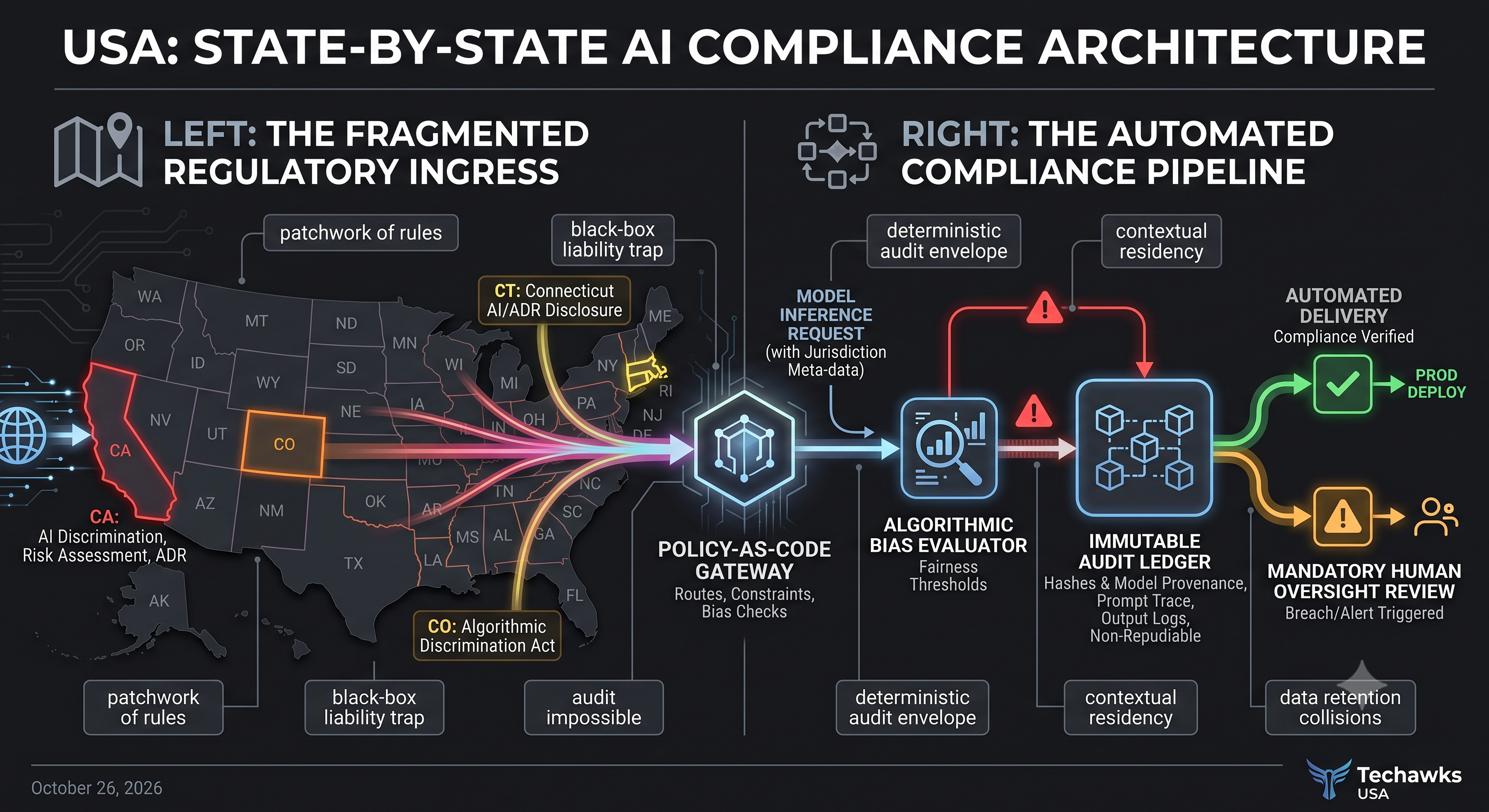
When state statutes mandate explainability, audit trails, and anti-bias guardrails for systems that impact consumers (credit, hiring, housing, insurance, and dynamic pricing), engineering teams hit three immediate architectural hurdles:
The Black-Box Liability Trap: If your production model makes an automated determination that materially affects a US consumer, "the weights are proprietary" is no longer a legally viable defense. You must be able to surface the causal inputs and decision rationale.
Contextual Residency & Data Retention Collisions: Different states now impose diverging statutory windows on training data consent, biometric markers, and automated deletion requests. A global data lake that pools customer state telemetry indiscriminately is a compliance nightmare.
Audit Impossibility: If model inferences, intermediate prompts, and evaluator outputs are ephemeral and unlogged, your system cannot survive a mandatory algorithmic impact assessment.
The Engineering Fix: The State-Aware Governance Gateway
Stop hardcoding geographic rules into application logic. Abstract your regulatory requirements into an infrastructure-level gateway:
Policy-As-Code Ingress Routing: Decouple jurisdiction logic from your models. Route inference requests through an automated policy engine (e.g., Open Policy Agent) that flags user jurisdiction and attaches requisite compliance constraints before reaching inference workers.
Deterministic Audit Envelope: Wrap every model invocation in an immutable telemetry envelope. Log the prompt template, model version, temperature, input token hash, and downstream evaluator score into a tamper-evident audit store.
Granular Circuit Breakers: For regulated decision paths (e.g., credit underwriting or automated screening), route outputs through secondary deterministic bias/fairness evaluators. If an inference breaches defined fairness thresholds, automatically shunt the request to a human-in-the-loop queue.
Compliance in modern software engineering is not legal paperwork—it is an infrastructure specification.
Discussion Question
How is your infrastructure team architecting for fragmented state-level AI regulations: are you building region-aware governance proxies, or treating compliance as a manual post-launch audit?
CTA
Navigate evolving US technology regulations, master production-grade system architecture, and stay ahead of enterprise shifts. Join Techawks USA.
While tech hubs debate foundation model benchmarks, a quiet regulatory fragmentation has taken hold across the US: the rise of conflicting, state-level algorithmic governance frameworks.
From California's tightening automated decision-making provisions and risk-assessment mandates to Colorado’s algorithmic discrimination enforcement, US engineering teams can no longer deploy monolithic, black-box AI pipelines nationwide without exposing their companies to severe regulatory liability.
When state statutes mandate explainability, audit trails, and anti-bias guardrails for systems that impact consumers (credit, hiring, housing, insurance, and dynamic pricing), engineering teams hit three immediate architectural hurdles:
The Black-Box Liability Trap: If your production model makes an automated determination that materially affects a US consumer, "the weights are proprietary" is no longer a legally viable defense. You must be able to surface the causal inputs and decision rationale.
Contextual Residency & Data Retention Collisions: Different states now impose diverging statutory windows on training data consent, biometric markers, and automated deletion requests. A global data lake that pools customer state telemetry indiscriminately is a compliance nightmare.
Audit Impossibility: If model inferences, intermediate prompts, and evaluator outputs are ephemeral and unlogged, your system cannot survive a mandatory algorithmic impact assessment.
The Engineering Fix: The State-Aware Governance Gateway
Stop hardcoding geographic rules into application logic. Abstract your regulatory requirements into an infrastructure-level gateway:
Policy-As-Code Ingress Routing: Decouple jurisdiction logic from your models. Route inference requests through an automated policy engine (e.g., Open Policy Agent) that flags user jurisdiction and attaches requisite compliance constraints before reaching inference workers.
Deterministic Audit Envelope: Wrap every model invocation in an immutable telemetry envelope. Log the prompt template, model version, temperature, input token hash, and downstream evaluator score into a tamper-evident audit store.
Granular Circuit Breakers: For regulated decision paths (e.g., credit underwriting or automated screening), route outputs through secondary deterministic bias/fairness evaluators. If an inference breaches defined fairness thresholds, automatically shunt the request to a human-in-the-loop queue.
Compliance in modern software engineering is not legal paperwork—it is an infrastructure specification.
Discussion Question
How is your infrastructure team architecting for fragmented state-level AI regulations: are you building region-aware governance proxies, or treating compliance as a manual post-launch audit?
CTA
Navigate evolving US technology regulations, master production-grade system architecture, and stay ahead of enterprise shifts. Join Techawks USA.
The US State-by-State AI Compliance Minefield: Why Your Architecture Needs Algorithmic Sandboxing
While tech hubs debate foundation model benchmarks, a quiet regulatory fragmentation has taken hold across the US: the rise of conflicting, state-level algorithmic governance frameworks.
From California's tightening automated decision-making provisions and risk-assessment mandates to Colorado’s algorithmic discrimination enforcement, US engineering teams can no longer deploy monolithic, black-box AI pipelines nationwide without exposing their companies to severe regulatory liability.
When state statutes mandate explainability, audit trails, and anti-bias guardrails for systems that impact consumers (credit, hiring, housing, insurance, and dynamic pricing), engineering teams hit three immediate architectural hurdles:
The Black-Box Liability Trap: If your production model makes an automated determination that materially affects a US consumer, "the weights are proprietary" is no longer a legally viable defense. You must be able to surface the causal inputs and decision rationale.
Contextual Residency & Data Retention Collisions: Different states now impose diverging statutory windows on training data consent, biometric markers, and automated deletion requests. A global data lake that pools customer state telemetry indiscriminately is a compliance nightmare.
Audit Impossibility: If model inferences, intermediate prompts, and evaluator outputs are ephemeral and unlogged, your system cannot survive a mandatory algorithmic impact assessment.
The Engineering Fix: The State-Aware Governance Gateway
Stop hardcoding geographic rules into application logic. Abstract your regulatory requirements into an infrastructure-level gateway:
Policy-As-Code Ingress Routing: Decouple jurisdiction logic from your models. Route inference requests through an automated policy engine (e.g., Open Policy Agent) that flags user jurisdiction and attaches requisite compliance constraints before reaching inference workers.
Deterministic Audit Envelope: Wrap every model invocation in an immutable telemetry envelope. Log the prompt template, model version, temperature, input token hash, and downstream evaluator score into a tamper-evident audit store.
Granular Circuit Breakers: For regulated decision paths (e.g., credit underwriting or automated screening), route outputs through secondary deterministic bias/fairness evaluators. If an inference breaches defined fairness thresholds, automatically shunt the request to a human-in-the-loop queue.
Compliance in modern software engineering is not legal paperwork—it is an infrastructure specification.
Discussion Question
How is your infrastructure team architecting for fragmented state-level AI regulations: are you building region-aware governance proxies, or treating compliance as a manual post-launch audit?
CTA
Navigate evolving US technology regulations, master production-grade system architecture, and stay ahead of enterprise shifts. Join Techawks USA.

 Arabic
 French
 Spanish
 Portuguese
 Deutsch
 Turkish
 Dutch
Dutch
 Italiano
 Russian
 Romaian
 Portuguese (Brazil)
 Greek
Greek