


The Sovereign Cloud Paradox: Why Your UAE AI Stack Is Likely Violating Dual-Jurisdiction Data Rules
The UAE has positioned itself as the compute and AI capital of the region, but builders face an acute architectural challenge: the dual-jurisdiction data sovereignty divide.
Engineering teams building products across Dubai and Abu Dhabi often make the mistake of treating the UAE as a single monolithic data environment. In reality, you are balancing:
Federal PDPL (Decree-Law 45/2021): Enforcing strict consent-first processing (with no generic "legitimate interests" loophole), heavy cross-border transfer restrictions, and mandatory data localization for regulated and government-adjacent telemetry.
Free Zone Frameworks (e.g., DIFC Regulation 10 & ADGM DPR): Enforcing autonomous systems compliance, mandatory AI impact assessments, and strict algorithmic transparency obligations.
The critical engineering failure occurs when teams integrate foundation model endpoints: egress routing without state provenance.
If your platform collects user interactions in the UAE mainland, routes raw prompts to an overseas inference gateway, and stores vector embeddings in a multi-tenant foreign cluster, you have broken the chain of custody. When enterprise or public-sector clients audit your data boundaries, a non-sovereign architecture halts sales cycles instantly.
The Fix: The Sovereign Ingress & Localized Inference Gateway
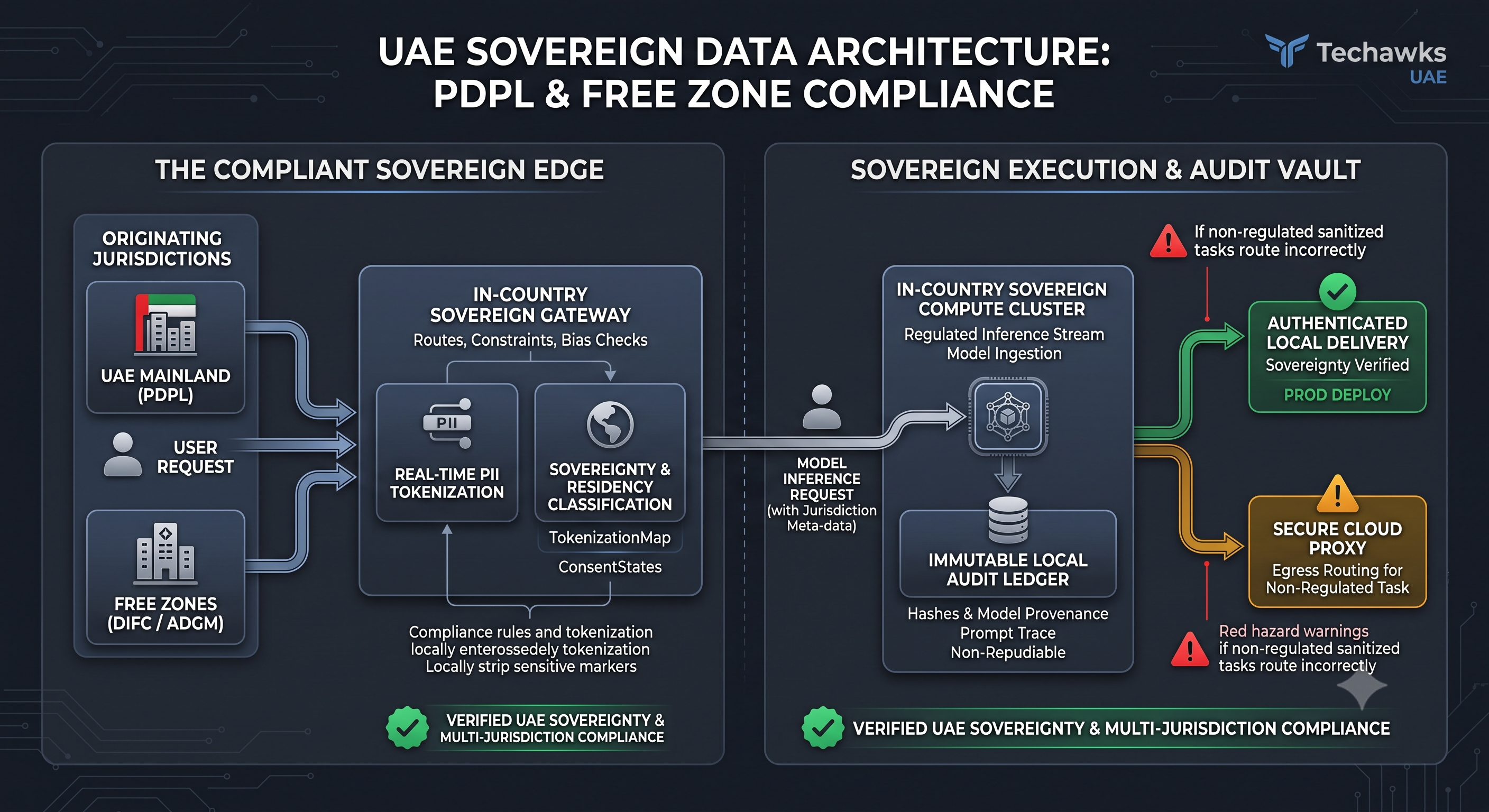
To build audit-proof enterprise systems in the UAE, implement a strict three-tier data routing layer:
In-Country Ingress Triage & Sanitization: Deploy an edge gateway within domestic UAE sovereign cloud infrastructure (e.g., local sovereign instances or dedicated in-country clusters). Intercept raw requests to redact PII and tokenize sensitive entities before any model ingestion.
Jurisdiction-Aware Workload Orchestration: Decouple your inference logic. Route standard, non-sensitive tasks to compliant multi-region models, but enforce strict routing policies that keep regulated sovereign data, corporate telemetry, and citizen records on in-country private compute or localized sovereign instances.
Tamper-Proof Audit Traces: Log consent states, model versioning, inference latency, and automated decision rationales within an immutable local data vault, satisfying both DIFC Regulation 10 transparency audits and federal PDPL compliance.
In the UAE tech ecosystem, compliance is not an afterthought handled by legal—it is an infrastructure design prerequisite.
Discussion Question
When building enterprise AI in the UAE, how is your infrastructure team handling data sovereignty: are you deploying fully on-soil sovereign compute, or running hybrid sanitized routing through local gateways?
CTA
Master sovereign infrastructure patterns, navigate regional compliance frameworks, and build mission-critical enterprise systems. Join Techawks UAE.
The UAE has positioned itself as the compute and AI capital of the region, but builders face an acute architectural challenge: the dual-jurisdiction data sovereignty divide.
Engineering teams building products across Dubai and Abu Dhabi often make the mistake of treating the UAE as a single monolithic data environment. In reality, you are balancing:
Federal PDPL (Decree-Law 45/2021): Enforcing strict consent-first processing (with no generic "legitimate interests" loophole), heavy cross-border transfer restrictions, and mandatory data localization for regulated and government-adjacent telemetry.
Free Zone Frameworks (e.g., DIFC Regulation 10 & ADGM DPR): Enforcing autonomous systems compliance, mandatory AI impact assessments, and strict algorithmic transparency obligations.
The critical engineering failure occurs when teams integrate foundation model endpoints: egress routing without state provenance.
If your platform collects user interactions in the UAE mainland, routes raw prompts to an overseas inference gateway, and stores vector embeddings in a multi-tenant foreign cluster, you have broken the chain of custody. When enterprise or public-sector clients audit your data boundaries, a non-sovereign architecture halts sales cycles instantly.
The Fix: The Sovereign Ingress & Localized Inference Gateway
To build audit-proof enterprise systems in the UAE, implement a strict three-tier data routing layer:
In-Country Ingress Triage & Sanitization: Deploy an edge gateway within domestic UAE sovereign cloud infrastructure (e.g., local sovereign instances or dedicated in-country clusters). Intercept raw requests to redact PII and tokenize sensitive entities before any model ingestion.
Jurisdiction-Aware Workload Orchestration: Decouple your inference logic. Route standard, non-sensitive tasks to compliant multi-region models, but enforce strict routing policies that keep regulated sovereign data, corporate telemetry, and citizen records on in-country private compute or localized sovereign instances.
Tamper-Proof Audit Traces: Log consent states, model versioning, inference latency, and automated decision rationales within an immutable local data vault, satisfying both DIFC Regulation 10 transparency audits and federal PDPL compliance.
In the UAE tech ecosystem, compliance is not an afterthought handled by legal—it is an infrastructure design prerequisite.
Discussion Question
When building enterprise AI in the UAE, how is your infrastructure team handling data sovereignty: are you deploying fully on-soil sovereign compute, or running hybrid sanitized routing through local gateways?
CTA
Master sovereign infrastructure patterns, navigate regional compliance frameworks, and build mission-critical enterprise systems. Join Techawks UAE.
The Sovereign Cloud Paradox: Why Your UAE AI Stack Is Likely Violating Dual-Jurisdiction Data Rules
The UAE has positioned itself as the compute and AI capital of the region, but builders face an acute architectural challenge: the dual-jurisdiction data sovereignty divide.
Engineering teams building products across Dubai and Abu Dhabi often make the mistake of treating the UAE as a single monolithic data environment. In reality, you are balancing:
Federal PDPL (Decree-Law 45/2021): Enforcing strict consent-first processing (with no generic "legitimate interests" loophole), heavy cross-border transfer restrictions, and mandatory data localization for regulated and government-adjacent telemetry.
Free Zone Frameworks (e.g., DIFC Regulation 10 & ADGM DPR): Enforcing autonomous systems compliance, mandatory AI impact assessments, and strict algorithmic transparency obligations.
The critical engineering failure occurs when teams integrate foundation model endpoints: egress routing without state provenance.
If your platform collects user interactions in the UAE mainland, routes raw prompts to an overseas inference gateway, and stores vector embeddings in a multi-tenant foreign cluster, you have broken the chain of custody. When enterprise or public-sector clients audit your data boundaries, a non-sovereign architecture halts sales cycles instantly.
The Fix: The Sovereign Ingress & Localized Inference Gateway
To build audit-proof enterprise systems in the UAE, implement a strict three-tier data routing layer:
In-Country Ingress Triage & Sanitization: Deploy an edge gateway within domestic UAE sovereign cloud infrastructure (e.g., local sovereign instances or dedicated in-country clusters). Intercept raw requests to redact PII and tokenize sensitive entities before any model ingestion.
Jurisdiction-Aware Workload Orchestration: Decouple your inference logic. Route standard, non-sensitive tasks to compliant multi-region models, but enforce strict routing policies that keep regulated sovereign data, corporate telemetry, and citizen records on in-country private compute or localized sovereign instances.
Tamper-Proof Audit Traces: Log consent states, model versioning, inference latency, and automated decision rationales within an immutable local data vault, satisfying both DIFC Regulation 10 transparency audits and federal PDPL compliance.
In the UAE tech ecosystem, compliance is not an afterthought handled by legal—it is an infrastructure design prerequisite.
Discussion Question
When building enterprise AI in the UAE, how is your infrastructure team handling data sovereignty: are you deploying fully on-soil sovereign compute, or running hybrid sanitized routing through local gateways?
CTA
Master sovereign infrastructure patterns, navigate regional compliance frameworks, and build mission-critical enterprise systems. Join Techawks UAE.

 Arabic
 French
 Spanish
 Portuguese
 Deutsch
 Turkish
 Dutch
Dutch
 Italiano
 Russian
 Romaian
 Portuguese (Brazil)
 Greek
Greek