


The Cross-Border Cloud Illusion: Why Relying on US Hyperscalers Leaves Canadian AI Teams Vulnerable
Canadian engineering teams often operate under an outdated assumption: “As long as we have standard contractual clauses and encryption in transit, sending Canadian user telemetry to us-east-1 or California API gateways is legally compliant.”
While technically permissible under baseline federal rules, the commercial reality on the ground has radically shifted: provincial privacy enforcement and enterprise data sovereignty mandates have outpaced federal inaction.
Between Quebec’s aggressive Law 25 (mandating rigorous cross-border privacy impact assessments and strict consent thresholds), provincial public-sector procurement barriers (like British Columbia and Ontario health/education mandates), and the evolving standards for "high-impact" algorithmic systems, US-dependent data pipelines create three severe operational liabilities:
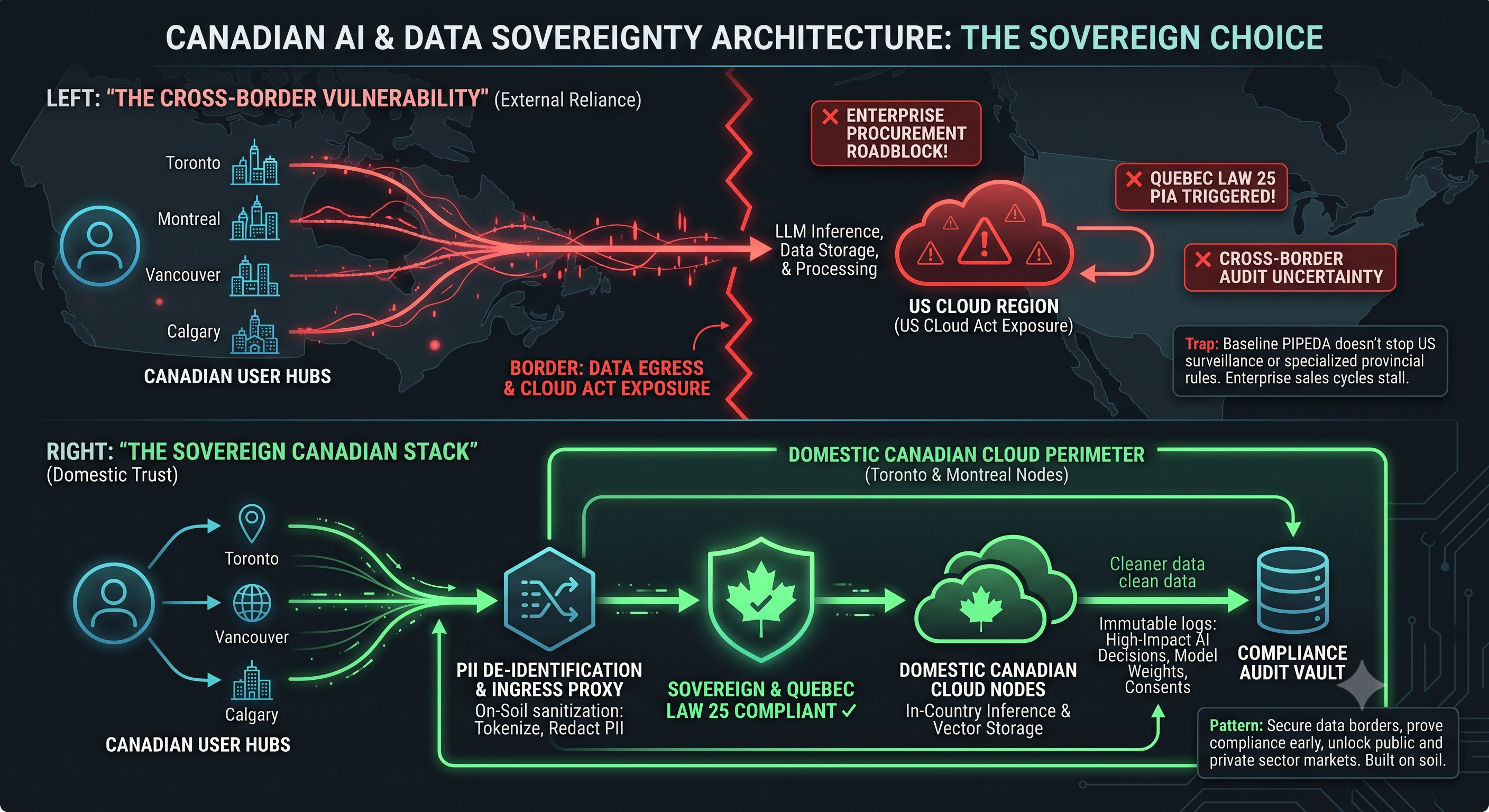
The Extraterritorial Invalidation Risk: Data routed through or hosted on US soil falls squarely under the US CLOUD Act, allowing US law enforcement to compel data disclosures without notifying foreign targets. For Canadian public sector, healthcare, and enterprise buyers, this is an automatic procurement red flag.
Quebec Law 25 Friction: If your product touches Quebec residents, you must conduct a formal Privacy Impact Assessment (PIA) before any cross-border transfer, proving that the destination jurisdiction offers equivalent protection. Routing raw prompt traces or embedding vectors south of the border turns a standard enterprise deployment into a multi-month compliance review.
The Local AI Moat: Canada is a global frontier for foundational AI research (from Vector to Mila), yet domestic builders frequently export the economic and operational control of their workloads to US hyperscalers, leaving their architectures defenseless against foreign upstream pricing and latency shifts.
The Fix: The Sovereign Canadian AI Architecture
Stop treating data localization as an enterprise add-on. Build a domestic-first execution harness:
Domestic Compute Ingress: Route Canadian user traffic exclusively to Canadian cloud regions (e.g., ca-central-1 / Montreal and Toronto cloud zones). Ensure prompt-token cache layers, operational databases, and vector stores reside within Canadian borders.
On-Soil Sanitization & PII Stripping: If specialized reasoning must escalate to foreign proprietary models, deploy a domestic intermediary proxy. Tokenize, de-identify, and redact sensitive personal entities on Canadian soil before payloads ever cross the border.
Algorithmic Accountability Logging: Maintain local, immutable audit logs capturing model weights, decision thresholds, and impact metrics. Pre-architecting for transparency satisfies Law 25 requirements and prepares your stack for emerging Canadian high-impact AI oversight without code refactoring.
In Canadian tech, the competitive advantage isn’t just shipping fast—it’s proving your infrastructure respects domestic data borders.
Discussion Question
Are you hosting your model endpoints and vector stores entirely in Canadian data centers (Toronto/Montreal), or are you still routing user payloads south to US cloud regions?
CTA
Master sovereign infrastructure, conquer local compliance frameworks, and build world-class tech tailored to the Canadian ecosystem. Join Techawks Canada.
Canadian engineering teams often operate under an outdated assumption: “As long as we have standard contractual clauses and encryption in transit, sending Canadian user telemetry to us-east-1 or California API gateways is legally compliant.”
While technically permissible under baseline federal rules, the commercial reality on the ground has radically shifted: provincial privacy enforcement and enterprise data sovereignty mandates have outpaced federal inaction.
Between Quebec’s aggressive Law 25 (mandating rigorous cross-border privacy impact assessments and strict consent thresholds), provincial public-sector procurement barriers (like British Columbia and Ontario health/education mandates), and the evolving standards for "high-impact" algorithmic systems, US-dependent data pipelines create three severe operational liabilities:
The Extraterritorial Invalidation Risk: Data routed through or hosted on US soil falls squarely under the US CLOUD Act, allowing US law enforcement to compel data disclosures without notifying foreign targets. For Canadian public sector, healthcare, and enterprise buyers, this is an automatic procurement red flag.
Quebec Law 25 Friction: If your product touches Quebec residents, you must conduct a formal Privacy Impact Assessment (PIA) before any cross-border transfer, proving that the destination jurisdiction offers equivalent protection. Routing raw prompt traces or embedding vectors south of the border turns a standard enterprise deployment into a multi-month compliance review.
The Local AI Moat: Canada is a global frontier for foundational AI research (from Vector to Mila), yet domestic builders frequently export the economic and operational control of their workloads to US hyperscalers, leaving their architectures defenseless against foreign upstream pricing and latency shifts.
The Fix: The Sovereign Canadian AI Architecture
Stop treating data localization as an enterprise add-on. Build a domestic-first execution harness:
Domestic Compute Ingress: Route Canadian user traffic exclusively to Canadian cloud regions (e.g., ca-central-1 / Montreal and Toronto cloud zones). Ensure prompt-token cache layers, operational databases, and vector stores reside within Canadian borders.
On-Soil Sanitization & PII Stripping: If specialized reasoning must escalate to foreign proprietary models, deploy a domestic intermediary proxy. Tokenize, de-identify, and redact sensitive personal entities on Canadian soil before payloads ever cross the border.
Algorithmic Accountability Logging: Maintain local, immutable audit logs capturing model weights, decision thresholds, and impact metrics. Pre-architecting for transparency satisfies Law 25 requirements and prepares your stack for emerging Canadian high-impact AI oversight without code refactoring.
In Canadian tech, the competitive advantage isn’t just shipping fast—it’s proving your infrastructure respects domestic data borders.
Discussion Question
Are you hosting your model endpoints and vector stores entirely in Canadian data centers (Toronto/Montreal), or are you still routing user payloads south to US cloud regions?
CTA
Master sovereign infrastructure, conquer local compliance frameworks, and build world-class tech tailored to the Canadian ecosystem. Join Techawks Canada.
The Cross-Border Cloud Illusion: Why Relying on US Hyperscalers Leaves Canadian AI Teams Vulnerable
Canadian engineering teams often operate under an outdated assumption: “As long as we have standard contractual clauses and encryption in transit, sending Canadian user telemetry to us-east-1 or California API gateways is legally compliant.”
While technically permissible under baseline federal rules, the commercial reality on the ground has radically shifted: provincial privacy enforcement and enterprise data sovereignty mandates have outpaced federal inaction.
Between Quebec’s aggressive Law 25 (mandating rigorous cross-border privacy impact assessments and strict consent thresholds), provincial public-sector procurement barriers (like British Columbia and Ontario health/education mandates), and the evolving standards for "high-impact" algorithmic systems, US-dependent data pipelines create three severe operational liabilities:
The Extraterritorial Invalidation Risk: Data routed through or hosted on US soil falls squarely under the US CLOUD Act, allowing US law enforcement to compel data disclosures without notifying foreign targets. For Canadian public sector, healthcare, and enterprise buyers, this is an automatic procurement red flag.
Quebec Law 25 Friction: If your product touches Quebec residents, you must conduct a formal Privacy Impact Assessment (PIA) before any cross-border transfer, proving that the destination jurisdiction offers equivalent protection. Routing raw prompt traces or embedding vectors south of the border turns a standard enterprise deployment into a multi-month compliance review.
The Local AI Moat: Canada is a global frontier for foundational AI research (from Vector to Mila), yet domestic builders frequently export the economic and operational control of their workloads to US hyperscalers, leaving their architectures defenseless against foreign upstream pricing and latency shifts.
The Fix: The Sovereign Canadian AI Architecture
Stop treating data localization as an enterprise add-on. Build a domestic-first execution harness:
Domestic Compute Ingress: Route Canadian user traffic exclusively to Canadian cloud regions (e.g., ca-central-1 / Montreal and Toronto cloud zones). Ensure prompt-token cache layers, operational databases, and vector stores reside within Canadian borders.
On-Soil Sanitization & PII Stripping: If specialized reasoning must escalate to foreign proprietary models, deploy a domestic intermediary proxy. Tokenize, de-identify, and redact sensitive personal entities on Canadian soil before payloads ever cross the border.
Algorithmic Accountability Logging: Maintain local, immutable audit logs capturing model weights, decision thresholds, and impact metrics. Pre-architecting for transparency satisfies Law 25 requirements and prepares your stack for emerging Canadian high-impact AI oversight without code refactoring.
In Canadian tech, the competitive advantage isn’t just shipping fast—it’s proving your infrastructure respects domestic data borders.
Discussion Question
Are you hosting your model endpoints and vector stores entirely in Canadian data centers (Toronto/Montreal), or are you still routing user payloads south to US cloud regions?
CTA
Master sovereign infrastructure, conquer local compliance frameworks, and build world-class tech tailored to the Canadian ecosystem. Join Techawks Canada.

 Arabic
 French
 Spanish
 Portuguese
 Deutsch
 Turkish
 Dutch
Dutch
 Italiano
 Russian
 Romaian
 Portuguese (Brazil)
 Greek
Greek