


The Async/Await Illusion: Why Unstructured Concurrency Is Leaking Your Production Resources
Across modern backend stacks—from Node.js and Python (FastAPI) to Go and Swift—asynchronous programming has become the default paradigm. But an expensive misconception persists in day-to-day coding:
❌ The Myth: "Just throw async/await or spawn background promises/tasks whenever you do I/O. The runtime handles the concurrency, so our service scales effortlessly."
✅ The Reality: Without Structured Concurrency, spawning asynchronous tasks creates orphan coroutines, un-cancellable child processes, and memory leaks that silently starve connection pools.
Where "Fire-and-Forget" Async Breaks Down:
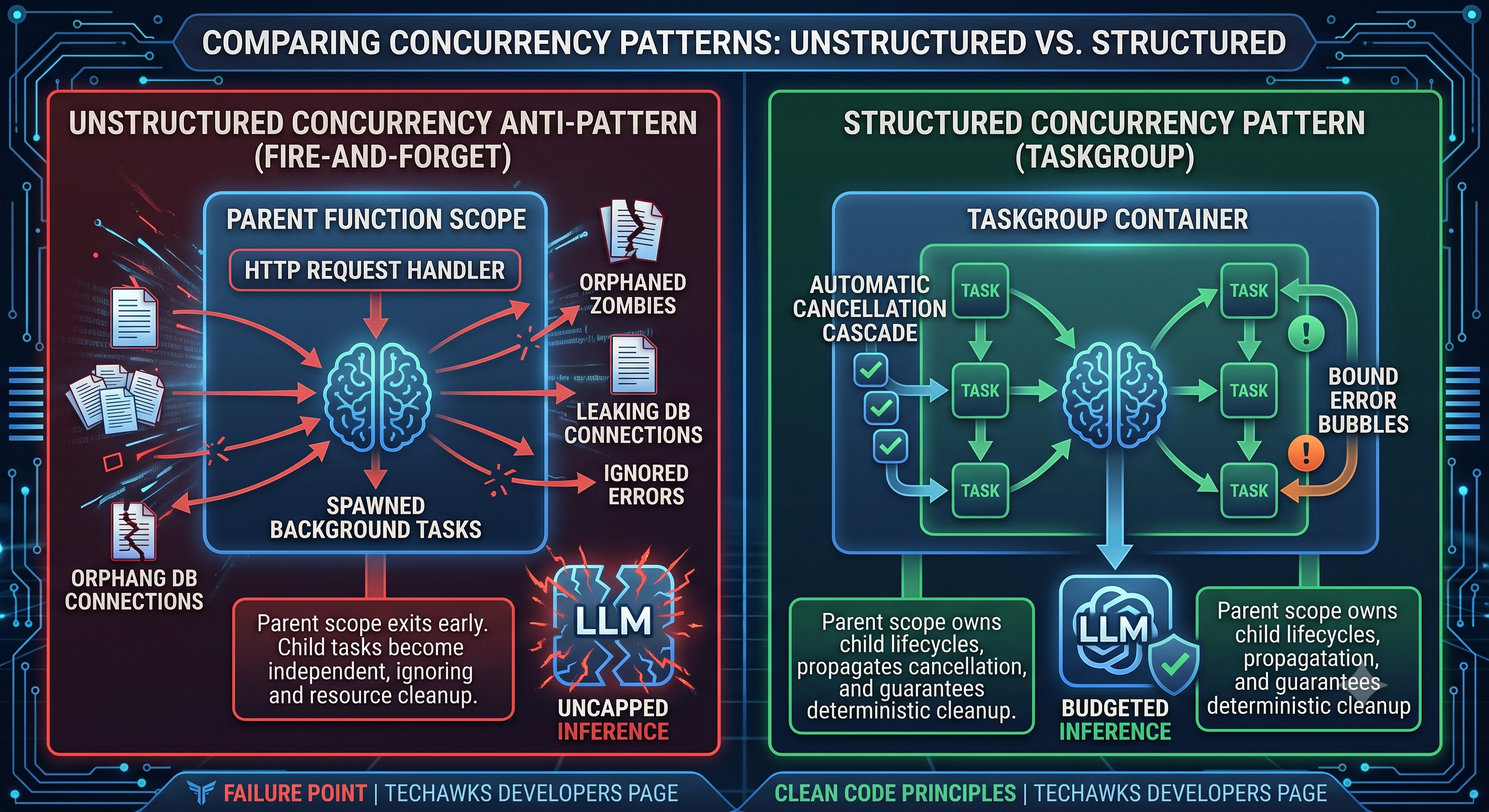
Orphaned Execution (The Zombie Task Problem): If an HTTP request is aborted by a client, typical unstructured background tasks (asyncio.create_task, unbounded Promise, or untracked goroutines) continue running in the background, consuming database connections, CPU, and downstream API quotas.
Broken Error Propagation: In free-floating async architectures, when child task B throws an uncaught exception while child task A is still executing, task A runs blind—often leaving your data in an inconsistent state while the error disappears into process-level crash logs.
Connection Pool Exhaustion: Blindly kicking off hundreds of concurrent operations via uncontrolled async bursts over-subscribes socket pools and database connection limits, leading to connection timeouts and latency spikes.
The Coding Fix: Adopt Structured Concurrency
Treat concurrent operations like control flow blocks (if, for, while): a parent task should never exit until all of its children have completed or been cleanly cancelled.
Enforce Strict Task Scopes: Use language constructs designed for scoped concurrency (e.g., Python’s asyncio.TaskGroup, Java's Virtual Thread StructuredTaskScope, Swift's withTaskGroup, or Go's errgroup.WithContext).
Propagate Cancellation Tokens: Always bind downstream HTTP clients and database queries to the lifecycle of the incoming request context (e.g., context.Context in Go or AbortSignal in JavaScript/Node). When the client disconnects, tear down every child task immediately.
Bound Your Concurrency: Never launch unbounded parallel tasks. Wrap batch async tasks in a semaphore or worker queue to cap peak active threads/coroutines.
The takeaway: Non-blocking code isn't inherently resilient code. If your concurrent tasks don't have explicit hierarchical lifecycles, you're not writing scalable software—you're just hiding leaks behind an async keyword.
Discussion Question
How do you handle request cancellation across your microservices? Do your background tasks terminate immediately when a user drops the connection, or do they finish running regardless?
CTA (Join Developers & Coding)
Join the Developers & Coding community to share clean architecture patterns, debug complex concurrency issues, and write production-grade code with engineers across the world.
Across modern backend stacks—from Node.js and Python (FastAPI) to Go and Swift—asynchronous programming has become the default paradigm. But an expensive misconception persists in day-to-day coding:
❌ The Myth: "Just throw async/await or spawn background promises/tasks whenever you do I/O. The runtime handles the concurrency, so our service scales effortlessly."
✅ The Reality: Without Structured Concurrency, spawning asynchronous tasks creates orphan coroutines, un-cancellable child processes, and memory leaks that silently starve connection pools.
Where "Fire-and-Forget" Async Breaks Down:
Orphaned Execution (The Zombie Task Problem): If an HTTP request is aborted by a client, typical unstructured background tasks (asyncio.create_task, unbounded Promise, or untracked goroutines) continue running in the background, consuming database connections, CPU, and downstream API quotas.
Broken Error Propagation: In free-floating async architectures, when child task B throws an uncaught exception while child task A is still executing, task A runs blind—often leaving your data in an inconsistent state while the error disappears into process-level crash logs.
Connection Pool Exhaustion: Blindly kicking off hundreds of concurrent operations via uncontrolled async bursts over-subscribes socket pools and database connection limits, leading to connection timeouts and latency spikes.
The Coding Fix: Adopt Structured Concurrency
Treat concurrent operations like control flow blocks (if, for, while): a parent task should never exit until all of its children have completed or been cleanly cancelled.
Enforce Strict Task Scopes: Use language constructs designed for scoped concurrency (e.g., Python’s asyncio.TaskGroup, Java's Virtual Thread StructuredTaskScope, Swift's withTaskGroup, or Go's errgroup.WithContext).
Propagate Cancellation Tokens: Always bind downstream HTTP clients and database queries to the lifecycle of the incoming request context (e.g., context.Context in Go or AbortSignal in JavaScript/Node). When the client disconnects, tear down every child task immediately.
Bound Your Concurrency: Never launch unbounded parallel tasks. Wrap batch async tasks in a semaphore or worker queue to cap peak active threads/coroutines.
The takeaway: Non-blocking code isn't inherently resilient code. If your concurrent tasks don't have explicit hierarchical lifecycles, you're not writing scalable software—you're just hiding leaks behind an async keyword.
Discussion Question
How do you handle request cancellation across your microservices? Do your background tasks terminate immediately when a user drops the connection, or do they finish running regardless?
CTA (Join Developers & Coding)
Join the Developers & Coding community to share clean architecture patterns, debug complex concurrency issues, and write production-grade code with engineers across the world.
The Async/Await Illusion: Why Unstructured Concurrency Is Leaking Your Production Resources
Across modern backend stacks—from Node.js and Python (FastAPI) to Go and Swift—asynchronous programming has become the default paradigm. But an expensive misconception persists in day-to-day coding:
❌ The Myth: "Just throw async/await or spawn background promises/tasks whenever you do I/O. The runtime handles the concurrency, so our service scales effortlessly."
✅ The Reality: Without Structured Concurrency, spawning asynchronous tasks creates orphan coroutines, un-cancellable child processes, and memory leaks that silently starve connection pools.
Where "Fire-and-Forget" Async Breaks Down:
Orphaned Execution (The Zombie Task Problem): If an HTTP request is aborted by a client, typical unstructured background tasks (asyncio.create_task, unbounded Promise, or untracked goroutines) continue running in the background, consuming database connections, CPU, and downstream API quotas.
Broken Error Propagation: In free-floating async architectures, when child task B throws an uncaught exception while child task A is still executing, task A runs blind—often leaving your data in an inconsistent state while the error disappears into process-level crash logs.
Connection Pool Exhaustion: Blindly kicking off hundreds of concurrent operations via uncontrolled async bursts over-subscribes socket pools and database connection limits, leading to connection timeouts and latency spikes.
The Coding Fix: Adopt Structured Concurrency
Treat concurrent operations like control flow blocks (if, for, while): a parent task should never exit until all of its children have completed or been cleanly cancelled.
Enforce Strict Task Scopes: Use language constructs designed for scoped concurrency (e.g., Python’s asyncio.TaskGroup, Java's Virtual Thread StructuredTaskScope, Swift's withTaskGroup, or Go's errgroup.WithContext).
Propagate Cancellation Tokens: Always bind downstream HTTP clients and database queries to the lifecycle of the incoming request context (e.g., context.Context in Go or AbortSignal in JavaScript/Node). When the client disconnects, tear down every child task immediately.
Bound Your Concurrency: Never launch unbounded parallel tasks. Wrap batch async tasks in a semaphore or worker queue to cap peak active threads/coroutines.
The takeaway: Non-blocking code isn't inherently resilient code. If your concurrent tasks don't have explicit hierarchical lifecycles, you're not writing scalable software—you're just hiding leaks behind an async keyword.
Discussion Question
How do you handle request cancellation across your microservices? Do your background tasks terminate immediately when a user drops the connection, or do they finish running regardless?
CTA (Join Developers & Coding)
Join the Developers & Coding community to share clean architecture patterns, debug complex concurrency issues, and write production-grade code with engineers across the world.

 English
 Arabic
 French
 Spanish
 Portuguese
 Turkish
 Dutch
Dutch
 Italiano
 Russian
 Romaian
 Portuguese (Brazil)
 Greek
Greek