


The Junior Developer Paradox: Why AI Code Generation Isn't Eliminating Software Jobs—It’s Changing What Counts as Experience
Job boards and tech forums are flooded with demoralizing doom-posting:
❌ The Myth: "Companies aren't hiring developers anymore because LLMs write code faster. Learning syntax and building portfolio projects is officially obsolete."
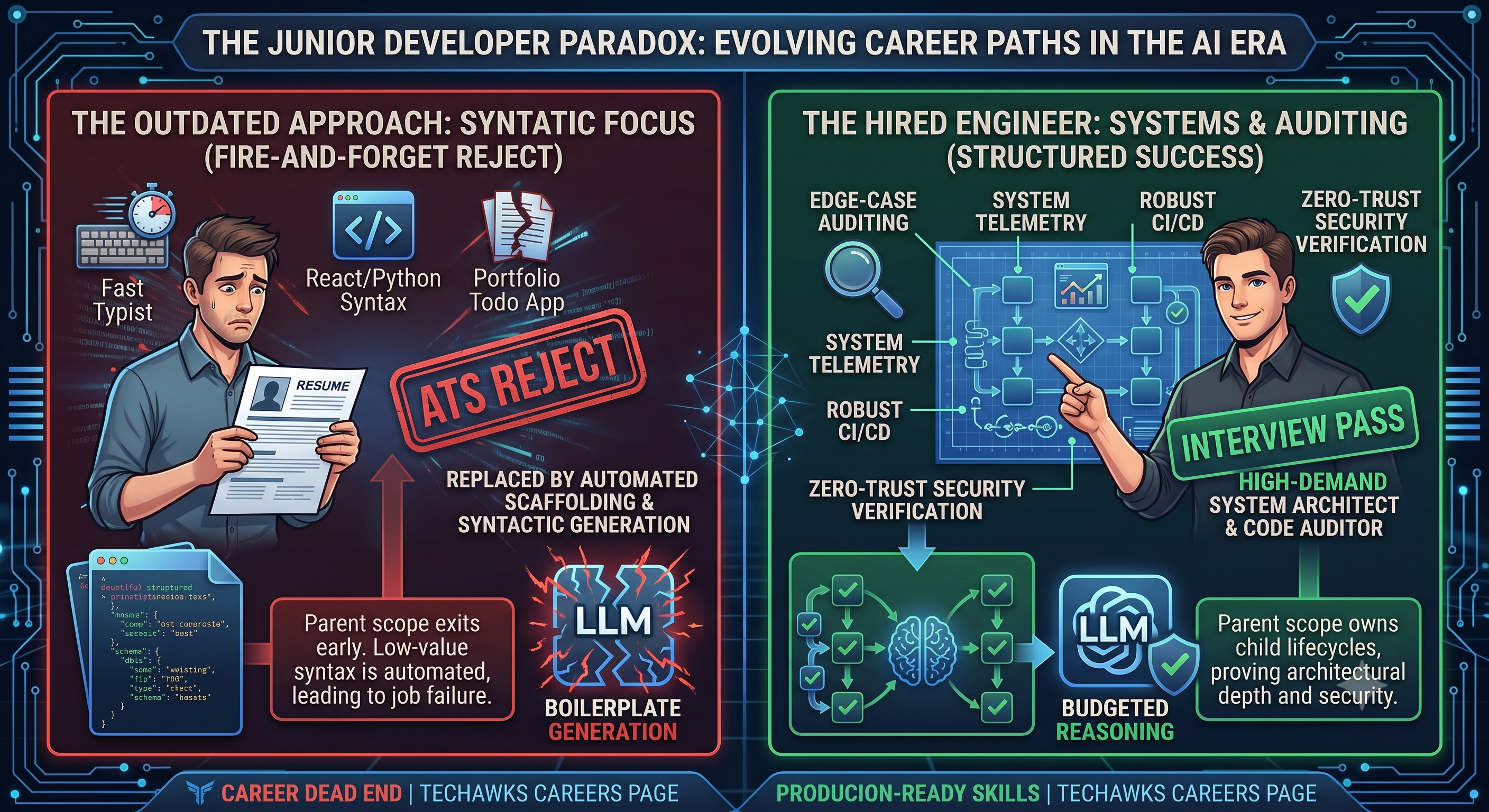
✅ The Reality: Hiring hasn’t stopped; it has bifurcated. Because AI tools now generate baseline syntax in seconds, companies no longer evaluate candidates on how fast they write code—they evaluate candidates on verification, architectural judgment, and security vigilance.
The Barbell Market: What Hiring Teams Actually Need
When an LLM can scaffold a boilerplate full-stack app in three minutes, shipping raw code is no longer a differentiator. However, industry security audits show that nearly 45% of AI-generated code contains known vulnerabilities, edge-case hallucinations, or memory leaks.
Engineering leaders aren't looking for coders who simply prompt and paste. They are hunting for candidates who act as the critical review layer:
Failure-Domain Awareness: Can you look at an AI-generated microservice and immediately spot the missing rate limits, uncaught database connection drops, or SQL injection vectors?
System Architecture & Tradeoffs: Can you explain why an event-driven queue fits a workload better than a polling REST pattern, rather than simply accepting whatever architecture an LLM defaults to?
Observability & Debugging Mastery: Any beginner can ask an AI to generate an API; a production-ready engineer understands how to trace a distributed latency bottleneck using telemetry, logs, and profiling tools when things break in staging.
How to Re-Engineer Your Resume & Portfolio Right Now
Retire Generic Scaffolding Projects: Stop submitting generic clones (e.g., standard Todo apps, basic e-commerce templates). Interviewers know AI wrote 90% of it.
Showcase the "Why" and the "Fix": Document your pull requests with deep architecture explanations: "Here is why the initial implementation failed at 5,000 concurrent requests, and how I refactored the database indexing and connection pool."
Highlight Systems Engineering: Emphasize integration testing, CI/CD pipeline configuration, Docker containerization, and automated schema validation. These are the skills hiring managers pay a premium for.
The takeaway: AI makes writing boilerplate free. That means your value as a job seeker lies entirely in your engineering judgment, code skepticism, and system design.
Discussion Question
What is your biggest roadblock in technical interviews right now—passing automated screening filters, or proving architectural depth beyond syntax?
CTA (Join Tech Jobs & Opportunities)
Join the Tech Jobs & Opportunities community to access verified openings, resume teardowns, and interview prep designed for today's technical hiring landscape.
Job boards and tech forums are flooded with demoralizing doom-posting:
❌ The Myth: "Companies aren't hiring developers anymore because LLMs write code faster. Learning syntax and building portfolio projects is officially obsolete."
✅ The Reality: Hiring hasn’t stopped; it has bifurcated. Because AI tools now generate baseline syntax in seconds, companies no longer evaluate candidates on how fast they write code—they evaluate candidates on verification, architectural judgment, and security vigilance.
The Barbell Market: What Hiring Teams Actually Need
When an LLM can scaffold a boilerplate full-stack app in three minutes, shipping raw code is no longer a differentiator. However, industry security audits show that nearly 45% of AI-generated code contains known vulnerabilities, edge-case hallucinations, or memory leaks.
Engineering leaders aren't looking for coders who simply prompt and paste. They are hunting for candidates who act as the critical review layer:
Failure-Domain Awareness: Can you look at an AI-generated microservice and immediately spot the missing rate limits, uncaught database connection drops, or SQL injection vectors?
System Architecture & Tradeoffs: Can you explain why an event-driven queue fits a workload better than a polling REST pattern, rather than simply accepting whatever architecture an LLM defaults to?
Observability & Debugging Mastery: Any beginner can ask an AI to generate an API; a production-ready engineer understands how to trace a distributed latency bottleneck using telemetry, logs, and profiling tools when things break in staging.
How to Re-Engineer Your Resume & Portfolio Right Now
Retire Generic Scaffolding Projects: Stop submitting generic clones (e.g., standard Todo apps, basic e-commerce templates). Interviewers know AI wrote 90% of it.
Showcase the "Why" and the "Fix": Document your pull requests with deep architecture explanations: "Here is why the initial implementation failed at 5,000 concurrent requests, and how I refactored the database indexing and connection pool."
Highlight Systems Engineering: Emphasize integration testing, CI/CD pipeline configuration, Docker containerization, and automated schema validation. These are the skills hiring managers pay a premium for.
The takeaway: AI makes writing boilerplate free. That means your value as a job seeker lies entirely in your engineering judgment, code skepticism, and system design.
Discussion Question
What is your biggest roadblock in technical interviews right now—passing automated screening filters, or proving architectural depth beyond syntax?
CTA (Join Tech Jobs & Opportunities)
Join the Tech Jobs & Opportunities community to access verified openings, resume teardowns, and interview prep designed for today's technical hiring landscape.
The Junior Developer Paradox: Why AI Code Generation Isn't Eliminating Software Jobs—It’s Changing What Counts as Experience
Job boards and tech forums are flooded with demoralizing doom-posting:
❌ The Myth: "Companies aren't hiring developers anymore because LLMs write code faster. Learning syntax and building portfolio projects is officially obsolete."
✅ The Reality: Hiring hasn’t stopped; it has bifurcated. Because AI tools now generate baseline syntax in seconds, companies no longer evaluate candidates on how fast they write code—they evaluate candidates on verification, architectural judgment, and security vigilance.
The Barbell Market: What Hiring Teams Actually Need
When an LLM can scaffold a boilerplate full-stack app in three minutes, shipping raw code is no longer a differentiator. However, industry security audits show that nearly 45% of AI-generated code contains known vulnerabilities, edge-case hallucinations, or memory leaks.
Engineering leaders aren't looking for coders who simply prompt and paste. They are hunting for candidates who act as the critical review layer:
Failure-Domain Awareness: Can you look at an AI-generated microservice and immediately spot the missing rate limits, uncaught database connection drops, or SQL injection vectors?
System Architecture & Tradeoffs: Can you explain why an event-driven queue fits a workload better than a polling REST pattern, rather than simply accepting whatever architecture an LLM defaults to?
Observability & Debugging Mastery: Any beginner can ask an AI to generate an API; a production-ready engineer understands how to trace a distributed latency bottleneck using telemetry, logs, and profiling tools when things break in staging.
How to Re-Engineer Your Resume & Portfolio Right Now
Retire Generic Scaffolding Projects: Stop submitting generic clones (e.g., standard Todo apps, basic e-commerce templates). Interviewers know AI wrote 90% of it.
Showcase the "Why" and the "Fix": Document your pull requests with deep architecture explanations: "Here is why the initial implementation failed at 5,000 concurrent requests, and how I refactored the database indexing and connection pool."
Highlight Systems Engineering: Emphasize integration testing, CI/CD pipeline configuration, Docker containerization, and automated schema validation. These are the skills hiring managers pay a premium for.
The takeaway: AI makes writing boilerplate free. That means your value as a job seeker lies entirely in your engineering judgment, code skepticism, and system design.
Discussion Question
What is your biggest roadblock in technical interviews right now—passing automated screening filters, or proving architectural depth beyond syntax?
CTA (Join Tech Jobs & Opportunities)
Join the Tech Jobs & Opportunities community to access verified openings, resume teardowns, and interview prep designed for today's technical hiring landscape.

 English
 Arabic
 French
 Spanish
 Portuguese
 Deutsch
 Turkish
 Dutch
Dutch
 Italiano
 Romaian
 Portuguese (Brazil)
 Greek
Greek