


Myth vs. Fact: “1M+ Context Windows Make Fine-Tuning Obsolete”
A persistent assumption circulating across US engineering slack channels and architecture reviews is that massive context windows have effectively killed parameter-efficient fine-tuning (PEFT/LoRA).
Here is what the benchmarks—and enterprise cloud bills—actually show:
❌ The Myth:
“Since frontier models can ingest hundreds of thousands of tokens of reference docs in a single request, fine-tuning is legacy architecture.”
✅ The Reality:
Long-context retrieval and fine-tuning solve two fundamentally different engineering problems: Context is for Working Memory; Fine-Tuning is for Behavioral Conditioning.
Here is why relying exclusively on mega-context prompts fails in production:
The “Lost in the Middle” & Latency Tax
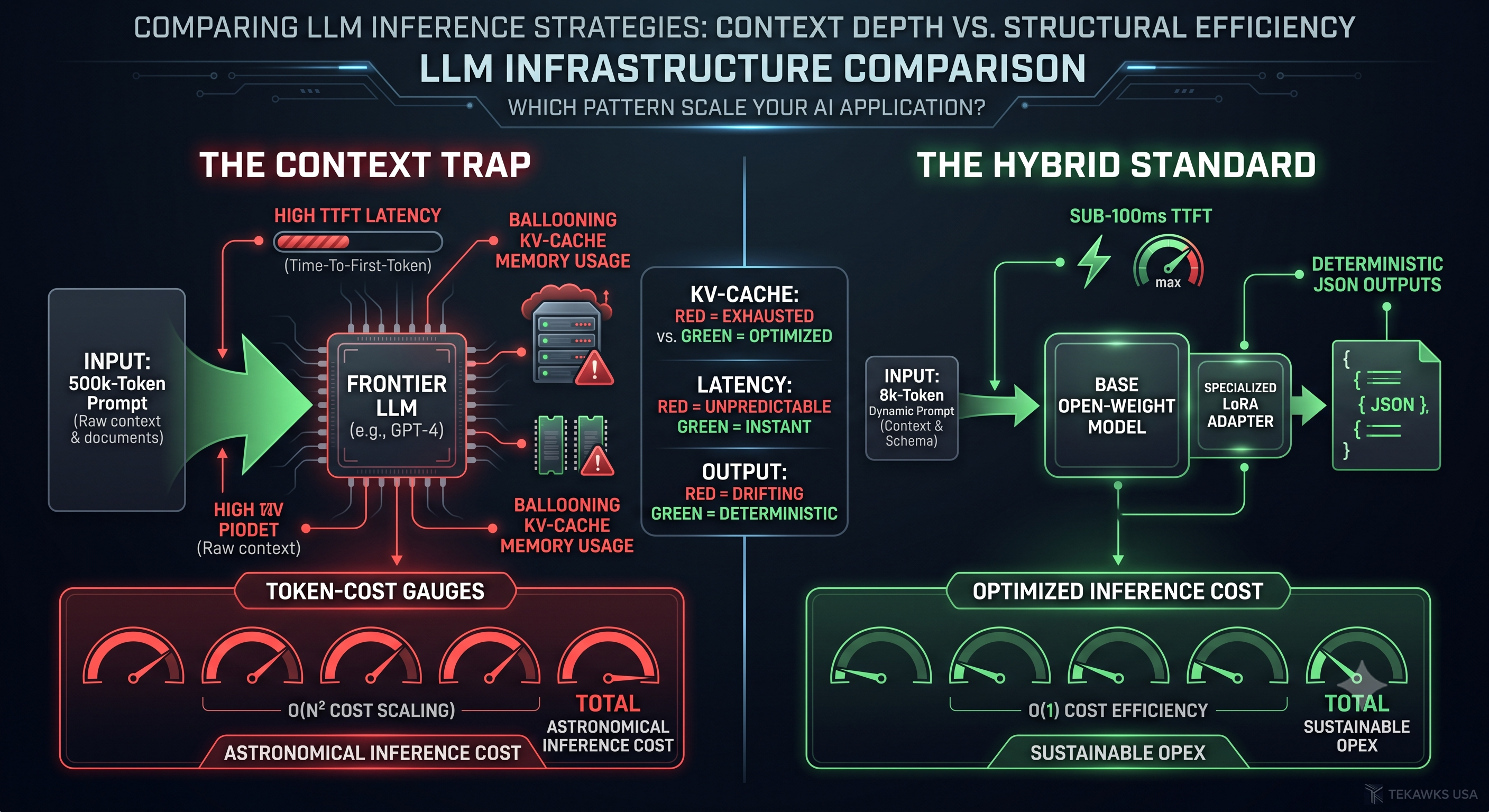
While needle-in-a-haystack retrieval has improved, attention mechanisms still suffer from degraded recall when reasoning across disparate segments of a massive prompt. Worse, Time-to-First-Token (TTFT) scales aggressively with input prompt length, making real-time interactive apps sluggish.
O(N²) KV Cache & Financial Drain
Prefix-caching helps, but repeatedly passing 200k tokens of company-specific domain logic, schema definitions, and style rules across millions of daily agent calls burns compute budgets exponentially faster than hosting an optimized, quantized LoRA adapter on an open-weight base model.
Style, Structure, and Constraint Compliance
Context windows can provide facts; fine-tuning teaches form and discipline. If you need an LLM to reliably output deterministic JSON schemas, adhere strictly to a proprietary compiler dialect, or follow rigorous internal safety boundaries without prompt drift, few-shot prompt injection will occasionally fail. Behavioral weight adaptation will not.
The Rule of Thumb for 2026 Architectures:
Use RAG / Context Windows when data changes dynamically by the minute (customer account data, live inventory, ephemeral logs).
Use Fine-Tuning / Post-Training when the syntax, task style, domain nomenclature, or output constraints are invariant across calls.
Discussion Question
Where has your team drawn the line in production: Are you leaning harder into dynamic context caching/RAG, or shifting deterministic workflows into fine-tuned internal models?
CTA (Join Techawks USA)
Cut through AI hype with field-tested architecture patterns. Join Techawks USA to connect with engineers, founders, and technical leaders building production-grade infrastructure across the nation.
A persistent assumption circulating across US engineering slack channels and architecture reviews is that massive context windows have effectively killed parameter-efficient fine-tuning (PEFT/LoRA).
Here is what the benchmarks—and enterprise cloud bills—actually show:
❌ The Myth:
“Since frontier models can ingest hundreds of thousands of tokens of reference docs in a single request, fine-tuning is legacy architecture.”
✅ The Reality:
Long-context retrieval and fine-tuning solve two fundamentally different engineering problems: Context is for Working Memory; Fine-Tuning is for Behavioral Conditioning.
Here is why relying exclusively on mega-context prompts fails in production:
The “Lost in the Middle” & Latency Tax
While needle-in-a-haystack retrieval has improved, attention mechanisms still suffer from degraded recall when reasoning across disparate segments of a massive prompt. Worse, Time-to-First-Token (TTFT) scales aggressively with input prompt length, making real-time interactive apps sluggish.
O(N²) KV Cache & Financial Drain
Prefix-caching helps, but repeatedly passing 200k tokens of company-specific domain logic, schema definitions, and style rules across millions of daily agent calls burns compute budgets exponentially faster than hosting an optimized, quantized LoRA adapter on an open-weight base model.
Style, Structure, and Constraint Compliance
Context windows can provide facts; fine-tuning teaches form and discipline. If you need an LLM to reliably output deterministic JSON schemas, adhere strictly to a proprietary compiler dialect, or follow rigorous internal safety boundaries without prompt drift, few-shot prompt injection will occasionally fail. Behavioral weight adaptation will not.
The Rule of Thumb for 2026 Architectures:
Use RAG / Context Windows when data changes dynamically by the minute (customer account data, live inventory, ephemeral logs).
Use Fine-Tuning / Post-Training when the syntax, task style, domain nomenclature, or output constraints are invariant across calls.
Discussion Question
Where has your team drawn the line in production: Are you leaning harder into dynamic context caching/RAG, or shifting deterministic workflows into fine-tuned internal models?
CTA (Join Techawks USA)
Cut through AI hype with field-tested architecture patterns. Join Techawks USA to connect with engineers, founders, and technical leaders building production-grade infrastructure across the nation.
Myth vs. Fact: “1M+ Context Windows Make Fine-Tuning Obsolete”
A persistent assumption circulating across US engineering slack channels and architecture reviews is that massive context windows have effectively killed parameter-efficient fine-tuning (PEFT/LoRA).
Here is what the benchmarks—and enterprise cloud bills—actually show:
❌ The Myth:
“Since frontier models can ingest hundreds of thousands of tokens of reference docs in a single request, fine-tuning is legacy architecture.”
✅ The Reality:
Long-context retrieval and fine-tuning solve two fundamentally different engineering problems: Context is for Working Memory; Fine-Tuning is for Behavioral Conditioning.
Here is why relying exclusively on mega-context prompts fails in production:
The “Lost in the Middle” & Latency Tax
While needle-in-a-haystack retrieval has improved, attention mechanisms still suffer from degraded recall when reasoning across disparate segments of a massive prompt. Worse, Time-to-First-Token (TTFT) scales aggressively with input prompt length, making real-time interactive apps sluggish.
O(N²) KV Cache & Financial Drain
Prefix-caching helps, but repeatedly passing 200k tokens of company-specific domain logic, schema definitions, and style rules across millions of daily agent calls burns compute budgets exponentially faster than hosting an optimized, quantized LoRA adapter on an open-weight base model.
Style, Structure, and Constraint Compliance
Context windows can provide facts; fine-tuning teaches form and discipline. If you need an LLM to reliably output deterministic JSON schemas, adhere strictly to a proprietary compiler dialect, or follow rigorous internal safety boundaries without prompt drift, few-shot prompt injection will occasionally fail. Behavioral weight adaptation will not.
The Rule of Thumb for 2026 Architectures:
Use RAG / Context Windows when data changes dynamically by the minute (customer account data, live inventory, ephemeral logs).
Use Fine-Tuning / Post-Training when the syntax, task style, domain nomenclature, or output constraints are invariant across calls.
Discussion Question
Where has your team drawn the line in production: Are you leaning harder into dynamic context caching/RAG, or shifting deterministic workflows into fine-tuned internal models?
CTA (Join Techawks USA)
Cut through AI hype with field-tested architecture patterns. Join Techawks USA to connect with engineers, founders, and technical leaders building production-grade infrastructure across the nation.

 English
 Arabic
 Spanish
 Portuguese
 Deutsch
 Turkish
 Dutch
Dutch
 Italiano
 Russian
 Romaian
 Portuguese (Brazil)
 Greek
Greek