


Myth vs Fact: Is the UK Becoming the Wild West for AI, or Copying the EU?
❌ Myth 1: "The UK is preparing to replicate the horizontal EU AI Act."
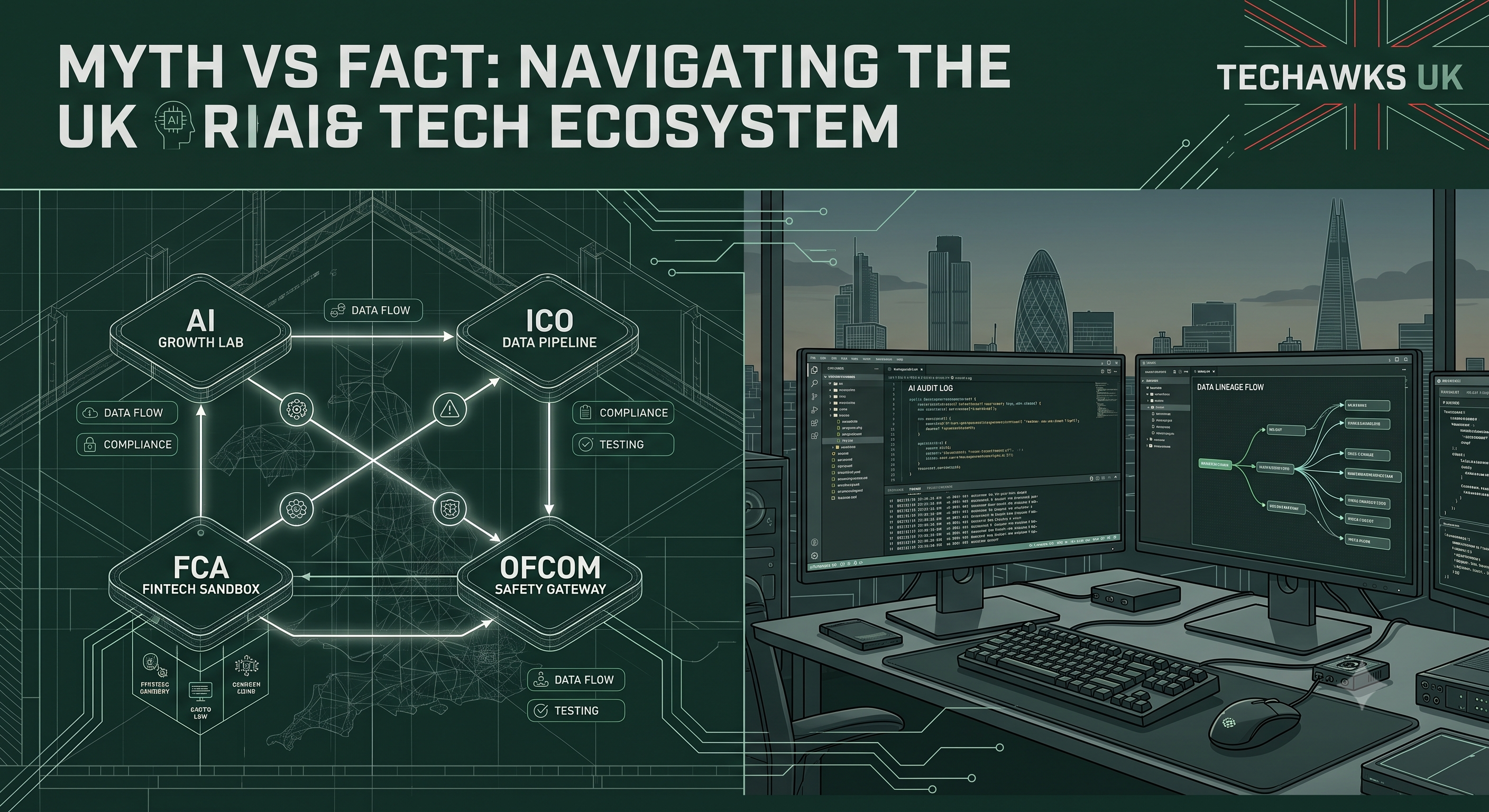
The Reality: The UK has deliberately bypassed a single, rigid, horizontal AI statute. Instead, the UK enforces a decentralized, sector-led regime. Governance is applied at the point of deployment by domain-specific regulators—the FCA in financial services, the MHRA in healthtech, the CMA for market competition, and Ofcom for content platforms. Through initiatives like the DSIT AI Growth Lab and cross-economy sandboxes, the UK provides controlled exemptions and live-testing environments for high-impact sectors rather than imposing blanket compliance hurdles before a model even runs.
❌ Myth 2: "No AI Act means UK tech startups operate with zero compliance overhead."
The Reality: "Pro-innovation" does not mean deregulation. British developers face some of the strictest point-of-use enforcement in the world:
Automated Decision-Making: Under the Data (Use and Access) framework, the UK GDPR specifically governs automated decision-making and AI data training with binding ICO statutory codes.
Online Safety Act (OSA): Ofcom now actively enforces mandatory safety duties for user-to-user and search platforms, backed by penalties of up to £18 million or 10% of qualifying worldwide turnover.
Competition & Platforms (DMCCA): The Competition and Markets Authority (CMA) holds sweeping direct intervention powers over companies with Strategic Market Status.
❌ Myth 3: "The UK ecosystem cannot compete with Silicon Valley on foundation models, so our tech advantage is gone."
The Reality: The UK's true competitive moat was never about burning billions of dollars in commodity hyperscale compute clusters. The British advantage lies in high-margin vertical intelligence and system architecture—spearheaded by world-class research spinouts from the Golden Triangle (Oxford, Cambridge, London), specialized biopharma AI, quantum systems, and fintech. You do not need to train a frontier model from scratch to build an indispensable, category-defining enterprise platform.
Why It Matters for UK Developers & Architects
In the UK, your primary architectural challenge is not wrestling with broad, abstract legislative mandates. It is designing audit-ready, explainable systems that can slide directly into regulated industry sandboxes (finance, healthcare, legaltech, and public services). If your AI pipelines lack lineage tracking, data provenance, and clear human-in-the-loop fallback pathways, you cannot sell to the UK's most lucrative enterprise buyers.
Discussion Question
Is your team leaning into the UK’s sector-specific sandboxes, or are you designing your compliance baseline against EU/global standards from day one? Let’s hear your perspective in the comments below! 👇
CTA
Join Techawks UK — The premier network for British software engineers, technical founders, and tech innovators scaling world-class systems across the UK. 🦅🇬🇧
❌ Myth 1: "The UK is preparing to replicate the horizontal EU AI Act."
The Reality: The UK has deliberately bypassed a single, rigid, horizontal AI statute. Instead, the UK enforces a decentralized, sector-led regime. Governance is applied at the point of deployment by domain-specific regulators—the FCA in financial services, the MHRA in healthtech, the CMA for market competition, and Ofcom for content platforms. Through initiatives like the DSIT AI Growth Lab and cross-economy sandboxes, the UK provides controlled exemptions and live-testing environments for high-impact sectors rather than imposing blanket compliance hurdles before a model even runs.
❌ Myth 2: "No AI Act means UK tech startups operate with zero compliance overhead."
The Reality: "Pro-innovation" does not mean deregulation. British developers face some of the strictest point-of-use enforcement in the world:
Automated Decision-Making: Under the Data (Use and Access) framework, the UK GDPR specifically governs automated decision-making and AI data training with binding ICO statutory codes.
Online Safety Act (OSA): Ofcom now actively enforces mandatory safety duties for user-to-user and search platforms, backed by penalties of up to £18 million or 10% of qualifying worldwide turnover.
Competition & Platforms (DMCCA): The Competition and Markets Authority (CMA) holds sweeping direct intervention powers over companies with Strategic Market Status.
❌ Myth 3: "The UK ecosystem cannot compete with Silicon Valley on foundation models, so our tech advantage is gone."
The Reality: The UK's true competitive moat was never about burning billions of dollars in commodity hyperscale compute clusters. The British advantage lies in high-margin vertical intelligence and system architecture—spearheaded by world-class research spinouts from the Golden Triangle (Oxford, Cambridge, London), specialized biopharma AI, quantum systems, and fintech. You do not need to train a frontier model from scratch to build an indispensable, category-defining enterprise platform.
Why It Matters for UK Developers & Architects
In the UK, your primary architectural challenge is not wrestling with broad, abstract legislative mandates. It is designing audit-ready, explainable systems that can slide directly into regulated industry sandboxes (finance, healthcare, legaltech, and public services). If your AI pipelines lack lineage tracking, data provenance, and clear human-in-the-loop fallback pathways, you cannot sell to the UK's most lucrative enterprise buyers.
Discussion Question
Is your team leaning into the UK’s sector-specific sandboxes, or are you designing your compliance baseline against EU/global standards from day one? Let’s hear your perspective in the comments below! 👇
CTA
Join Techawks UK — The premier network for British software engineers, technical founders, and tech innovators scaling world-class systems across the UK. 🦅🇬🇧
Myth vs Fact: Is the UK Becoming the Wild West for AI, or Copying the EU?
❌ Myth 1: "The UK is preparing to replicate the horizontal EU AI Act."
The Reality: The UK has deliberately bypassed a single, rigid, horizontal AI statute. Instead, the UK enforces a decentralized, sector-led regime. Governance is applied at the point of deployment by domain-specific regulators—the FCA in financial services, the MHRA in healthtech, the CMA for market competition, and Ofcom for content platforms. Through initiatives like the DSIT AI Growth Lab and cross-economy sandboxes, the UK provides controlled exemptions and live-testing environments for high-impact sectors rather than imposing blanket compliance hurdles before a model even runs.
❌ Myth 2: "No AI Act means UK tech startups operate with zero compliance overhead."
The Reality: "Pro-innovation" does not mean deregulation. British developers face some of the strictest point-of-use enforcement in the world:
Automated Decision-Making: Under the Data (Use and Access) framework, the UK GDPR specifically governs automated decision-making and AI data training with binding ICO statutory codes.
Online Safety Act (OSA): Ofcom now actively enforces mandatory safety duties for user-to-user and search platforms, backed by penalties of up to £18 million or 10% of qualifying worldwide turnover.
Competition & Platforms (DMCCA): The Competition and Markets Authority (CMA) holds sweeping direct intervention powers over companies with Strategic Market Status.
❌ Myth 3: "The UK ecosystem cannot compete with Silicon Valley on foundation models, so our tech advantage is gone."
The Reality: The UK's true competitive moat was never about burning billions of dollars in commodity hyperscale compute clusters. The British advantage lies in high-margin vertical intelligence and system architecture—spearheaded by world-class research spinouts from the Golden Triangle (Oxford, Cambridge, London), specialized biopharma AI, quantum systems, and fintech. You do not need to train a frontier model from scratch to build an indispensable, category-defining enterprise platform.
Why It Matters for UK Developers & Architects
In the UK, your primary architectural challenge is not wrestling with broad, abstract legislative mandates. It is designing audit-ready, explainable systems that can slide directly into regulated industry sandboxes (finance, healthcare, legaltech, and public services). If your AI pipelines lack lineage tracking, data provenance, and clear human-in-the-loop fallback pathways, you cannot sell to the UK's most lucrative enterprise buyers.
Discussion Question
Is your team leaning into the UK’s sector-specific sandboxes, or are you designing your compliance baseline against EU/global standards from day one? Let’s hear your perspective in the comments below! 👇
CTA
Join Techawks UK — The premier network for British software engineers, technical founders, and tech innovators scaling world-class systems across the UK. 🦅🇬🇧

 English
 Arabic
 French
 Spanish
 Portuguese
 Deutsch
 Turkish
 Dutch
Dutch
 Russian
 Romaian
 Portuguese (Brazil)
 Greek
Greek