


Myth vs. Fact: “Because the UK Has No AI Act, Your Deployment Has No Legal Guardrails”
A pervasive misconception in the UK tech ecosystem is that because Westminster rejected the EU’s horizontal, monolithic AI Act in favour of a “pro-innovation” strategy, building AI products in the UK is essentially an unregulated greenfield.
Engineers and founders keep confusing the absence of a single codified statute with an absence of statutory enforcement.
Here is the architectural reality:
❌ The Myth:
“The UK operates on voluntary AI safety pledges and light-touch principles. We don’t need formal AI compliance pipelines unless we sell directly into the EU.”
✅ The Reality:
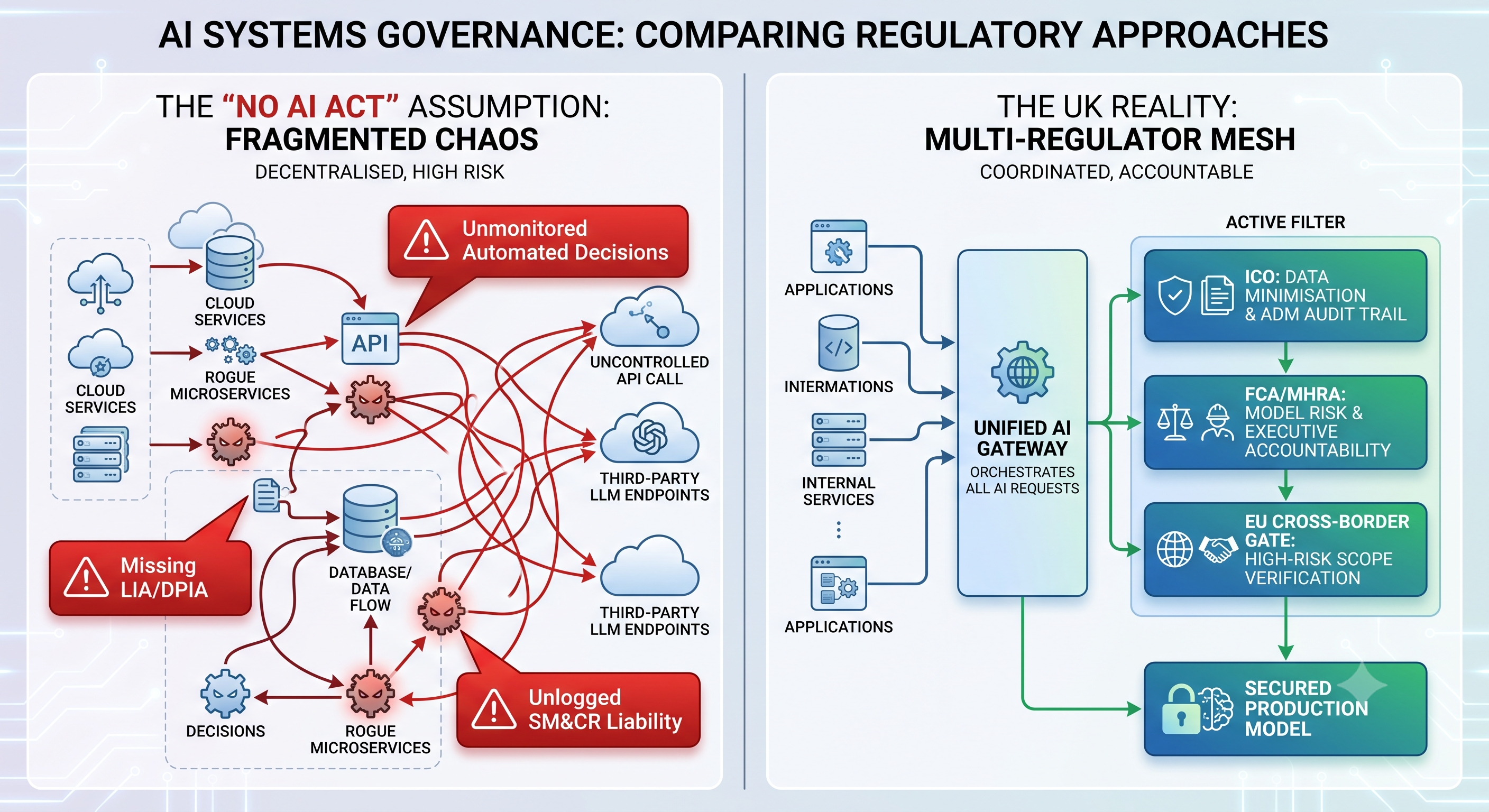
The UK’s decentralised, sector-led regime is often harder to navigate than a unified framework. Instead of a single omnibus checklist, UK engineering teams are subject to overlapping enforcement from multiple regulators, each turning existing statutory powers into binding AI mandates.
If you deploy models, automated decision-making (ADM), or algorithmic pipelines in the UK, your architecture is currently governed across three active fronts:
The ICO’s Statutory AI Code of Practice & UK GDPR
Under statutory duty, the Information Commissioner’s Office (ICO) enforces strict data protection rules around AI. Under the Data (Use and Access) framework, deploying automated decisions with legal or significant effects requires auditable safeguards: mandatory human-in-the-loop remediation, explainability traces, and pre-deployment Data Protection Impact Assessments (DPIAs).
Sector Regulators with Real Teeth (FCA, MHRA, CMA)
The UK doesn't have an "AI Police"—it has existing statutory bodies that have weaponised their core remits against algorithmic drift. If you deploy AI in fintech, the FCA’s Consumer Duty and Senior Managers Regime (SM&CR) holds individual executives directly accountable for discriminatory or hallucinated AI outputs. In healthcare, the MHRA treats diagnostic ML as medical software with strict lifecycle surveillance.
The Extraterritorial Spillover
If your UK-built API serves European users or processes downstream outputs used in the EU, your architecture falls directly under the EU AI Act’s extraterritorial scope anyway—including conformity assessments and post-market tracking for high-risk domains.
The Engineering Takeaway for UK Builders:
Stop treating AI governance as legal documentation after deployment. Implement an Immutable AI Asset Register and telemetry logs today: trace training datasets, log model inference checkpoints, and ensure every automated decision produces an auditable rationale.
Discussion Question
Is your UK engineering team maintaining a centralized AI model and tool register, or are departments quietly adopting black-box APIs without a documented DPIA?
CTA (Join Techawks UK)
Cut through policy confusion with practical, production-ready engineering standards. Join Techawks UK to connect with tech founders, systems architects, and engineering leaders building compliant, world-class technology across the UK.
A pervasive misconception in the UK tech ecosystem is that because Westminster rejected the EU’s horizontal, monolithic AI Act in favour of a “pro-innovation” strategy, building AI products in the UK is essentially an unregulated greenfield.
Engineers and founders keep confusing the absence of a single codified statute with an absence of statutory enforcement.
Here is the architectural reality:
❌ The Myth:
“The UK operates on voluntary AI safety pledges and light-touch principles. We don’t need formal AI compliance pipelines unless we sell directly into the EU.”
✅ The Reality:
The UK’s decentralised, sector-led regime is often harder to navigate than a unified framework. Instead of a single omnibus checklist, UK engineering teams are subject to overlapping enforcement from multiple regulators, each turning existing statutory powers into binding AI mandates.
If you deploy models, automated decision-making (ADM), or algorithmic pipelines in the UK, your architecture is currently governed across three active fronts:
The ICO’s Statutory AI Code of Practice & UK GDPR
Under statutory duty, the Information Commissioner’s Office (ICO) enforces strict data protection rules around AI. Under the Data (Use and Access) framework, deploying automated decisions with legal or significant effects requires auditable safeguards: mandatory human-in-the-loop remediation, explainability traces, and pre-deployment Data Protection Impact Assessments (DPIAs).
Sector Regulators with Real Teeth (FCA, MHRA, CMA)
The UK doesn't have an "AI Police"—it has existing statutory bodies that have weaponised their core remits against algorithmic drift. If you deploy AI in fintech, the FCA’s Consumer Duty and Senior Managers Regime (SM&CR) holds individual executives directly accountable for discriminatory or hallucinated AI outputs. In healthcare, the MHRA treats diagnostic ML as medical software with strict lifecycle surveillance.
The Extraterritorial Spillover
If your UK-built API serves European users or processes downstream outputs used in the EU, your architecture falls directly under the EU AI Act’s extraterritorial scope anyway—including conformity assessments and post-market tracking for high-risk domains.
The Engineering Takeaway for UK Builders:
Stop treating AI governance as legal documentation after deployment. Implement an Immutable AI Asset Register and telemetry logs today: trace training datasets, log model inference checkpoints, and ensure every automated decision produces an auditable rationale.
Discussion Question
Is your UK engineering team maintaining a centralized AI model and tool register, or are departments quietly adopting black-box APIs without a documented DPIA?
CTA (Join Techawks UK)
Cut through policy confusion with practical, production-ready engineering standards. Join Techawks UK to connect with tech founders, systems architects, and engineering leaders building compliant, world-class technology across the UK.
Myth vs. Fact: “Because the UK Has No AI Act, Your Deployment Has No Legal Guardrails”
A pervasive misconception in the UK tech ecosystem is that because Westminster rejected the EU’s horizontal, monolithic AI Act in favour of a “pro-innovation” strategy, building AI products in the UK is essentially an unregulated greenfield.
Engineers and founders keep confusing the absence of a single codified statute with an absence of statutory enforcement.
Here is the architectural reality:
❌ The Myth:
“The UK operates on voluntary AI safety pledges and light-touch principles. We don’t need formal AI compliance pipelines unless we sell directly into the EU.”
✅ The Reality:
The UK’s decentralised, sector-led regime is often harder to navigate than a unified framework. Instead of a single omnibus checklist, UK engineering teams are subject to overlapping enforcement from multiple regulators, each turning existing statutory powers into binding AI mandates.
If you deploy models, automated decision-making (ADM), or algorithmic pipelines in the UK, your architecture is currently governed across three active fronts:
The ICO’s Statutory AI Code of Practice & UK GDPR
Under statutory duty, the Information Commissioner’s Office (ICO) enforces strict data protection rules around AI. Under the Data (Use and Access) framework, deploying automated decisions with legal or significant effects requires auditable safeguards: mandatory human-in-the-loop remediation, explainability traces, and pre-deployment Data Protection Impact Assessments (DPIAs).
Sector Regulators with Real Teeth (FCA, MHRA, CMA)
The UK doesn't have an "AI Police"—it has existing statutory bodies that have weaponised their core remits against algorithmic drift. If you deploy AI in fintech, the FCA’s Consumer Duty and Senior Managers Regime (SM&CR) holds individual executives directly accountable for discriminatory or hallucinated AI outputs. In healthcare, the MHRA treats diagnostic ML as medical software with strict lifecycle surveillance.
The Extraterritorial Spillover
If your UK-built API serves European users or processes downstream outputs used in the EU, your architecture falls directly under the EU AI Act’s extraterritorial scope anyway—including conformity assessments and post-market tracking for high-risk domains.
The Engineering Takeaway for UK Builders:
Stop treating AI governance as legal documentation after deployment. Implement an Immutable AI Asset Register and telemetry logs today: trace training datasets, log model inference checkpoints, and ensure every automated decision produces an auditable rationale.
Discussion Question
Is your UK engineering team maintaining a centralized AI model and tool register, or are departments quietly adopting black-box APIs without a documented DPIA?
CTA (Join Techawks UK)
Cut through policy confusion with practical, production-ready engineering standards. Join Techawks UK to connect with tech founders, systems architects, and engineering leaders building compliant, world-class technology across the UK.

 English
 Arabic
 French
 Spanish
 Portuguese
 Turkish
 Dutch
Dutch
 Italiano
 Russian
 Romaian
 Portuguese (Brazil)
 Greek
Greek