


Myth vs Fact: Is Canada Losing Its AI Lead to the US, or Reinventing the Deep-Tech Stack?
❌ Myth 1: "Canada has no sovereign compute; every Canadian AI startup is trapped on US cloud infrastructure."
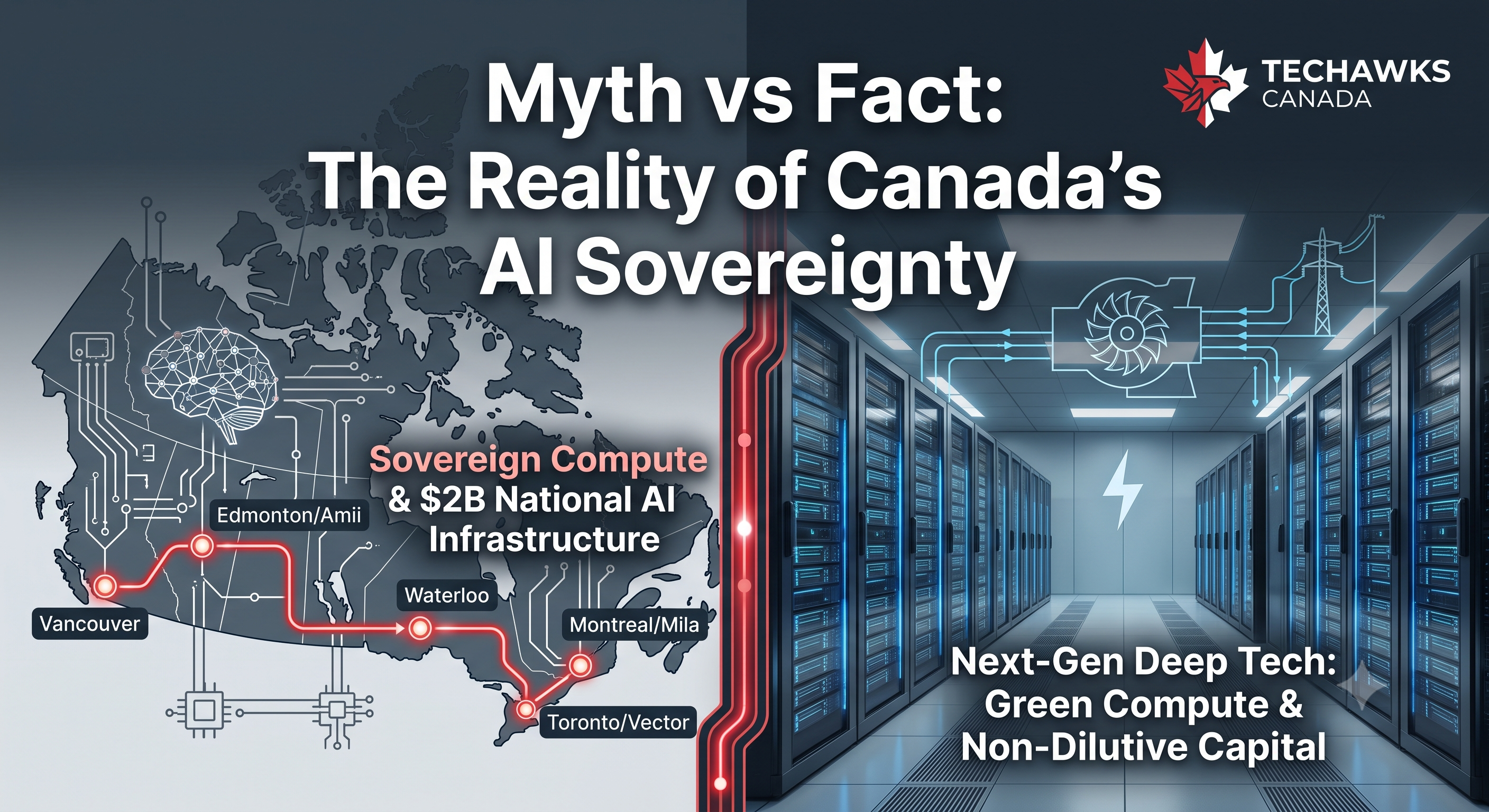
The Reality: The historical gap between world-class Canadian algorithm research and domestic compute availability is closing. Under the federal $2 Billion Sovereign AI Compute Strategy, Canada launched the AI Sovereign Compute Infrastructure Program (AI SCIP) and the AI Compute Access Fund to build public, Canadian-operated AI supercomputing systems and commercial data center capacity. Combined with recent Responsible Data Centre Development Principles signed by major cloud and frontier AI players, Canada is actively deploying domestic compute powered by provincial green grids (hydroelectric in Quebec, clean firm power in Ontario) to host sovereign enterprise workloads locally.
❌ Myth 2: "SR&ED tax credits are only for academic research and low-margin software contracts."
The Reality: Recent legislative expansions transformed Canada's Scientific Research and Experimental Development (SR&ED) program for technical builders:
Capital Cost Reinstatement: Physical hardware, specialized prototyping rigs, and dedicated compute infrastructure are once again eligible for claims.
Doubled Expenditure Cap: Canadian-Controlled Private Corporations (CCPCs) saw the enhanced refundable limit double from $3M to $6M—unlocking up to $2.1M in direct, non-dilutive cash refunds.
Engineering Uncertainty vs. CRUD: Calling third-party APIs doesn't qualify, but designing novel distributed architectures, overcoming latency in multi-agent routing, or custom model quantization under resource constraints directly meets the CRA’s "technological uncertainty" test.
❌ Myth 3: "Canadian tech can't compete with US hyperscalers on foundation models."
The Reality: Trying to outspend Silicon Valley on brute-force, trillion-parameter commodity LLMs was never a viable playbook. The Canadian advantage is in high-leverage vertical AI and quantum-adjacent systems:
Enterprise NLP & Agentic Workflows: Champions like Cohere and local enterprise builders focus on retrieval-augmented generation (RAG), embeddings, and data-private on-prem deployments.
Photonic Quantum & Deep Physics: From Xanadu’s public TSX/Nasdaq milestones to clean-energy materials design, Canadian teams build at the intersection of algorithmic theory and physical hardware.
Why It Matters for Canadian Builders
Building tech in Canada no longer means accepting a discount valuation or an inevitable talent drain. The teams capturing outsized returns in 2026 are those taking advantage of domestic compute allocations, tapping non-dilutive capital (SR&ED / IRAP) to offset infrastructure costs, and deploying enterprise solutions where strict PIPEDA and data sovereignty compliance are mandatory.
Discussion Question
For Canadian developers and engineering leads: Are you structuring your R&D to claim domestic compute and SR&ED capital allowances, or is the pull toward US hyperscale tooling still unavoidable for your architecture? Let’s debate in the comments! 👇
CTA
Join Techawks Canada — The premier network uniting Canadian developers, AI researchers, and technical founders scaling defensible systems across the Great White North. 🦅🇨🇦
❌ Myth 1: "Canada has no sovereign compute; every Canadian AI startup is trapped on US cloud infrastructure."
The Reality: The historical gap between world-class Canadian algorithm research and domestic compute availability is closing. Under the federal $2 Billion Sovereign AI Compute Strategy, Canada launched the AI Sovereign Compute Infrastructure Program (AI SCIP) and the AI Compute Access Fund to build public, Canadian-operated AI supercomputing systems and commercial data center capacity. Combined with recent Responsible Data Centre Development Principles signed by major cloud and frontier AI players, Canada is actively deploying domestic compute powered by provincial green grids (hydroelectric in Quebec, clean firm power in Ontario) to host sovereign enterprise workloads locally.
❌ Myth 2: "SR&ED tax credits are only for academic research and low-margin software contracts."
The Reality: Recent legislative expansions transformed Canada's Scientific Research and Experimental Development (SR&ED) program for technical builders:
Capital Cost Reinstatement: Physical hardware, specialized prototyping rigs, and dedicated compute infrastructure are once again eligible for claims.
Doubled Expenditure Cap: Canadian-Controlled Private Corporations (CCPCs) saw the enhanced refundable limit double from $3M to $6M—unlocking up to $2.1M in direct, non-dilutive cash refunds.
Engineering Uncertainty vs. CRUD: Calling third-party APIs doesn't qualify, but designing novel distributed architectures, overcoming latency in multi-agent routing, or custom model quantization under resource constraints directly meets the CRA’s "technological uncertainty" test.
❌ Myth 3: "Canadian tech can't compete with US hyperscalers on foundation models."
The Reality: Trying to outspend Silicon Valley on brute-force, trillion-parameter commodity LLMs was never a viable playbook. The Canadian advantage is in high-leverage vertical AI and quantum-adjacent systems:
Enterprise NLP & Agentic Workflows: Champions like Cohere and local enterprise builders focus on retrieval-augmented generation (RAG), embeddings, and data-private on-prem deployments.
Photonic Quantum & Deep Physics: From Xanadu’s public TSX/Nasdaq milestones to clean-energy materials design, Canadian teams build at the intersection of algorithmic theory and physical hardware.
Why It Matters for Canadian Builders
Building tech in Canada no longer means accepting a discount valuation or an inevitable talent drain. The teams capturing outsized returns in 2026 are those taking advantage of domestic compute allocations, tapping non-dilutive capital (SR&ED / IRAP) to offset infrastructure costs, and deploying enterprise solutions where strict PIPEDA and data sovereignty compliance are mandatory.
Discussion Question
For Canadian developers and engineering leads: Are you structuring your R&D to claim domestic compute and SR&ED capital allowances, or is the pull toward US hyperscale tooling still unavoidable for your architecture? Let’s debate in the comments! 👇
CTA
Join Techawks Canada — The premier network uniting Canadian developers, AI researchers, and technical founders scaling defensible systems across the Great White North. 🦅🇨🇦
Myth vs Fact: Is Canada Losing Its AI Lead to the US, or Reinventing the Deep-Tech Stack?
❌ Myth 1: "Canada has no sovereign compute; every Canadian AI startup is trapped on US cloud infrastructure."
The Reality: The historical gap between world-class Canadian algorithm research and domestic compute availability is closing. Under the federal $2 Billion Sovereign AI Compute Strategy, Canada launched the AI Sovereign Compute Infrastructure Program (AI SCIP) and the AI Compute Access Fund to build public, Canadian-operated AI supercomputing systems and commercial data center capacity. Combined with recent Responsible Data Centre Development Principles signed by major cloud and frontier AI players, Canada is actively deploying domestic compute powered by provincial green grids (hydroelectric in Quebec, clean firm power in Ontario) to host sovereign enterprise workloads locally.
❌ Myth 2: "SR&ED tax credits are only for academic research and low-margin software contracts."
The Reality: Recent legislative expansions transformed Canada's Scientific Research and Experimental Development (SR&ED) program for technical builders:
Capital Cost Reinstatement: Physical hardware, specialized prototyping rigs, and dedicated compute infrastructure are once again eligible for claims.
Doubled Expenditure Cap: Canadian-Controlled Private Corporations (CCPCs) saw the enhanced refundable limit double from $3M to $6M—unlocking up to $2.1M in direct, non-dilutive cash refunds.
Engineering Uncertainty vs. CRUD: Calling third-party APIs doesn't qualify, but designing novel distributed architectures, overcoming latency in multi-agent routing, or custom model quantization under resource constraints directly meets the CRA’s "technological uncertainty" test.
❌ Myth 3: "Canadian tech can't compete with US hyperscalers on foundation models."
The Reality: Trying to outspend Silicon Valley on brute-force, trillion-parameter commodity LLMs was never a viable playbook. The Canadian advantage is in high-leverage vertical AI and quantum-adjacent systems:
Enterprise NLP & Agentic Workflows: Champions like Cohere and local enterprise builders focus on retrieval-augmented generation (RAG), embeddings, and data-private on-prem deployments.
Photonic Quantum & Deep Physics: From Xanadu’s public TSX/Nasdaq milestones to clean-energy materials design, Canadian teams build at the intersection of algorithmic theory and physical hardware.
Why It Matters for Canadian Builders
Building tech in Canada no longer means accepting a discount valuation or an inevitable talent drain. The teams capturing outsized returns in 2026 are those taking advantage of domestic compute allocations, tapping non-dilutive capital (SR&ED / IRAP) to offset infrastructure costs, and deploying enterprise solutions where strict PIPEDA and data sovereignty compliance are mandatory.
Discussion Question
For Canadian developers and engineering leads: Are you structuring your R&D to claim domestic compute and SR&ED capital allowances, or is the pull toward US hyperscale tooling still unavoidable for your architecture? Let’s debate in the comments! 👇
CTA
Join Techawks Canada — The premier network uniting Canadian developers, AI researchers, and technical founders scaling defensible systems across the Great White North. 🦅🇨🇦

 English
 Arabic
 French
 Spanish
 Portuguese
 Deutsch
 Turkish
 Dutch
Dutch
 Italiano
 Russian
 Portuguese (Brazil)
 Greek
Greek